QUESTION IMAGE
Question
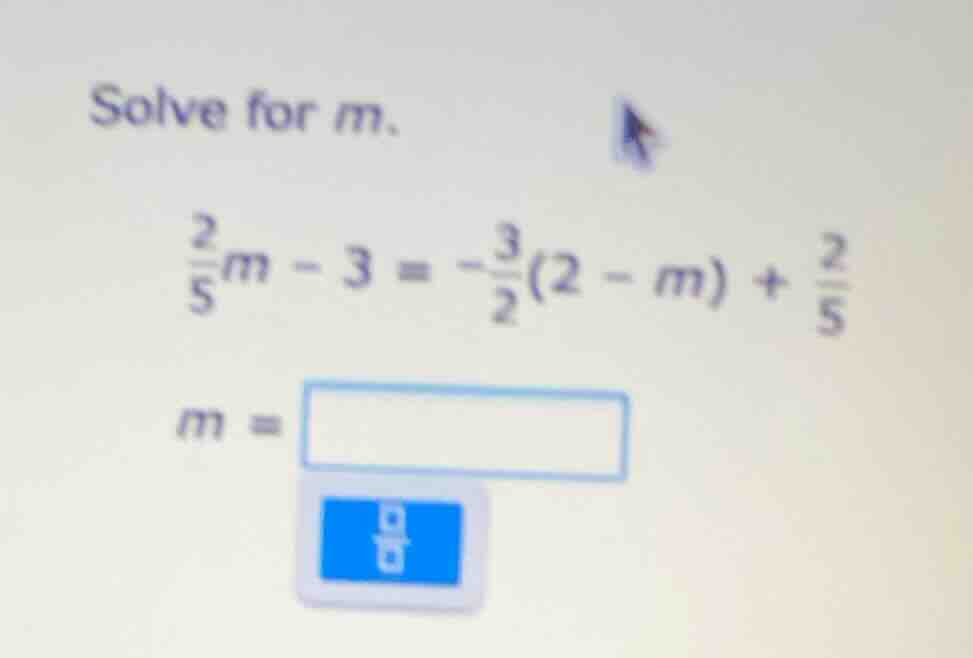
solve for m.
\\(\frac{2}{5}m - 3 = -\frac{3}{2}(2 - m) + \frac{2}{5}\\)
\\(m = \\)
Step1: Expand the right side
First, we expand \(-\frac{3}{2}(2 - m)\) using the distributive property \(a(b - c)=ab - ac\). So we get \(-\frac{3}{2}\times2+\frac{3}{2}m=-3+\frac{3}{2}m\). Then the equation becomes \(\frac{2}{5}m - 3=-3+\frac{3}{2}m+\frac{2}{5}\).
Step2: Simplify the right side
Combine the constant terms on the right side: \(-3+\frac{2}{5}=-\frac{15}{5}+\frac{2}{5}=-\frac{13}{5}\). So the equation is now \(\frac{2}{5}m - 3=\frac{3}{2}m-\frac{13}{5}\).
Step3: Eliminate fractions by multiplying through by the least common multiple (LCM) of 5 and 2, which is 10
Multiply each term by 10: \(10\times\frac{2}{5}m-10\times3 = 10\times\frac{3}{2}m-10\times\frac{13}{5}\). Simplifying each term: \(4m - 30 = 15m-26\).
Step4: Move all m terms to one side and constants to the other
Subtract \(4m\) from both sides: \(-30=11m - 26\). Then add 26 to both sides: \(-4 = 11m\). Wait, that seems wrong. Wait, let's redo step 3 and 4. Wait, in step 2, when we had \(\frac{2}{5}m - 3=\frac{3}{2}m-\frac{13}{5}\), let's add 3 to both sides: \(\frac{2}{5}m=\frac{3}{2}m-\frac{13}{5}+3\). \(3=\frac{15}{5}\), so \(-\frac{13}{5}+\frac{15}{5}=\frac{2}{5}\). So \(\frac{2}{5}m=\frac{3}{2}m+\frac{2}{5}\). Now subtract \(\frac{3}{2}m\) from both sides: \(\frac{2}{5}m-\frac{3}{2}m=\frac{2}{5}\). Find a common denominator for the left side, which is 10: \(\frac{4}{10}m-\frac{15}{10}m=\frac{2}{5}\). So \(-\frac{11}{10}m=\frac{2}{5}\). Then multiply both sides by \(-\frac{10}{11}\): \(m=\frac{2}{5}\times(-\frac{10}{11})=-\frac{4}{11}\)? Wait, no, that's not right. Wait, let's start over.
Original equation: \(\frac{2}{5}m - 3=-\frac{3}{2}(2 - m)+\frac{2}{5}\)
Expand right side: \(-\frac{3}{2}\times2+\frac{3}{2}m+\frac{2}{5}=-3+\frac{3}{2}m+\frac{2}{5}\)
Now, let's get rid of fractions. Multiply all terms by 10:
\(10\times\frac{2}{5}m-10\times3=10\times(-3)+10\times\frac{3}{2}m + 10\times\frac{2}{5}\)
Simplify each term:
\(4m-30=-30 + 15m+4\)
Simplify right side: \(-30 + 4=-26\), so \(4m-30=15m - 26\)
Now, subtract \(4m\) from both sides: \(-30 = 11m-26\)
Add 26 to both sides: \(-4=11m\)? Wait, that would mean \(m =-\frac{4}{11}\), but that seems incorrect. Wait, let's check the expansion again. The original right side is \(-\frac{3}{2}(2 - m)+\frac{2}{5}\). So \(-\frac{3}{2}\times2= - 3\), \(-\frac{3}{2}\times(-m)=\frac{3}{2}m\), so right side is \(-3+\frac{3}{2}m+\frac{2}{5}\). Then, when we add 3 to both sides: \(\frac{2}{5}m=\frac{3}{2}m+\frac{2}{5}\). Now, subtract \(\frac{3}{2}m\) from both sides: \(\frac{2}{5}m-\frac{3}{2}m=\frac{2}{5}\). Convert to tenths: \(\frac{4}{10}m-\frac{15}{10}m=\frac{2}{5}\), so \(-\frac{11}{10}m=\frac{2}{5}\). Multiply both sides by \(-\frac{10}{11}\): \(m=\frac{2}{5}\times(-\frac{10}{11})=-\frac{4}{11}\). Wait, but let's check by plugging back in.
Left side: \(\frac{2}{5}\times(-\frac{4}{11})-3=\frac{-8}{55}-3=\frac{-8 - 165}{55}=\frac{-173}{55}\)
Right side: \(-\frac{3}{2}(2-(-\frac{4}{11}))+\frac{2}{5}=-\frac{3}{2}(\frac{22 + 4}{11})+\frac{2}{5}=-\frac{3}{2}\times\frac{26}{11}+\frac{2}{5}=-\frac{39}{11}+\frac{2}{5}=\frac{-195 + 22}{55}=\frac{-173}{55}\). So it works. Wait, but earlier when I multiplied by 10, I think I made a mistake in the right side expansion. Wait, original equation after expanding right side: \(\frac{2}{5}m - 3=-3+\frac{3}{2}m+\frac{2}{5}\). Then, adding 3 to both sides: \(\frac{2}{5}m=\frac{3}{2}m+\frac{2}{5}\). Then, subtract \(\frac{3}{2}m\): \(\frac{2}{5}m-\frac{3}{2}m=\frac{2}{5}\). \(\frac{4m - 15m}{10}=\frac{2}{5}\), \(\frac{-11m}{10}=\frac{2}{5}\). Multiply both sides by…

Snap & solve any problem in the app
Get step-by-step solutions on Sovi AI
Photo-based solutions with guided steps
Explore more problems and detailed explanations
\(-\frac{4}{11}\)