QUESTION IMAGE
Question
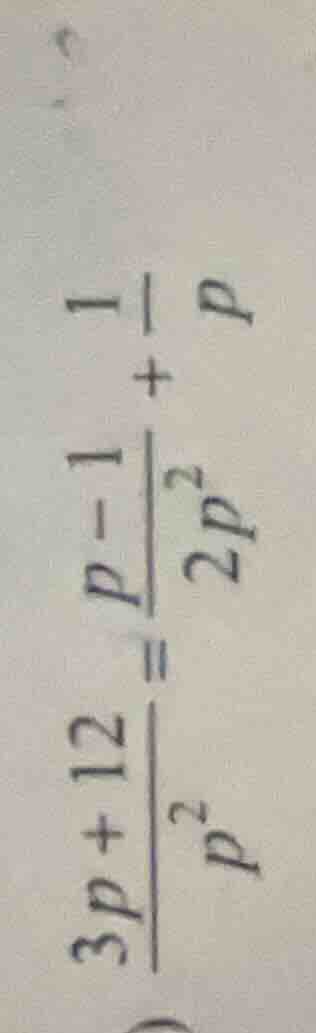
(\frac{3p + 12}{p^{2}}=\frac{p - 1}{2p^{2}}+\frac{1}{p})
Step1: Identify the common denominator
The denominators are \(p^2\), \(2p^2\), and \(p\). The least common denominator (LCD) is \(2p^2\).
Step2: Multiply each term by the LCD
Multiply each term in the equation \(\frac{3p + 12}{p^2}=\frac{p - 1}{2p^2}+\frac{1}{p}\) by \(2p^2\) to eliminate the denominators:
Step3: Simplify each term
Simplify each term:
- For the first term: \(2p^2\times\frac{3p + 12}{p^2}=2(3p + 12)=6p + 24\)
- For the second term: \(2p^2\times\frac{p - 1}{2p^2}=p - 1\)
- For the third term: \(2p^2\times\frac{1}{p}=2p\)
So the equation becomes:
Step4: Combine like terms on the right side
Combine the \(p\) terms on the right side: \(p + 2p = 3p\), so the equation is:
Step5: Subtract \(3p\) from both sides
Subtract \(3p\) from both sides:
Step6: Subtract 24 from both sides
Subtract 24 from both sides:
Step7: Divide by 3
Divide both sides by 3:
Step8: Check for extraneous solutions
We need to check if \(p = \frac{-25}{3}\) makes any original denominator zero. The denominators are \(p^2\), \(2p^2\), and \(p\). Since \(p=\frac{-25}{3}
eq0\), it is a valid solution.

Snap & solve any problem in the app
Get step-by-step solutions on Sovi AI
Photo-based solutions with guided steps
Explore more problems and detailed explanations
\(p = -\frac{25}{3}\)