QUESTION IMAGE
Question
\arctan(x + t)e^{-\frac{1}{2}t}
t = 2
🆕 New Concept Discovered: Function Transformations
How parameters shift and scale a parent graph.
Step 1: Identify the parent function and parameters
The given function is:
We are given a specific value for the parameter \( t \):
Substituting \( t = 2 \) into the function gives:
Step 2: Analyze the horizontal shift
The parent function is \( y = \arctan(x) \).
Replacing \( x \) with \( x + 2 \) shifts the entire graph horizontally.
- Adding a positive constant inside the function argument, \( (x + d) \), shifts the graph to the left by \( d \) units.
- Therefore, \( \arctan(x + 2) \) shifts the standard arctangent graph to the left by \( 2 \) units.
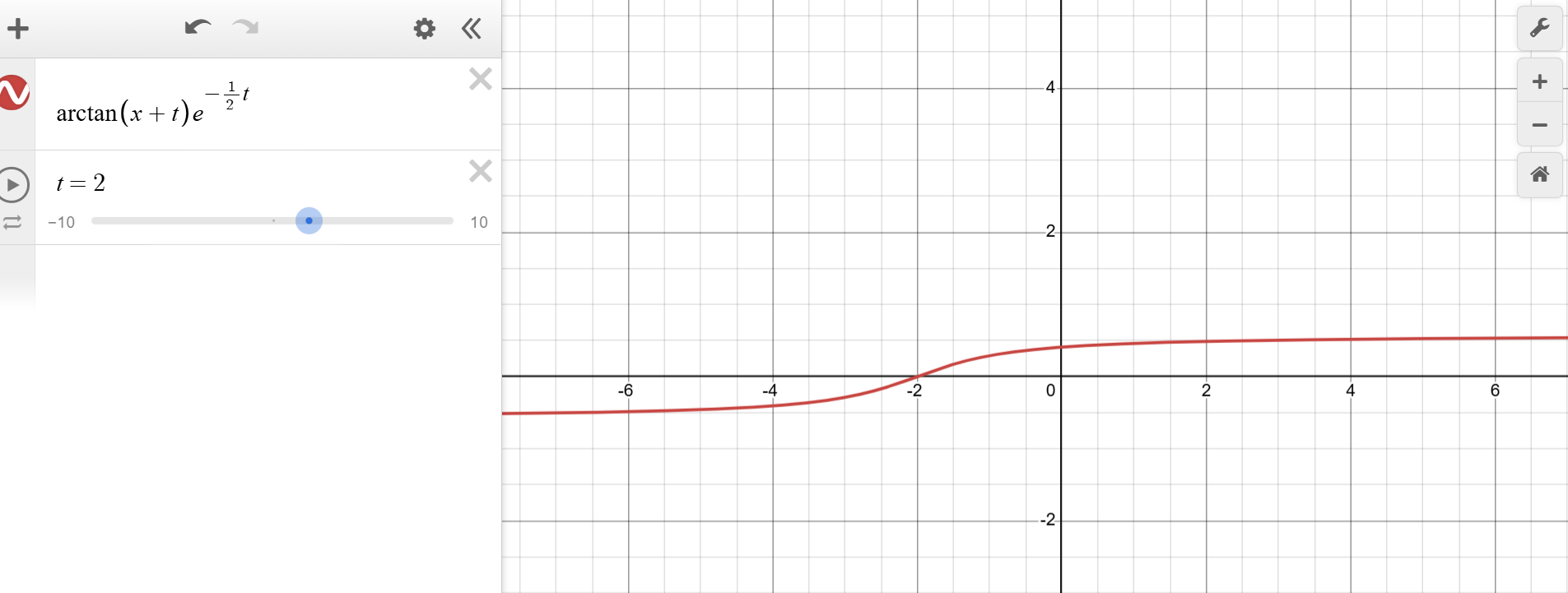
- The inflection point (center) of the standard arctangent graph is at \( (0,0) \). Shifting it left by \( 2 \) units moves this center point to \( (-2, 0) \). This matches the x-intercept shown on the graph.
Step 3: Analyze the vertical scaling
The factor \( e^{-1} = \frac{1}{e} \approx 0.368 \) acts as a vertical compression factor.
- The horizontal asymptotes of the standard \( \arctan(x) \) function are \( y = \frac{\pi}{2} \approx 1.57 \) and \( y = -\frac{\pi}{2} \approx -1.57 \).
- Multiplying by \( e^{-1} \) scales these asymptotes vertically.
- The new horizontal asymptotes are:
This matches the graph, where the curve flattens out vertically well below \( y = 1 \) and above \( y = -1 \).

Snap & solve any problem in the app
Get step-by-step solutions on Sovi AI
Photo-based solutions with guided steps
Explore more problems and detailed explanations
The graph represents the function \( f(x) = \arctan(x + t)e^{-\frac{1}{2}t} \) evaluated at \( t = 2 \), which simplifies to:
This is a standard arctangent curve that has been:
- Shifted left by 2 units (moving the center inflection point to \( (-2, 0) \)).
- Vertically compressed by a factor of \( \frac{1}{e} \approx 0.368 \) (making the horizontal asymptotes \( y \approx \pm 0.58 \)).