QUESTION IMAGE
Question
match each table with its equation.
$y = x^3$
$y = x$
$y = \frac{1}{x}$
$y = |x|$
$y = \sqrt{x}$
$y = x^2$
a. \
b. \
c. \
d. \
e. \
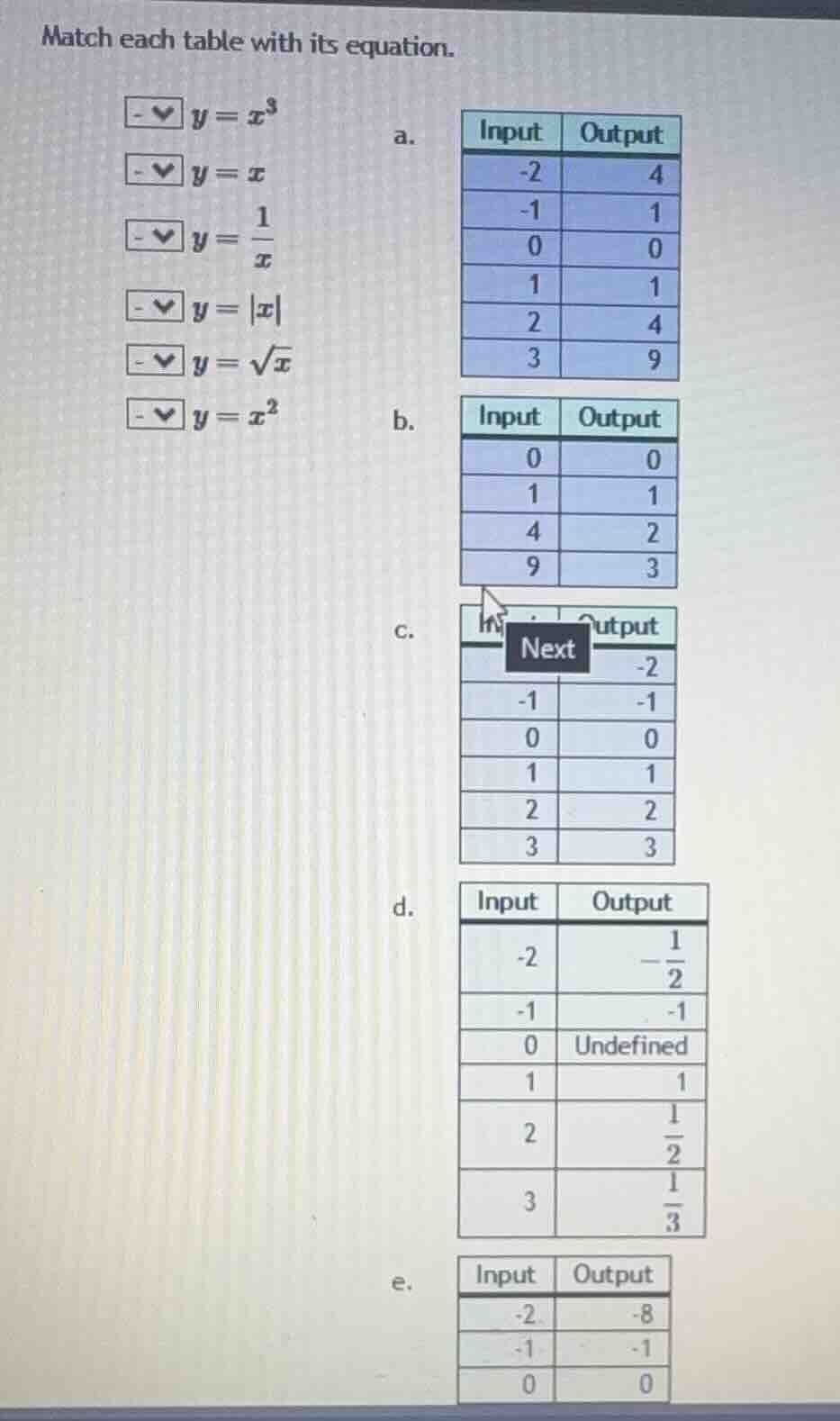
for Table a:
Step1: Analyze the output for each input
For input \( x = -2 \), output is \( 4 \); \( x = -1 \), output \( 1 \); \( x = 0 \), output \( 0 \); \( x = 1 \), output \( 1 \); \( x = 2 \), output \( 4 \); \( x = 3 \), output \( 9 \). Notice that \( (-2)^2 = 4 \), \( (-1)^2 = 1 \), \( 0^2 = 0 \), \( 1^2 = 1 \), \( 2^2 = 4 \), \( 3^2 = 9 \). So the equation is \( y = x^2 \).
for Table b:
Step1: Analyze the output for each input
For input \( x = 0 \), output \( 0 \); \( x = 1 \), output \( 1 \); \( x = 4 \), output \( 2 \); \( x = 9 \), output \( 3 \). Notice that \( \sqrt{0} = 0 \), \( \sqrt{1} = 1 \), \( \sqrt{4} = 2 \), \( \sqrt{9} = 3 \). So the equation is \( y=\sqrt{x} \).
for Table c:
Step1: Analyze the output for each input
For input \( x = -1 \), output \( -1 \); \( x = 0 \), output \( 0 \); \( x = 1 \), output \( 1 \); \( x = 2 \), output \( 2 \); \( x = 3 \), output \( 3 \). Notice that \( y = x \) (since output equals input). So the equation is \( y = x \).
for Table d:
Step1: Analyze the output for each input
For input \( x = -2 \), output \( -\frac{1}{2} \); \( x = -1 \), output \( -1 \); \( x = 0 \), undefined; \( x = 1 \), output \( 1 \); \( x = 2 \), output \( \frac{1}{2} \); \( x = 3 \), output \( \frac{1}{3} \). Notice that \( y=\frac{1}{x} \) (since \( \frac{1}{-2}=-\frac{1}{2} \), \( \frac{1}{-1}=-1 \), \( \frac{1}{1}=1 \), \( \frac{1}{2}=\frac{1}{2} \), \( \frac{1}{3}=\frac{1}{3} \)).

Snap & solve any problem in the app
Get step-by-step solutions on Sovi AI
Photo-based solutions with guided steps
Explore more problems and detailed explanations
- Table a: \( y = x^2 \)
- Table b: \( y=\sqrt{x} \)
- Table c: \( y = x \)
- Table d: \( y=\frac{1}{x} \)
- Table e: \( y = x^3 \) (assuming the remaining inputs follow \( y = x^3 \), e.g., if \( x = 1 \), \( y = 1^3 = 1 \); \( x = 2 \), \( y = 2^3 = 8 \) etc.) Also, for the absolute value function \( y = |x| \), we can check if there's a table left, but from the given tables, the above matches.