QUESTION IMAGE
Question
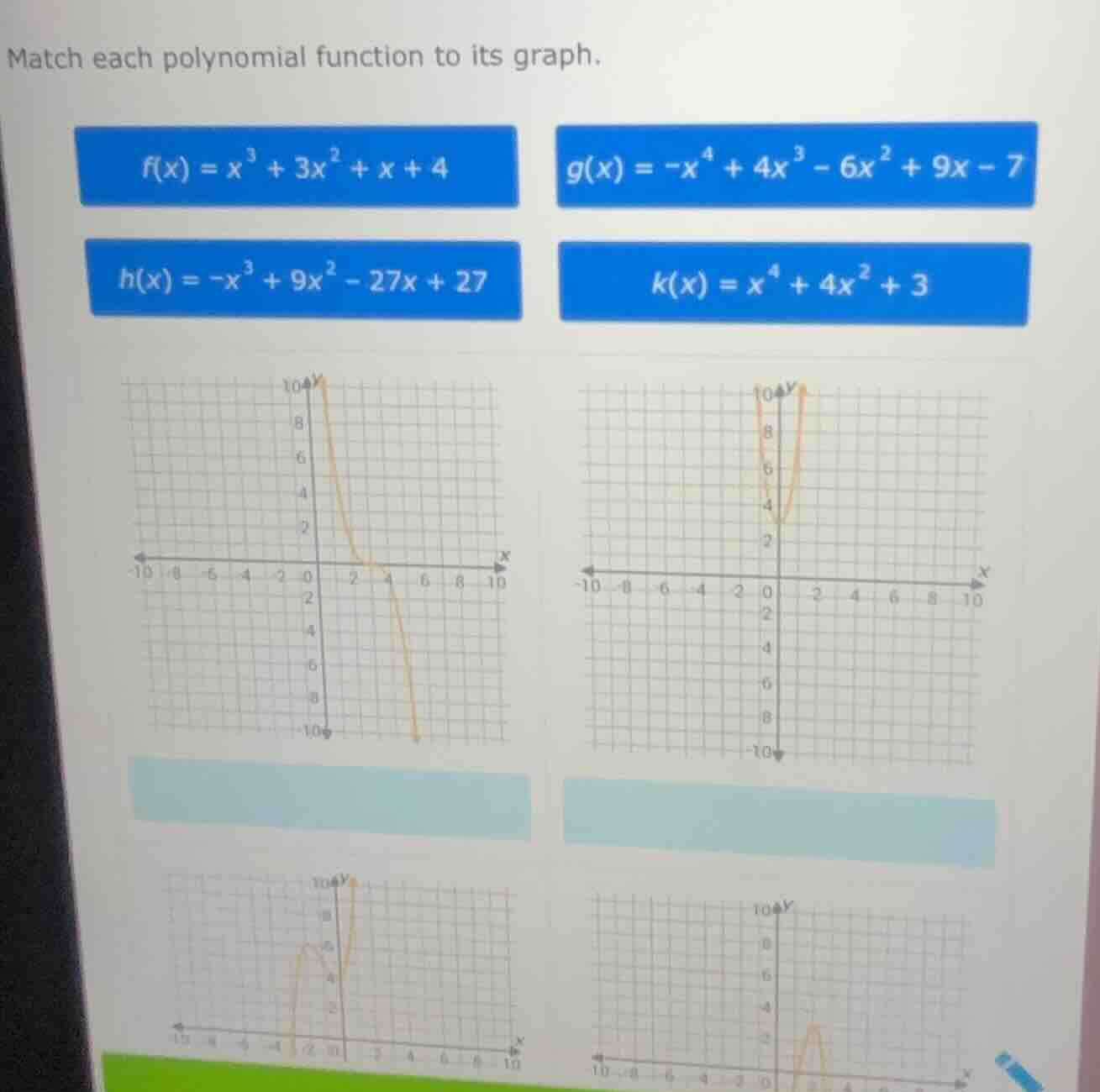
match each polynomial function to its graph.
$f(x) = x^3 + 3x^2 + x + 4$
$g(x) = -x^4 + 4x^3 - 6x^2 + 9x - 7$
$h(x) = -x^3 + 9x^2 - 27x + 27$
$k(x) = x^4 + 4x^2 + 3$
Step1: Analyze \( f(x) = x^3 + 3x^2 + x + 4 \)
- Degree: 3 (odd), leading coefficient: \( 1>0 \). So as \( x\to+\infty \), \( f(x)\to+\infty \); as \( x\to-\infty \), \( f(x)\to-\infty \).
- Let's check \( f(0)=4 \). The graph with a cubic curve starting from bottom left, going up, and having \( y \)-intercept 4.
Step2: Analyze \( g(x) = -x^4 + 4x^3 - 6x^2 + 9x - 7 \)
- Degree: 4 (even), leading coefficient: \( -1<0 \). So as \( x\to\pm\infty \), \( g(x)\to-\infty \).
- Let's check \( g(0)= -7 \). The graph with a quartic curve opening down, \( y \)-intercept -7.
Step3: Analyze \( h(x) = -x^3 + 9x^2 - 27x + 27 \)
- Degree: 3 (odd), leading coefficient: \( -1<0 \). So as \( x\to+\infty \), \( h(x)\to-\infty \); as \( x\to-\infty \), \( h(x)\to+\infty \).
- Let's check \( h(3)= -27 + 81 - 81 + 27 = 0 \), so \( x = 3 \) is a root. The graph with a cubic curve starting from top left, going down, and passing through \( (3,0) \).
Step4: Analyze \( k(x) = x^4 + 4x^2 + 3 \)
- Degree: 4 (even), leading coefficient: \( 1>0 \). So as \( x\to\pm\infty \), \( k(x)\to+\infty \).
- Let's check \( k(0)=3 \). The graph with a quartic curve opening up, \( y \)-intercept 3.

Snap & solve any problem in the app
Get step-by-step solutions on Sovi AI
Photo-based solutions with guided steps
Explore more problems and detailed explanations
- \( f(x) = x^3 + 3x^2 + x + 4 \): The cubic graph with \( y \)-intercept 4, rising to the right and falling to the left.
- \( g(x) = -x^4 + 4x^3 - 6x^2 + 9x - 7 \): The quartic graph opening down, \( y \)-intercept -7.
- \( h(x) = -x^3 + 9x^2 - 27x + 27 \): The cubic graph with root at \( x = 3 \), falling to the right and rising to the left.
- \( k(x) = x^4 + 4x^2 + 3 \): The quartic graph opening up, \( y \)-intercept 3.
(Note: To match precisely, we can use the end - behavior and key points. For example, \( k(x) \) has no real roots (since \( x^4 + 4x^2 + 3=(x^2 + 1)(x^2+3)>0 \) for all real \( x \)), so it's the graph that never crosses the \( x \)-axis and opens up. \( f(x) \) has one real root (since it's a cubic with positive leading coefficient and \( f(0) = 4 \), \( f(-4)=-64 + 48-4 + 4=-16<0 \), so it crosses the \( x \)-axis once). \( h(x) \) can be factored as \( -(x - 3)^3 \), so it has a triple root at \( x = 3 \), so the graph touches the \( x \)-axis at \( x = 3 \) and has a cubic shape with negative leading coefficient. \( g(x) \) is a quartic with negative leading coefficient, and we can check its derivative \( g^\prime(x)=-4x^3 + 12x^2-12x + 9=-4x^3+12x^2 - 12x+9 \), and analyze its critical points, but the end - behavior and \( y \)-intercept are sufficient for matching.)