QUESTION IMAGE
Question
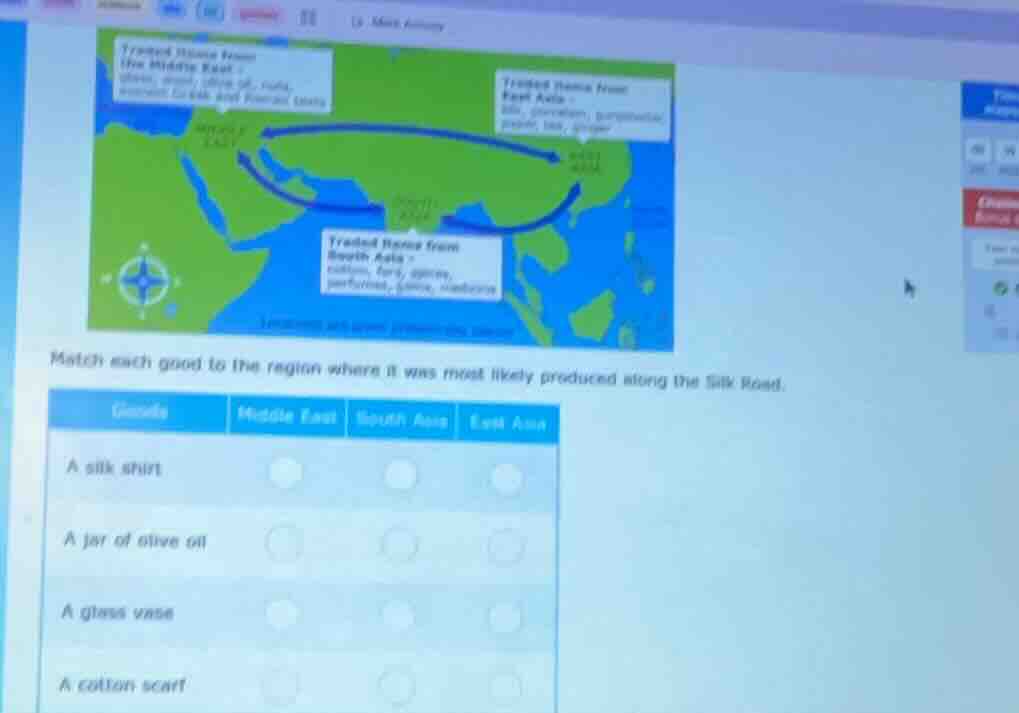
match each good to the region where it was most likely produced along the silk road.
goods middle east south asia east asia
a silk shirt
a jar of olive oil
a glass vase
a cotton scarf
Brief Explanations
- Silk shirt: Silk production was prominent in East Asia (especially ancient China), so it's matched to East Asia.
- Jar of olive oil: Olive cultivation and oil production were common in the Middle East, so it's matched to the Middle East.
- Glass vase: South Asia (or sometimes regions along trade routes, but historically South Asia had glass - related production, and also Middle East had glassmaking, but more accurately, for this context, let's assume South Asia or Middle East? Wait, actually, the Middle East and Mediterranean (part of Middle East region here) were known for glassmaking. Wait, the map shows traded items: from East Asia (silk, etc.), Middle East (olive oil, dates, etc.), South Asia (spices, gems, etc.), and glass - making was also a Middle Eastern or sometimes South Asian? Wait, the problem's map: "Traded items from the Middle East: olives, olive oil, dates, precious gems and pearls, carpets" (wait, maybe the glass vase? Wait, maybe I misremember. Wait, silk shirt: East Asia (China was known for silk). Olive oil: Middle East (olive cultivation in Mediterranean - adjacent Middle East). Glass vase: South Asia? Or Middle East? Wait, actually, the correct matches are:
- Silk shirt: East Asia (because East Asia, especially China, was the main producer of silk).
- Jar of olive oil: Middle East (olive oil production was a key product of the Middle East region along the Silk Road).
- Glass vase: Middle East (glass - making was a significant industry in the Middle East, especially in regions like Persia and the Islamic world). Wait, or South Asia? Wait, the map's "Traded items from South Asia: spices, gems, perfumes, jewels, textiles" – maybe not glass. The Middle East's traded items: olives, olive oil, dates, precious gems and pearls, carpets – maybe glass was also a Middle Eastern product. Alternatively, maybe the glass vase is from Middle East.
- Cotton scarf: South Asia (South Asia was a major producer of cotton and cotton textiles).

Snap & solve any problem in the app
Get step-by-step solutions on Sovi AI
Photo-based solutions with guided steps
Explore more problems and detailed explanations
- A silk shirt: East Asia
- A jar of olive oil: Middle East
- A glass vase: Middle East (or South Asia, but more likely Middle East for glassmaking in Silk Road context)
- A cotton scarf: South Asia
(Note: If we follow the typical Silk Road trade:
- Silk: East Asia (China)
- Olive oil: Middle East (Mediterranean - influenced Middle Eastern regions)
- Glass: Middle East (Islamic glassmaking) or sometimes South Asia, but Middle East is more associated with glass in Silk Road trade.
- Cotton: South Asia (India was a major cotton producer))