QUESTION IMAGE
Question
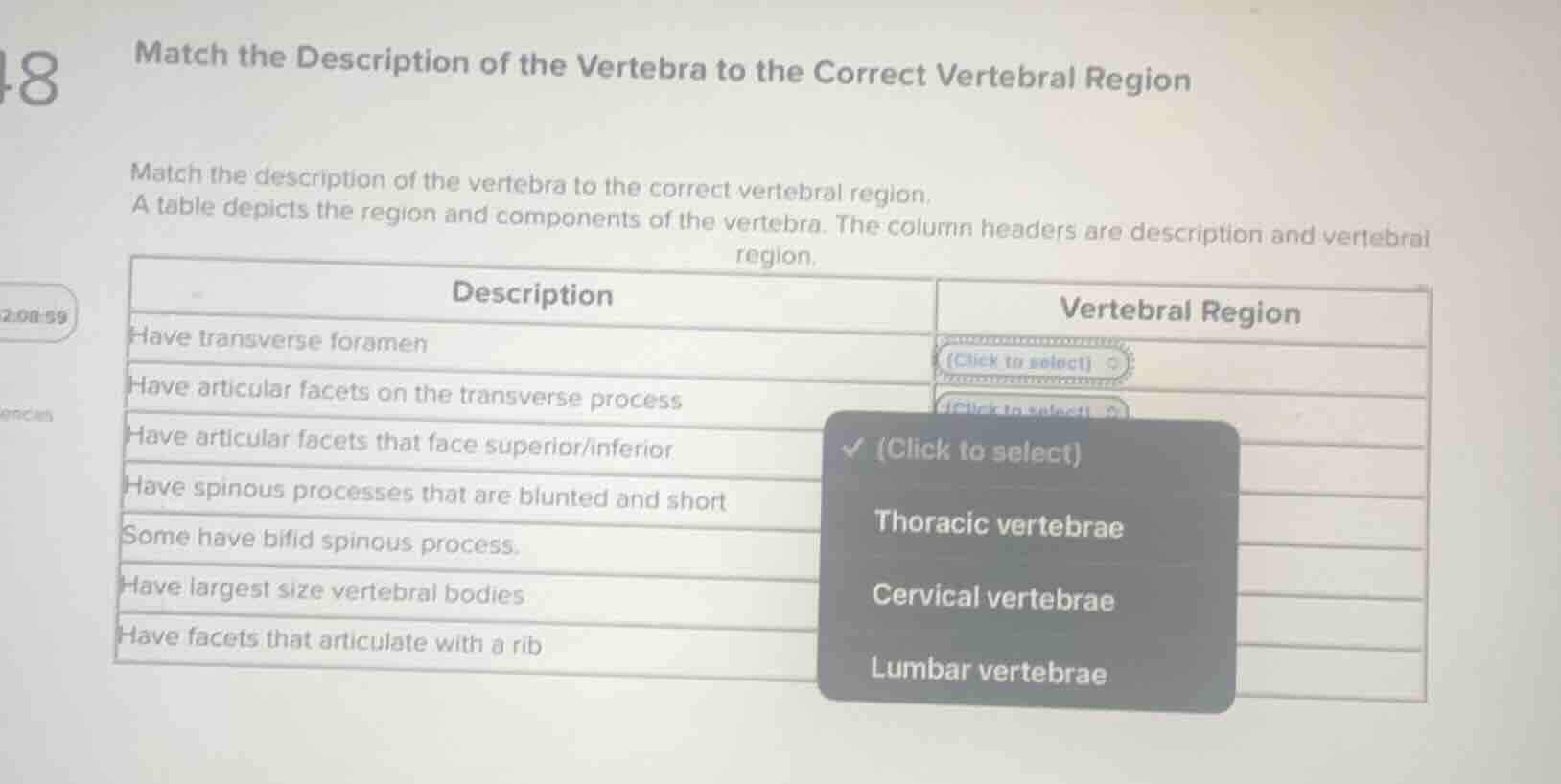
match the description of the vertebra to the correct vertebral region
match the description of the vertebra to the correct vertebral region.
a table depicts the region and components of the vertebra. the column headers are description and vertebral region.
\
options in dropdown:
- thoracic vertebrae
- cervical vertebrae
- lumbar vertebrae
Analyze cervical vertebrae features
Using the Axial Skeleton and Skeletal Terminology knowledge points, we identify features unique to the neck region.
- Transverse foramina are passages for vertebral arteries found exclusively in cervical vertebrae.
- Bifid spinous processes (forked tips) are characteristic of cervical vertebrae (specifically C2 through C6).
Analyze thoracic vertebrae features
Using the Skeletal System Organization and Skeletal Terminology knowledge points, we identify features associated with rib articulation.
- Articular facets on transverse processes (transverse costal facets) articulate with rib tubercles, unique to thoracic vertebrae.
- Facets that articulate with a rib (demifacets or costal facets on the body) are also unique to thoracic vertebrae.
Analyze lumbar vertebrae features
Using the Skeletal System Organization and Skeletal Terminology knowledge points, we identify features associated with weight-bearing.
- Largest size vertebral bodies are found in lumbar vertebrae to support the body's weight.
- Blunted and short spinous processes (hatchet-shaped) project directly posteriorly on lumbar vertebrae.
- Articular facets facing superior/inferior (medially/laterally oriented) lock the lumbar vertebrae together to limit rotation.
Match descriptions to regions
Using the Axial Skeleton knowledge point, we match each description to its correct vertebral region:
- Have transverse foramen: Cervical vertebrae
- Have articular facets on the transverse process: Thoracic vertebrae
- Have articular facets that face superior/inferior: Lumbar vertebrae
- Have spinous processes that are blunted and short: Lumbar vertebrae
- Some have bifid spinous process: Cervical vertebrae
- Have largest size vertebral bodies: Lumbar vertebrae
- Have facets that articulate with a rib: Thoracic vertebrae

Snap & solve any problem in the app
Get step-by-step solutions on Sovi AI
Photo-based solutions with guided steps
Explore more problems and detailed explanations
| Description | Vertebral Region |
|---|---|
| Have articular facets on the transverse process | Thoracic vertebrae |
| Have articular facets that face superior/inferior | Lumbar vertebrae |
| Have spinous processes that are blunted and short | Lumbar vertebrae |
| Some have bifid spinous process | Cervical vertebrae |
| Have largest size vertebral bodies | Lumbar vertebrae |
| Have facets that articulate with a rib | Thoracic vertebrae |