QUESTION IMAGE
Question
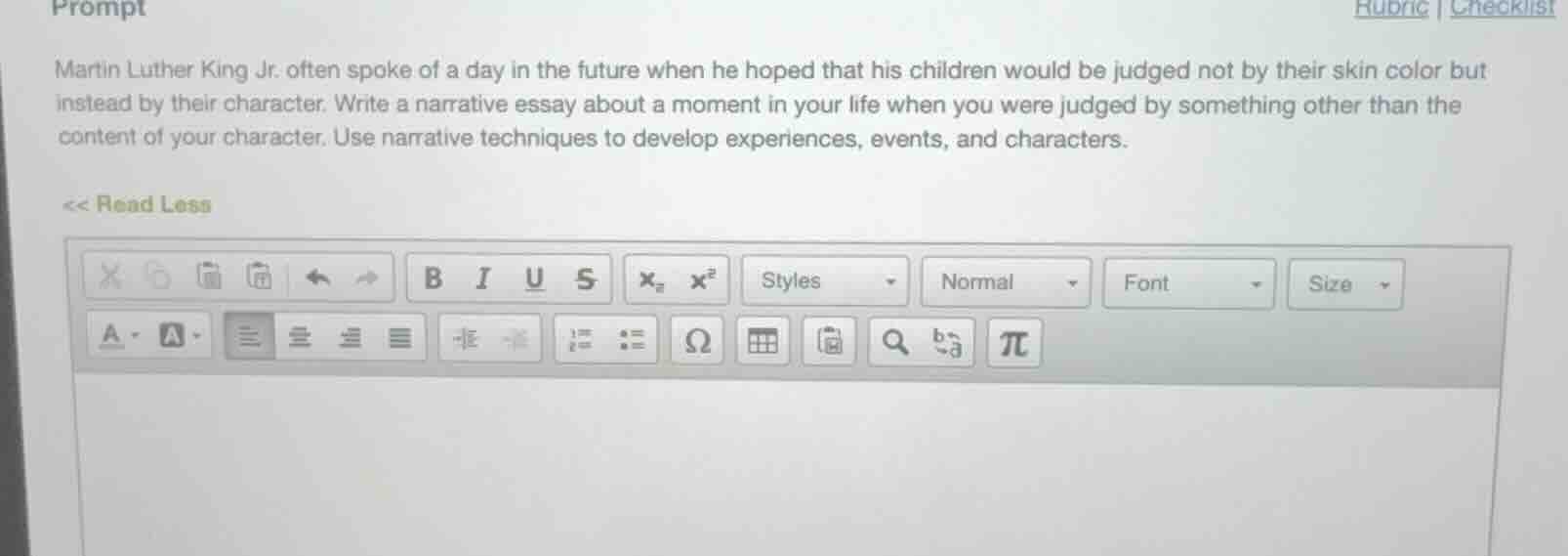
martin luther king jr. often spoke of a day in the future when he hoped that his children would be judged not by their skin color but instead by their character. write a narrative essay about a moment in your life when you were judged by something other than the content of your character. use narrative techniques to develop experiences, events, and characters.
Deconstruct the writing prompt
Using the Writing Prompt Analysis and Narrative Prompt Deconstruction knowledge points, we break down the prompt's core requirements:
- Topic: A personal moment when you were judged by something other than the content of your character.
- Format: Narrative essay (telling a story with a clear beginning, middle, and end).
- Goal: Use narrative techniques to develop experiences, events, and characters.
Outline key narrative elements
Using the Narrative Essay Elements knowledge point, we structure the story to ensure it contains:
- Exposition: Establish the setting, characters, and the initial situation.
- Rising Action: Introduce the conflict or the moment of judgment.
- Climax: The turning point where the judgment occurs and its immediate impact is felt.
- Falling Action: The immediate aftermath and how you reacted.
- Resolution: Reflection on what you learned about yourself and the content of your character.
Draft the narrative essay
We will write a cohesive, engaging personal narrative that directly addresses the prompt, focusing on sensory details, dialogue, and internal reflection.

Snap & solve any problem in the app
Get step-by-step solutions on Sovi AI
Photo-based solutions with guided steps
Explore more problems and detailed explanations
Here is a complete narrative essay written in response to the prompt:
***
Beyond the Cover
The scent of old paper and floor wax always felt like a sanctuary to me. On rainy Tuesday afternoons, the local public library was my second home, a quiet haven where I could lose myself in worlds far larger than my small suburban town. At fifteen, my uniform consisted of oversized vintage band t-shirts, worn-out combat boots, and a patch-covered backpack. To me, it was a creative expression of my love for music; to others, as I would soon learn, it was a visual shorthand for trouble.
I was standing in the history section, running my fingers along the spines of biographies, searching for a book on the Reconstruction era for a school project. A few feet away, an elderly woman was trying to reach a heavy reference volume on the top shelf. Seeing her struggle, I stepped forward, smiling warmly. "Would you like some help with that?" I asked, reaching up to gently slide the book from the shelf.
Instead of a thank you, she gasped and quickly pulled her purse closer to her chest, stepping back with a look of sheer alarm in her eyes. She stared at my chipped black nail polish and the skull patches on my backpack, her expression hardening into suspicion. "No, thank you," she said, her voice sharp and cold. "I can manage. Please step away."
Her words stung like an unexpected slap. In that brief, quiet interaction, I had been weighed, measured, and categorized as a threat based entirely on my outward appearance. The warmth in my chest evaporated, replaced by a heavy, hollow ache. I realized that she didn't see a helpful student; she saw a stereotype.
Instead of reacting with anger, which would only confirm her unfair assumptions, I took a deep breath, handed the book to a nearby librarian with a polite nod, and walked back to my study table. As I sat down, I realized that while I could not control how others chose to judge me by my cover, I had absolute control over the story I wrote inside. True character is not defined by the clothes we wear, but by how we choose to treat others—even when they fail to see who we truly are.