QUESTION IMAGE
Question
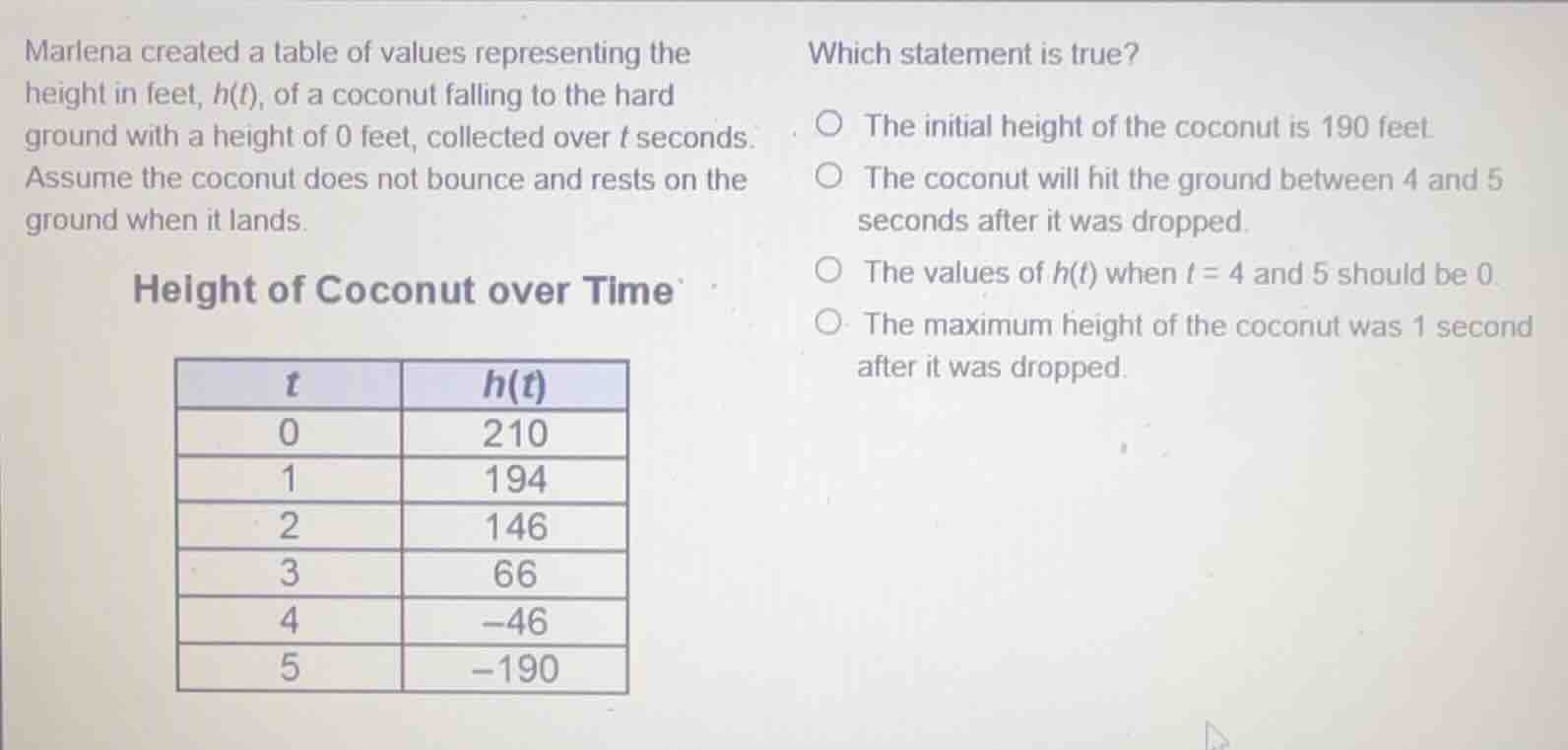
marlena created a table of values representing the height in feet, (h(t)), of a coconut falling to the hard ground with a height of 0 feet, collected over (t) seconds. assume the coconut does not bounce and rests on the ground when it lands.
height of coconut over time
\
which statement is true?
- the initial height of the coconut is 190 feet.
- the coconut will hit the ground between 4 and 5 seconds after it was dropped.
- the values of (h(t)) when (t = 4) and 5 should be 0.
- the maximum height of the coconut was 1 second after it was dropped.
Analyze the given table and context
We are given a table representing the height \(h(t)\) in feet of a falling coconut over time \(t\) in seconds.
The problem states that the ground is at a height of \(0\) feet, and the coconut does not bounce, meaning it rests on the ground once it lands. Thus, the height \(h(t)\) cannot realistically be negative; once it reaches \(0\), it remains at \(0\).
Let's look at the data points:
- At \(t = 0\), \(h(0) = 210\)
- At \(t = 1\), \(h(1) = 194\)
- At \(t = 2\), \(h(2) = 146\)
- At \(t = 3\), \(h(3) = 66\)
- At \(t = 4\), \(h(4) = -46\)
- At \(t = 5\), \(h(5) = -190\)
Evaluate Option 1
- Statement: "The initial height of the coconut is 190 feet."
- Analysis: The initial height corresponds to the height at time \(t = 0\). From the table, \(h(0) = 210\) feet. Therefore, this statement is false.
Evaluate Option 2
- Statement: "The coconut will hit the ground between 4 and 5 seconds after it was dropped."
- Analysis: The coconut hits the ground when its height \(h(t) = 0\). Looking at the table:
- At \(t = 3\), \(h(3) = 66\) feet (above the ground).
- At \(t = 4\), the mathematical model gives \(h(4) = -46\) feet.
Since the height changes from positive (\(66\)) to negative (\(-46\)) between \(t = 3\) and \(t = 4\), the height must cross \(0\) during this interval. Thus, the coconut hits the ground between \(3\) and \(4\) seconds, not between \(4\) and \(5\) seconds. Therefore, this statement is false.
Evaluate Option 3
- Statement: "The values of \(h(t)\) when \(t = 4\) and \(5\) should be 0."
- Analysis: Since the problem states that the coconut "does not bounce and rests on the ground when it lands," its physical height cannot be negative. Once it hits the ground (which happens between \(t = 3\) and \(t = 4\)), it stays on the ground at a height of \(0\) feet. Therefore, for any time \(t\) after it lands, the real-world height \(h(t)\) must be \(0\). Thus, the values at \(t = 4\) and \(t = 5\) should be \(0\) instead of the negative values predicted by the theoretical model. This statement is true.
Evaluate Option 4
- Statement: "The maximum height of the coconut was 1 second after it was dropped."
- Analysis: The coconut is falling, so its height decreases over time. The maximum height is at the start, \(t = 0\), where \(h(0) = 210\) feet. At \(t = 1\), the height is \(194\) feet, which is less than \(210\) feet. Therefore, this statement is false.

Snap & solve any problem in the app
Get step-by-step solutions on Sovi AI
Photo-based solutions with guided steps
Explore more problems and detailed explanations
- The initial height of the coconut is 190 feet.
- The coconut will hit the ground between 4 and 5 seconds after it was dropped.
- The values of h(t) when t = 4 and 5 should be 0. (Correct answer)
- The maximum height of the coconut was 1 second after it was dropped.