QUESTION IMAGE
Question
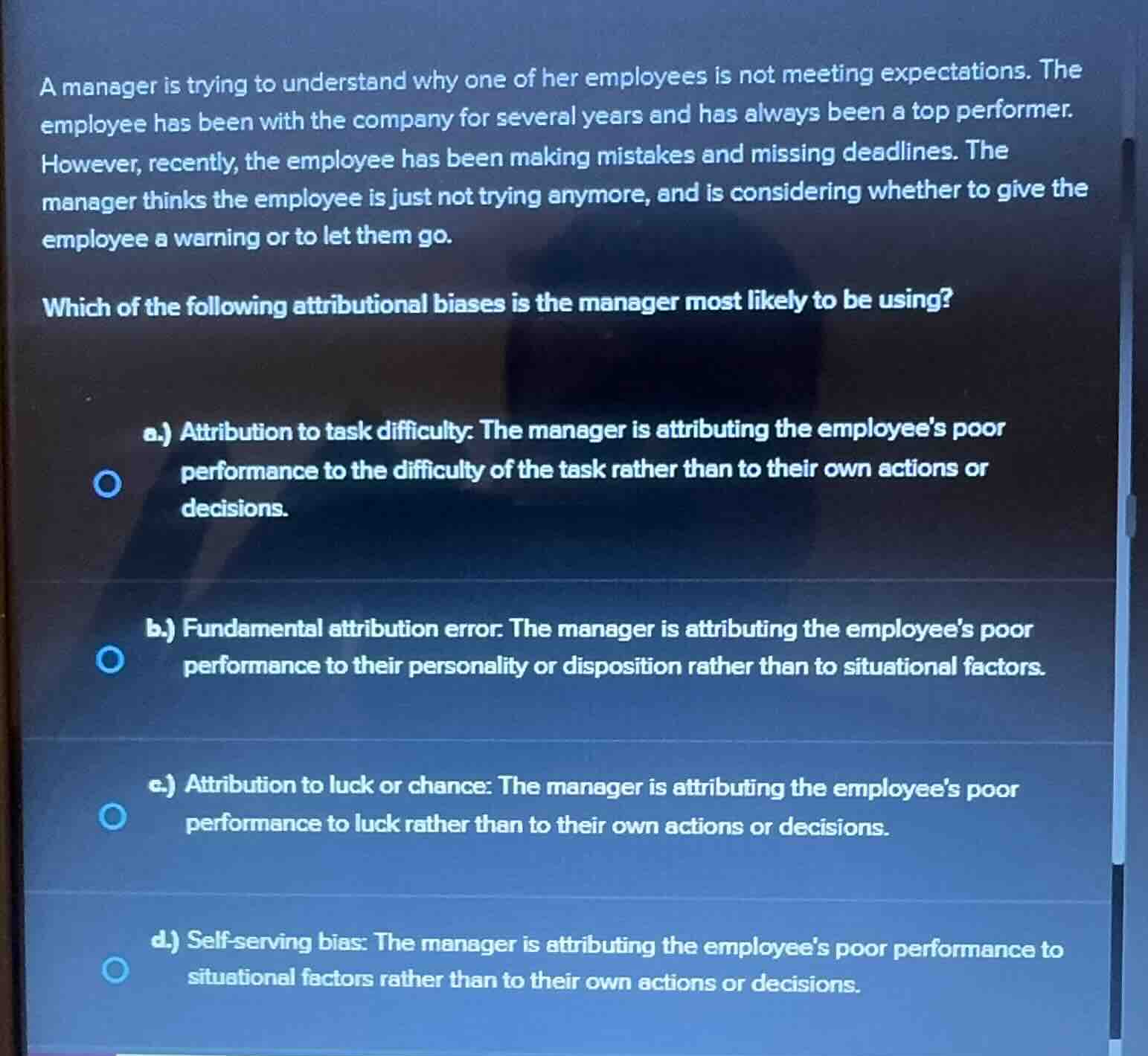
a manager is trying to understand why one of her employees is not meeting expectations. the employee has been with the company for several years and has always been a top performer. however, recently, the employee has been making mistakes and missing deadlines. the manager thinks the employee is just not trying anymore, and is considering whether to give the employee a warning or to let them go.
which of the following attributional biases is the manager most likely to be using?
a.) attribution to task difficulty: the manager is attributing the employees poor performance to the difficulty of the task rather than to their own actions or decisions.
b.) fundamental attribution error: the manager is attributing the employees poor performance to their personality or disposition rather than to situational factors.
c.) attribution to luck or chance: the manager is attributing the employees poor performance to luck rather than to their own actions or decisions.
d.) self-serving bias: the manager is attributing the employees poor performance to situational factors rather than to their own actions or decisions.
Analyze the manager's behavior
Using the Perceptual Influences and Social Perception Barriers knowledge points
The manager observes that a historically top-performing employee is suddenly making mistakes and missing deadlines. Instead of considering external or situational factors (such as personal issues, burnout, or changes in workload), the manager immediately assumes the employee is "just not trying anymore" (an internal, dispositional cause).
Identify the attributional bias
The tendency to underestimate external, situational influences and overestimate internal, personal factors when evaluating someone else's behavior is known as the Fundamental Attribution Error.
- Option (a) is incorrect because the manager is not blaming task difficulty.
- Option (b) correctly describes the fundamental attribution error, where the manager attributes poor performance to internal disposition (lack of effort) rather than situational factors.
- Option (c) is incorrect because the manager is not attributing the performance to luck.
- Option (d) is incorrect because self-serving bias is the tendency to attribute one's own successes to internal factors and failures to external factors.

Snap & solve any problem in the app
Get step-by-step solutions on Sovi AI
Photo-based solutions with guided steps
Explore more problems and detailed explanations
- a.) Attribution to task difficulty: The manager is attributing the employee's poor performance to the difficulty of the task rather than to their own actions or decisions.
- b.) Fundamental attribution error: The manager is attributing the employee's poor performance to their personality or disposition rather than to situational factors. (Correct answer)
- c.) Attribution to luck or chance: The manager is attributing the employee's poor performance to luck rather than to their own actions or decisions.
- d.) Self-serving bias: The manager is attributing the employee's poor performance to situational factors rather than to their own actions or decisions.