QUESTION IMAGE
Question
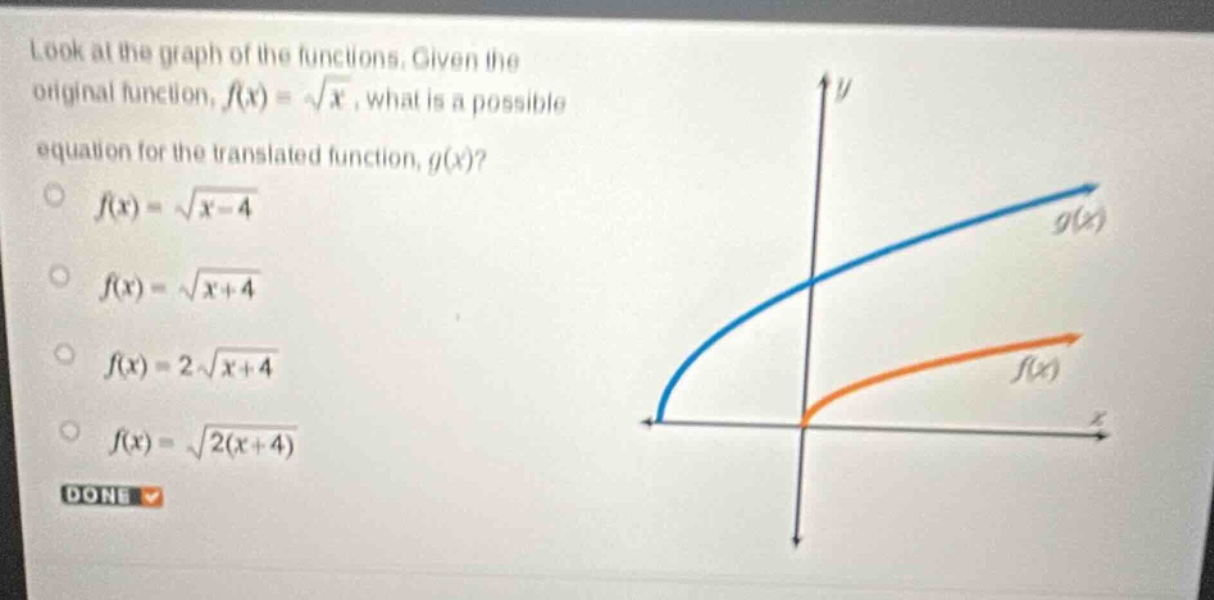
look at the graph of the functions. given the original function, (f(x) = sqrt{x}), what is a possible equation for the translated function, (g(x))?
- (f(x) = sqrt{x-4})
- (f(x) = sqrt{x+4})
- (f(x) = 2sqrt{x+4})
- (f(x) = sqrt{2(x+4)})
⚡ Using what you learned: combining transformations
Step 1: Identify the horizontal translation
The original function is \( f(x) = \sqrt{x} \), which has its endpoint at the origin \( (0,0) \).
Looking at the graph of the translated function \( g(x) \), the endpoint has shifted to the left along the negative \( x \)-axis. A shift to the left by \( c \) units is represented by replacing \( x \) with \( x + c \) inside the function:
Since the shift is to the left, the term inside the square root must be of the form \( x + 4 \) rather than \( x - 4 \). This eliminates the first option.
Step 2: Identify the vertical stretch
Comparing the curves of \( f(x) \) and \( g(x) \), the graph of \( g(x) \) is steeper and taller than the graph of \( f(x) \). This indicates a vertical stretch by a factor greater than 1:
Looking at the remaining options:
- \( f(x) = \sqrt{x+4} \) (no vertical stretch, \( a = 1 \))
- \( f(x) = 2\sqrt{x+4} \) (vertical stretch by a factor of 2)
- \( f(x) = \sqrt{2(x+4)} \) (horizontal compression, which is equivalent to a vertical stretch of \( \sqrt{2} \approx 1.41 \), but the options list the function names as \( f(x) \) instead of \( g(x) \))
Comparing the height of \( g(x) \) relative to \( f(x) \), the curve is significantly taller, which is best represented by a vertical stretch factor of 2.
(Note: The options in the image contain a typo where they write \( f(x) = \dots \) instead of \( g(x) = \dots \). The correct option representing the transformation of \( g(x) \) is \( 2\sqrt{x+4} \).)

Snap & solve any problem in the app
Get step-by-step solutions on Sovi AI
Photo-based solutions with guided steps
Explore more problems and detailed explanations
\( f(x) = 2\sqrt{x+4} \) (representing the translated function \( g(x) \))