QUESTION IMAGE
Question
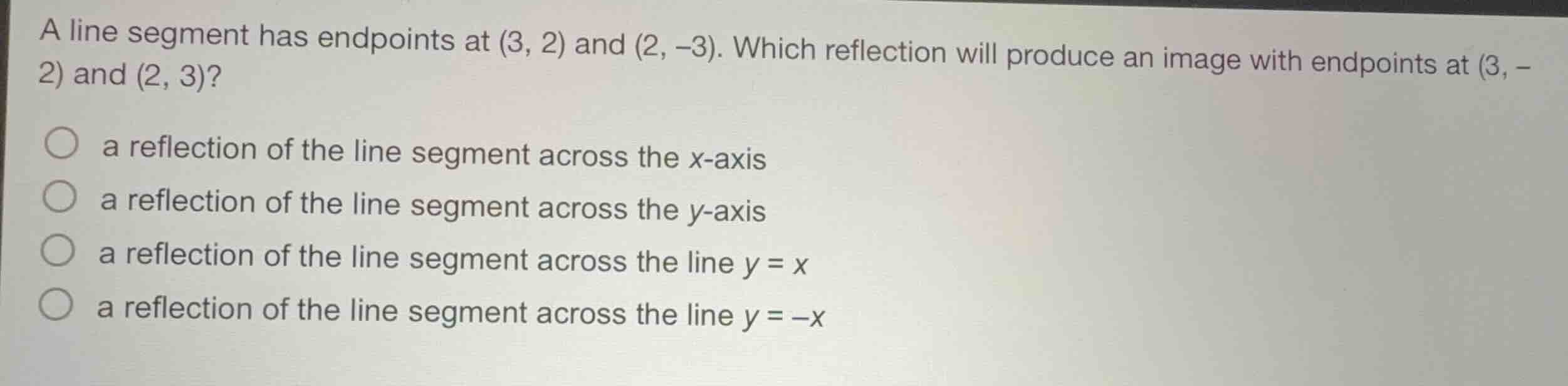
a line segment has endpoints at \\((3, 2)\\) and \\((2, -3)\\). which reflection will produce an image with endpoints at \\((3, -2)\\) and \\((2, 3)\\)?
a reflection of the line segment across the \\(x\\)-axis
a reflection of the line segment across the \\(y\\)-axis
a reflection of the line segment across the line \\(y = x\\)
a reflection of the line segment across the line \\(y = -x\\)
Identify the given endpoints
We are given a line segment with original endpoints:
The reflected image has endpoints:
Analyze coordinate changes
Let's compare the coordinates of each original point with its image:
- For the first endpoint:
Here, the \(x\)-coordinate remains unchanged, while the \(y\)-coordinate is negated:
- For the second endpoint:
Similarly, the \(x\)-coordinate remains unchanged, while the \(y\)-coordinate is negated:
Determine the transformation rule
The transformation mapping each point \((x, y)\) to \((x, -y)\) represents a reflection across the \(x\)-axis.
This is because reflecting a point across the horizontal \(x\)-axis keeps its horizontal distance from the \(y\)-axis the same but flips its vertical position.
Match with the options
Let's evaluate the given choices:
- Option 1: a reflection of the line segment across the \(x\)-axis. This matches our rule \((x, y)
ightarrow (x, -y)\).
- Option 2: a reflection of the line segment across the \(y\)-axis. This corresponds to \((x, y)
ightarrow (-x, y)\).
- Option 3: a reflection of the line segment across the line \(y = x\). This corresponds to \((x, y)
ightarrow (y, x)\).
- Option 4: a reflection of the line segment across the line \(y = -x\). This corresponds to \((x, y)
ightarrow (-y, -x)\).

Snap & solve any problem in the app
Get step-by-step solutions on Sovi AI
Photo-based solutions with guided steps
Explore more problems and detailed explanations
- a reflection of the line segment across the x-axis (Correct answer)
- a reflection of the line segment across the y-axis
- a reflection of the line segment across the line y = x
- a reflection of the line segment across the line y = -x