QUESTION IMAGE
Question
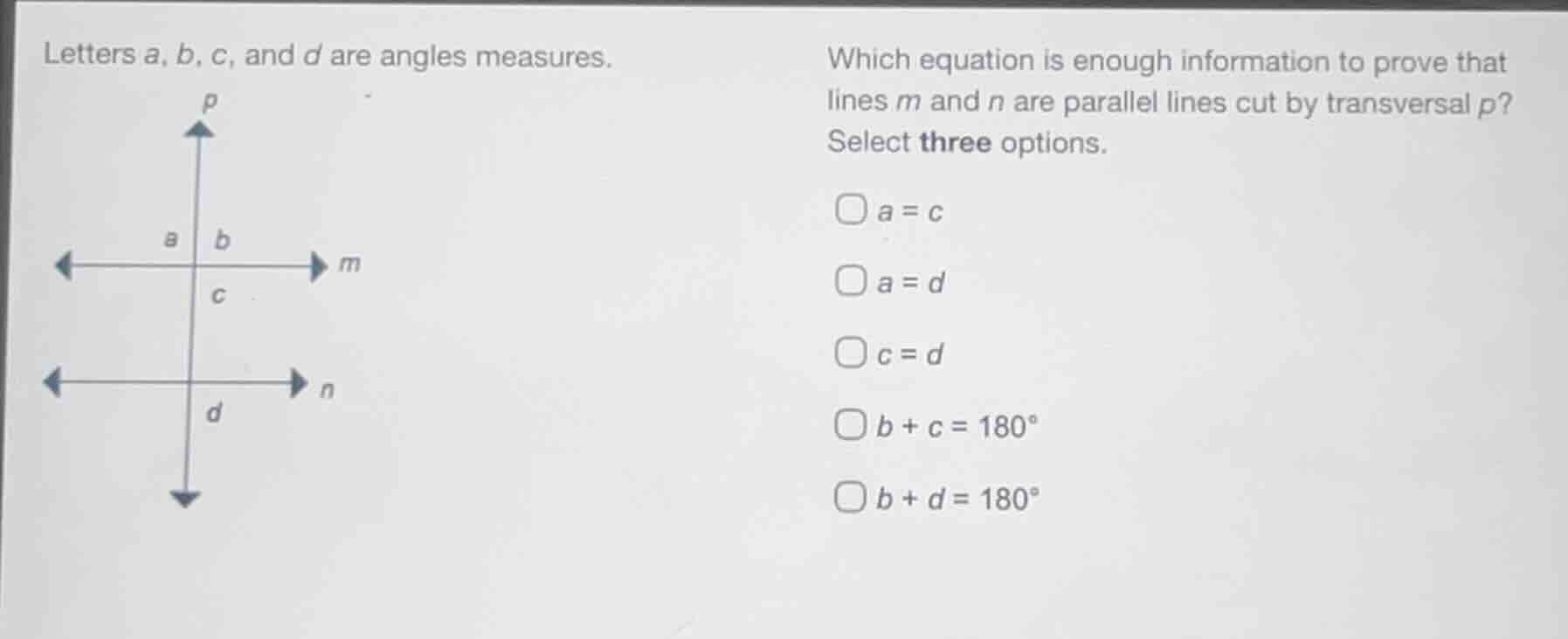
letters a, b, c, and d are angles measures.
which equation is enough information to prove that lines m and n are parallel lines cut by transversal p?
select three options.
\\(a = c\\)
\\(a = d\\)
\\(c = d\\)
\\(b + c = 180^{\circ}\\)
\\(b + d = 180^{\circ}\\)
Identify angle relationships
Analyze the positions of the angles relative to lines \(m\), \(n\), and transversal \(p\).
- Angle \(a\) and angle \(c\) are vertical angles on line \(m\), so \(a = c\) is always true and does not prove lines are parallel.
- Angle \(a\) and angle \(d\) are corresponding angles.
- Angle \(c\) and angle \(d\) are alternate interior angles.
- Angle \(b\) and angle \(c\) form a linear pair on line \(m\), so \(b + c = 180^\circ\) is always true and does not prove lines are parallel.
- Angle \(b\) and angle \(d\) are consecutive interior angles.
Apply converse theorems
Using the Converse Theorems, determine which equations prove \(m \parallel n\).
- If corresponding angles are equal, the lines are parallel. Thus, \(a = d\) proves \(m \parallel n\) using the Corresponding Angles converse.
- If alternate interior angles are equal, the lines are parallel. Thus, \(c = d\) proves \(m \parallel n\) using the Alternate Interior Angles converse.
- If consecutive interior angles are supplementary, the lines are parallel. Thus, \(b + d = 180^\circ\) proves \(m \parallel n\) using the Consecutive Interior Angles converse.

Snap & solve any problem in the app
Get step-by-step solutions on Sovi AI
Photo-based solutions with guided steps
Explore more problems and detailed explanations
- \(a = c\)
- \(a = d\) (Correct answer)
- \(c = d\) (Correct answer)
- \(b + c = 180^\circ\)
- \(b + d = 180^\circ\) (Correct answer)