QUESTION IMAGE
Question
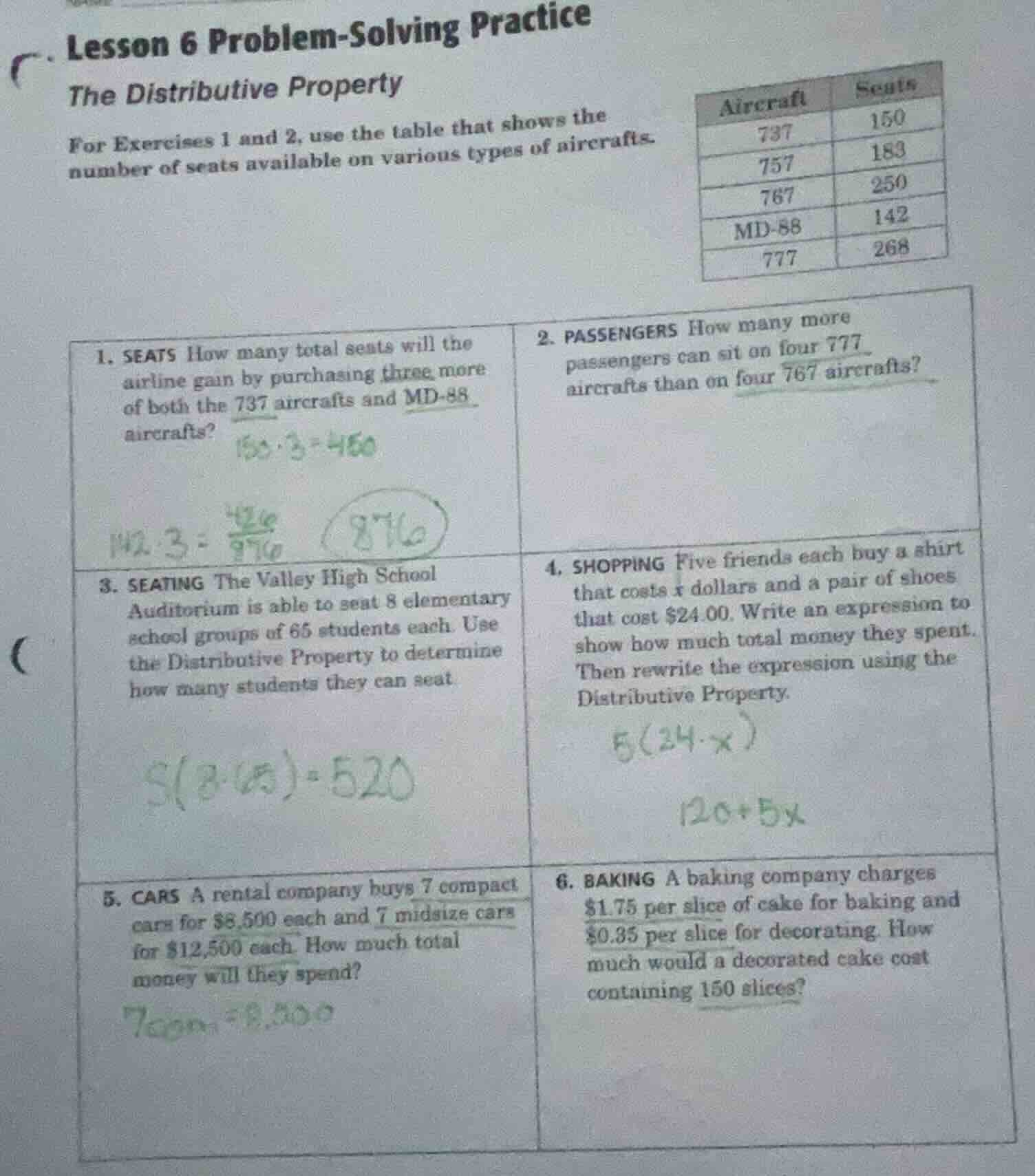
lesson 6 problem - solving practice
the distributive property
for exercises 1 and 2, use the table that shows the number of seats available on various types of aircrafts.
| aircraft | seats |
|---|---|
| 757 | 183 |
| 767 | 250 |
| md - 88 | 142 |
| 777 | 268 |
- seats how many total seats will the airline gain by purchasing three more of both the 737 aircrafts and md - 88 aircrafts?
- passengers how many more passengers can sit on four 777 aircrafts than on four 767 aircrafts?
- seating the valley high school auditorium is able to seat 8 elementary school groups of 65 students each. use the distributive property to determine how many students they can seat.
- shopping five friends each buy a shirt that costs $x$ dollars and a pair of shoes that cost $24.00. write an expression to show how much total money they spent. then rewrite the expression using the distributive property.
- cars a rental company buys 7 compact cars for $8,500 each and 7 midsize cars for $12,500 each. how much total money will they spend?
- baking a baking company charges $1.75 per slice of cake for baking and $0.35 per slice for decorating. how much would a decorated cake coat containing 150 slices?
Let's solve each problem one by one:
Problem 1: SEATS
We need to find the total seats gained by purchasing 3 more of 737 and MD - 88 aircrafts.
- Step 1: Calculate seats from 3 737 aircrafts
The number of seats in one 737 aircraft is 150. So for 3 aircrafts, we use the formula: Number of seats = Number of aircrafts×Seats per aircraft.
So, for 737: \(3\times150 = 450\)
- Step 2: Calculate seats from 3 MD - 88 aircrafts
The number of seats in one MD - 88 aircraft is 142. For 3 aircrafts: \(3\times142=426\)
- Step 3: Find the total seats
To find the total seats, we add the seats from 737 and MD - 88 aircrafts.
Total seats=\(450 + 426=876\)
Problem 2: PASSENGERS
We need to find how many more passengers can sit on four 777 aircrafts than on four 767 aircrafts.
- Step 1: Calculate seats in four 777 aircrafts
Seats in one 777 aircraft is 268. So for 4 aircrafts: \(4\times268 = 1072\)
- Step 2: Calculate seats in four 767 aircrafts
Seats in one 767 aircraft is 250. So for 4 aircrafts: \(4\times250=1000\)
- Step 3: Find the difference
Subtract the seats of 767 from 777: \(1072-1000 = 72\)
Problem 3: SEATING
The Valley High School Auditorium can seat 8 elementary school groups of 65 students each. We use the distributive property.
The total number of students is given by the formula: Total students=Number of groups×Students per group.
Using the distributive property (even though it's a simple multiplication here, we can think of it as \(8\times65=(8\times60)+(8\times5)=480 + 40=520\))
So the number of students they can seat is 520.
Problem 4: SHOPPING
Five friends each buy a shirt (cost \(x\) dollars) and a pair of shoes (cost \$24.00).
- Step 1: Write the expression for total cost
Each friend spends \((x + 24)\) dollars (cost of shirt + cost of shoes). For 5 friends, the total cost is \(5(x + 24)\)
- Step 2: Rewrite using distributive property
Using the distributive property \(a(b + c)=ab+ac\), where \(a = 5\), \(b=x\) and \(c = 24\)
\(5(x + 24)=5x+5\times24=5x + 120\)
Problem 5: CARS
A rental company buys 7 compact cars for \$8,500 each and 7 midsize cars for \$12,500 each. We need to find the total money spent.
- Step 1: Calculate cost of 7 compact cars
Cost of one compact car is \$8500. For 7 cars: \(7\times8500 = 59500\)
- Step 2: Calculate cost of 7 midsize cars
Cost of one midsize car is \$12500. For 7 cars: \(7\times12500=87500\)
- Step 3: Find the total cost
Total cost=Cost of compact cars+Cost of midsize cars=\(59500+87500 = 147000\)
We can also use the distributive property: \(7\times(8500 + 12500)=7\times21000=147000\)
Problem 6: BAKING
A baking company charges \$1.75 per slice for baking and \$0.35 per slice for decorating. We need to find the cost of a decorated cake with 150 slices.
- Step 1: Calculate cost per slice for decorated cake
The cost per slice for a decorated cake is the sum of baking cost and decorating cost per slice. So, cost per slice=\(1.75+0.35 = 2.1\)
- Step 2: Calculate cost for 150 slices
Using the formula: Total cost=Number of slices×Cost per slice.
Total cost=\(150\times2.1=315\)

Snap & solve any problem in the app
Get step-by-step solutions on Sovi AI
Photo-based solutions with guided steps
Explore more problems and detailed explanations
s:
- \(\boldsymbol{876}\)
- \(\boldsymbol{72}\)
- \(\boldsymbol{520}\)
- The expression is \(5(x + 24)\) and using distributive property it is \(5x+120\)
- \(\boldsymbol{147000}\)
- \(\boldsymbol{315}\)