QUESTION IMAGE
Question
lesson 11.2 checkpoint
once you have completed the above problems and checked your solutions, complete the lesson checkpoint below.
complete the lesson reflection above by circling your current understanding of the learning goal.
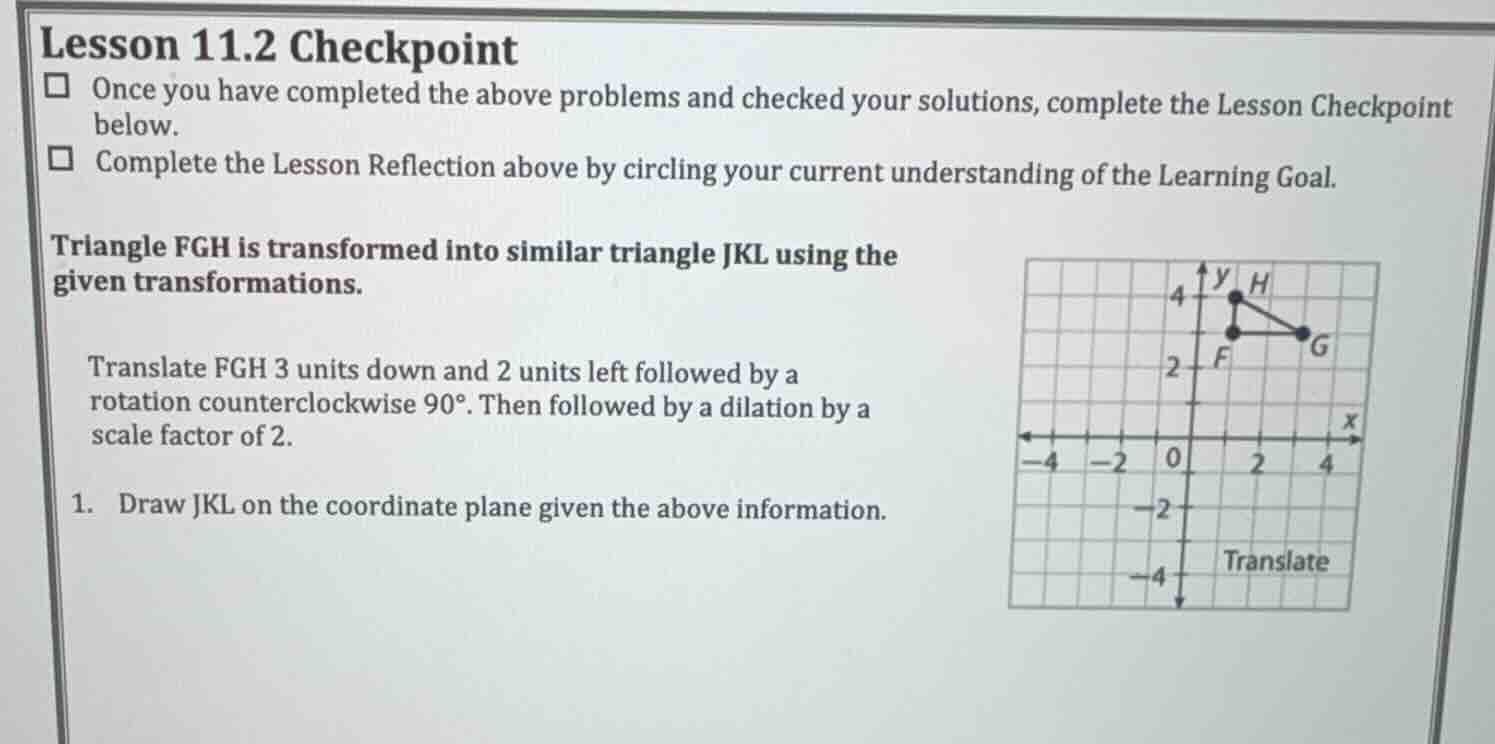
triangle fgh is transformed into similar triangle jkl using the given transformations.
translate fgh 3 units down and 2 units left followed by a rotation counterclockwise 90°. then followed by a dilation by a scale factor of 2.
- draw jkl on the coordinate plane given the above information.
Identify original coordinates
Using the Geometric Transformations knowledge point, we first identify the coordinates of the vertices of \(\triangle FGH\) from the given coordinate plane:
Apply translation
Using the Geometric Transformations knowledge point, we translate each vertex 3 units down and 2 units left using the rule \((x, y)
ightarrow (x - 2, y - 3)\):
Apply counterclockwise rotation
Using the Coordinate Rules for Rotations knowledge point, we rotate the translated points \(90^\circ\) counterclockwise about the origin using the rule \((x, y)
ightarrow (-y, x)\):
Apply dilation
Using the Geometric Dilations and Dilation Scale Factor knowledge points, we dilate the rotated points about the origin by a scale factor of 2 using the rule \((x, y)
ightarrow (2x, 2y)\) to find the final vertices of \(\triangle JKL\):
Verify final triangle
Using the Composite Transformations knowledge point, we confirm the final coordinates of \(\triangle JKL\):
- Vertex \(J\) is at \((0, -2)\).
- Vertex \(K\) is at \((0, 2)\).
- Vertex \(L\) is at \((-2, -2)\).

Snap & solve any problem in the app
Get step-by-step solutions on Sovi AI
Photo-based solutions with guided steps
Explore more problems and detailed explanations
To draw \(\triangle JKL\) on the coordinate plane, plot the vertices at the following coordinates and connect them to form the triangle:
- \(J(0, -2)\)
- \(K(0, 2)\)
- \(L(-2, -2)\)