QUESTION IMAGE
Question
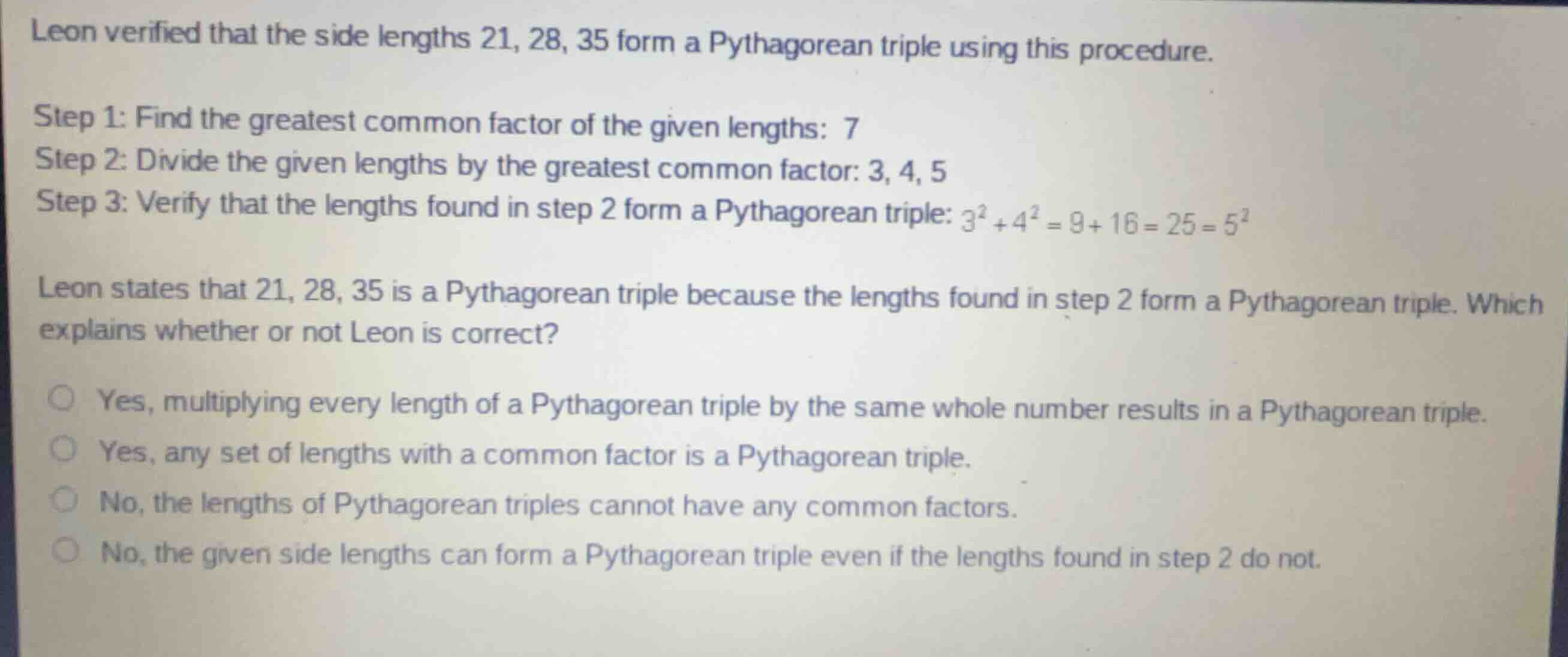
leon verified that the side lengths 21, 28, 35 form a pythagorean triple using this procedure.
step 1: find the greatest common factor of the given lengths: 7
step 2: divide the given lengths by the greatest common factor: 3, 4, 5
step 3: verify that the lengths found in step 2 form a pythagorean triple: \\(3^2 + 4^2 = 9 + 16 = 25 = 5^2\\)
leon states that 21, 28, 35 is a pythagorean triple because the lengths found in step 2 form a pythagorean triple. which explains whether or not leon is correct?
yes, multiplying every length of a pythagorean triple by the same whole number results in a pythagorean triple.
yes, any set of lengths with a common factor is a pythagorean triple.
no, the lengths of pythagorean triples cannot have any common factors.
no, the given side lengths can form a pythagorean triple even if the lengths found in step 2 do not.
Verify the relationship between the sets of lengths
Scale the triple by the common factor
Evaluate the statements

Snap & solve any problem in the app
Get step-by-step solutions on Sovi AI
Photo-based solutions with guided steps
Explore more problems and detailed explanations
- (A) Yes, multiplying every length of a Pythagorean triple by the same whole number results in a Pythagorean triple. (Correct answer)
- (B) Yes, any set of lengths with a common factor is a Pythagorean triple.
- (C) No, the lengths of Pythagorean triples cannot have any common factors.
- (D) No, the given side lengths can form a Pythagorean triple even if the lengths found in step 2 do not.