QUESTION IMAGE
Question
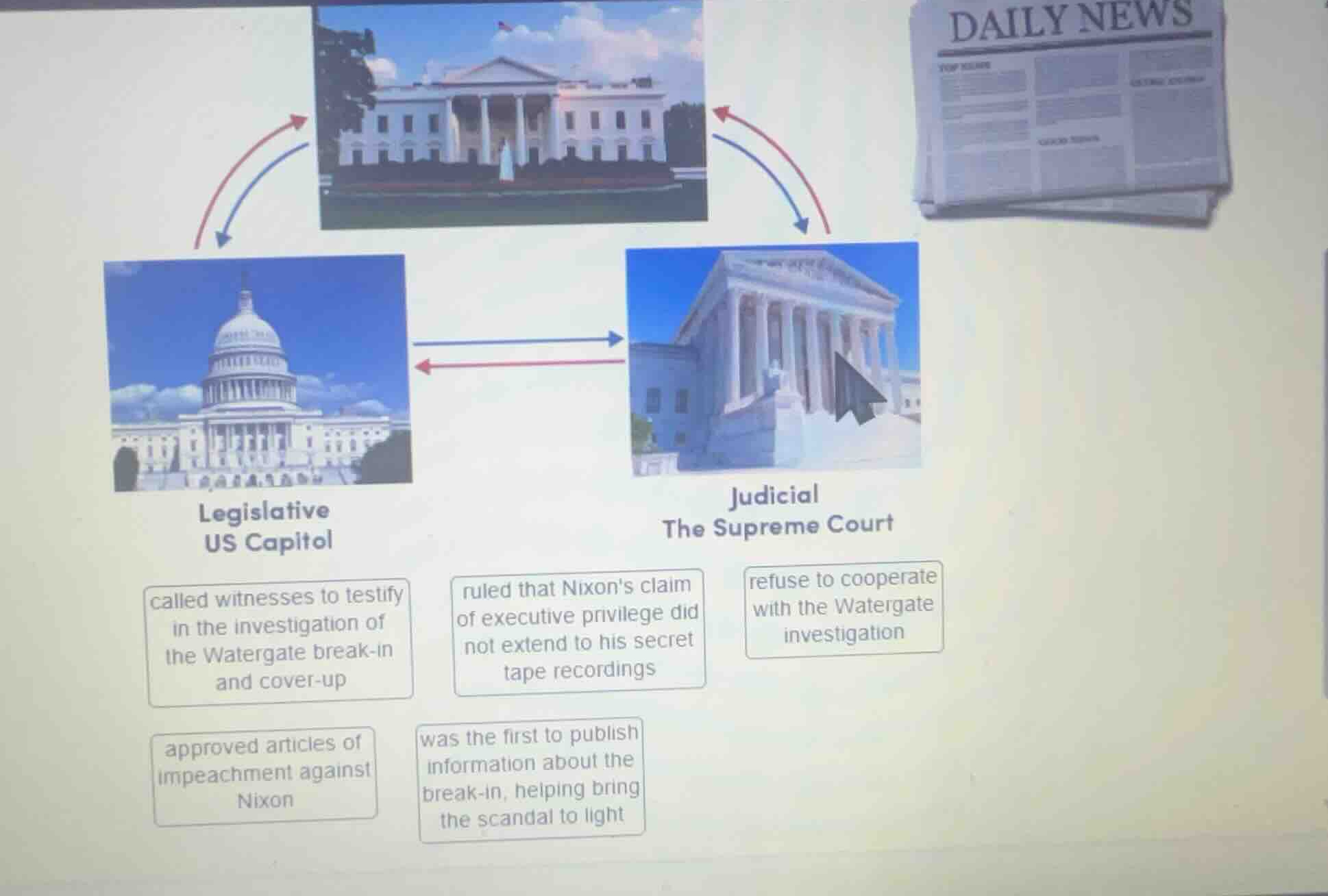
legislative us capitol
judicial the supreme court
called witnesses to testify in the investigation of the watergate break-in and cover-up
ruled that nixons claim of executive privilege did not extend to his secret tape recordings
refuse to cooperate with the watergate investigation
approved articles of impeachment against nixon
was the first to publish information about the break-in, helping bring the scandal to light
Identify the components of the diagram
The diagram represents the interactions between the three branches of the United States government (Executive represented by the White House, Legislative represented by the US Capitol, and Judicial represented by the Supreme Court) along with the press (represented by the Daily News) during the Watergate scandal. Below the diagram are five historical events/actions related to the scandal:
- "called witnesses to testify in the investigation of the Watergate break-in and cover-up"
- "ruled that Nixon's claim of executive privilege did not extend to his secret tape recordings"
- "refuse to cooperate with the Watergate investigation"
- "approved articles of impeachment against Nixon"
- "was the first to publish information about the break-in, helping bring the scandal to light"
Map each action to the correct actor
Let's match each of the five descriptions to the corresponding branch of government, the President (Executive), or the press:
- Executive (President Richard Nixon / White House):
- Action: "refuse to cooperate with the Watergate investigation" (Nixon repeatedly refused to turn over tapes and cooperate with congressional committees).
- Legislative (US Capitol / Congress):
- Action 1: "called witnesses to testify in the investigation of the Watergate break-in and cover-up" (The Senate Watergate Committee held highly publicized hearings and called key administration officials to testify).
- Action 2: "approved articles of impeachment against Nixon" (The House Judiciary Committee voted to approve three articles of impeachment against President Nixon in July 1974).
- Judicial (The Supreme Court):
- Action: "ruled that Nixon's claim of executive privilege did not extend to his secret tape recordings" (In the landmark case United States v. Nixon (1974), the Supreme Court ruled unanimously that the president must surrender the tapes).
- The Press (Daily News / Media):
- Action: "was the first to publish information about the break-in, helping bring the scandal to light" (Journalists, most famously Bob Woodward and Carl Bernstein of The Washington Post, investigated and published crucial details connecting the break-in to the White House).
Synthesize the roles in the constitutional crisis
This exercise demonstrates how the system of checks and balances functioned during a major constitutional crisis:
- The Legislative branch used its oversight and impeachment powers to investigate executive misconduct.
- The Judicial branch used its power of judicial review to limit executive privilege and enforce the rule of law.
- The Executive branch attempted to resist these checks by asserting executive privilege and refusing cooperation.
- The Free Press acted as an external check by informing the public and keeping the investigation active.

Snap & solve any problem in the app
Get step-by-step solutions on Sovi AI
Photo-based solutions with guided steps
Explore more problems and detailed explanations
Based on the historical roles of each branch of government and the press during the Watergate scandal, here is the correct categorization for each description:
Executive Branch (The White House / President Nixon)
- refuse to cooperate with the Watergate investigation
Legislative Branch (US Capitol / Congress)
- called witnesses to testify in the investigation of the Watergate break-in and cover-up
- approved articles of impeachment against Nixon
Judicial Branch (The Supreme Court)
- ruled that Nixon's claim of executive privilege did not extend to his secret tape recordings
The Press (Daily News / Media)
- was the first to publish information about the break-in, helping bring the scandal to light