QUESTION IMAGE
Question
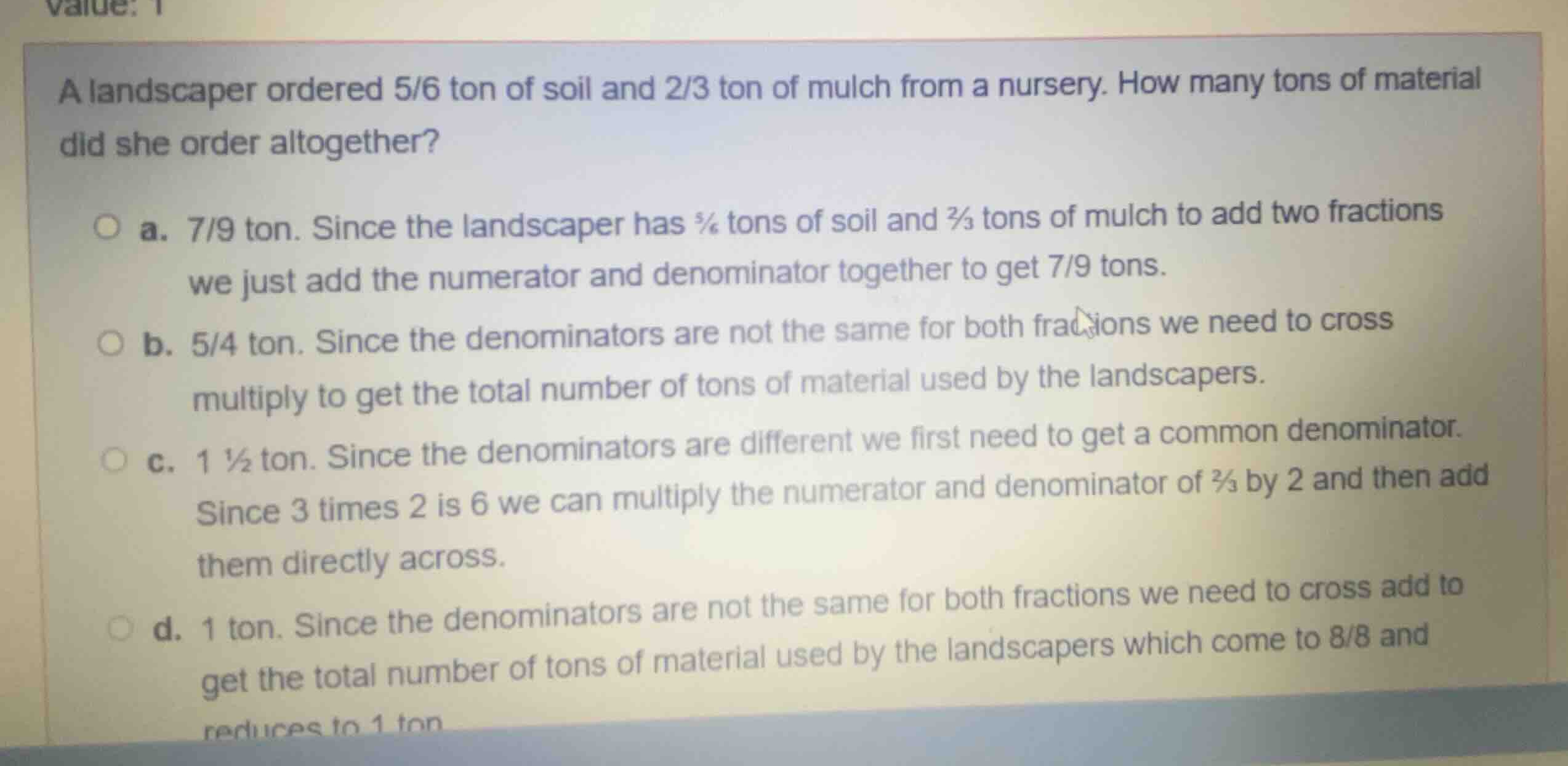
a landscaper ordered \\(\frac{5}{6}\\) ton of soil and \\(\frac{2}{3}\\) ton of mulch from a nursery. how many tons of material did she order altogether?
a. \\(\frac{7}{9}\\) ton. since the landscaper has \\(\frac{5}{6}\\) tons of soil and \\(\frac{2}{3}\\) tons of mulch to add two fractions we just add the numerator and denominator together to get \\(\frac{7}{9}\\) tons.
b. \\(\frac{5}{4}\\) ton. since the denominators are not the same for both fractions we need to cross multiply to get the total number of tons of material used by the landscapers.
c. \\(1\frac{1}{2}\\) ton. since the denominators are different we first need to get a common denominator. since 3 times 2 is 6 we can multiply the numerator and denominator of \\(\frac{2}{3}\\) by 2 and then add them directly across.
d. 1 ton. since the denominators are not the same for both fractions we need to cross add to get the total number of tons of material used by the landscapers which come to \\(\frac{8}{8}\\) and reduces to 1 ton.
Identify the operation
Find a common denominator
Add and simplify

Snap & solve any problem in the app
Get step-by-step solutions on Sovi AI
Photo-based solutions with guided steps
Explore more problems and detailed explanations
- a. 7/9 ton. Since the landscaper has 5/6 tons of soil and 2/3 tons of mulch to add two fractions we just add the numerator and denominator together to get 7/9 tons.
- b. 5/4 ton. Since the denominators are not the same for both fractions we need to cross multiply to get the total number of tons of material used by the landscapers.
- c. 1 1/2 ton. Since the denominators are different we first need to get a common denominator. Since 3 times 2 is 6 we can multiply the numerator and denominator of 2/3 by 2 and then add them directly across. (Correct answer)
- d. 1 ton. Since the denominators are not the same for both fractions we need to cross add to get the total number of tons of material used by the landscapers which come to 8/8 and reduces to 1 ton.