QUESTION IMAGE
Question
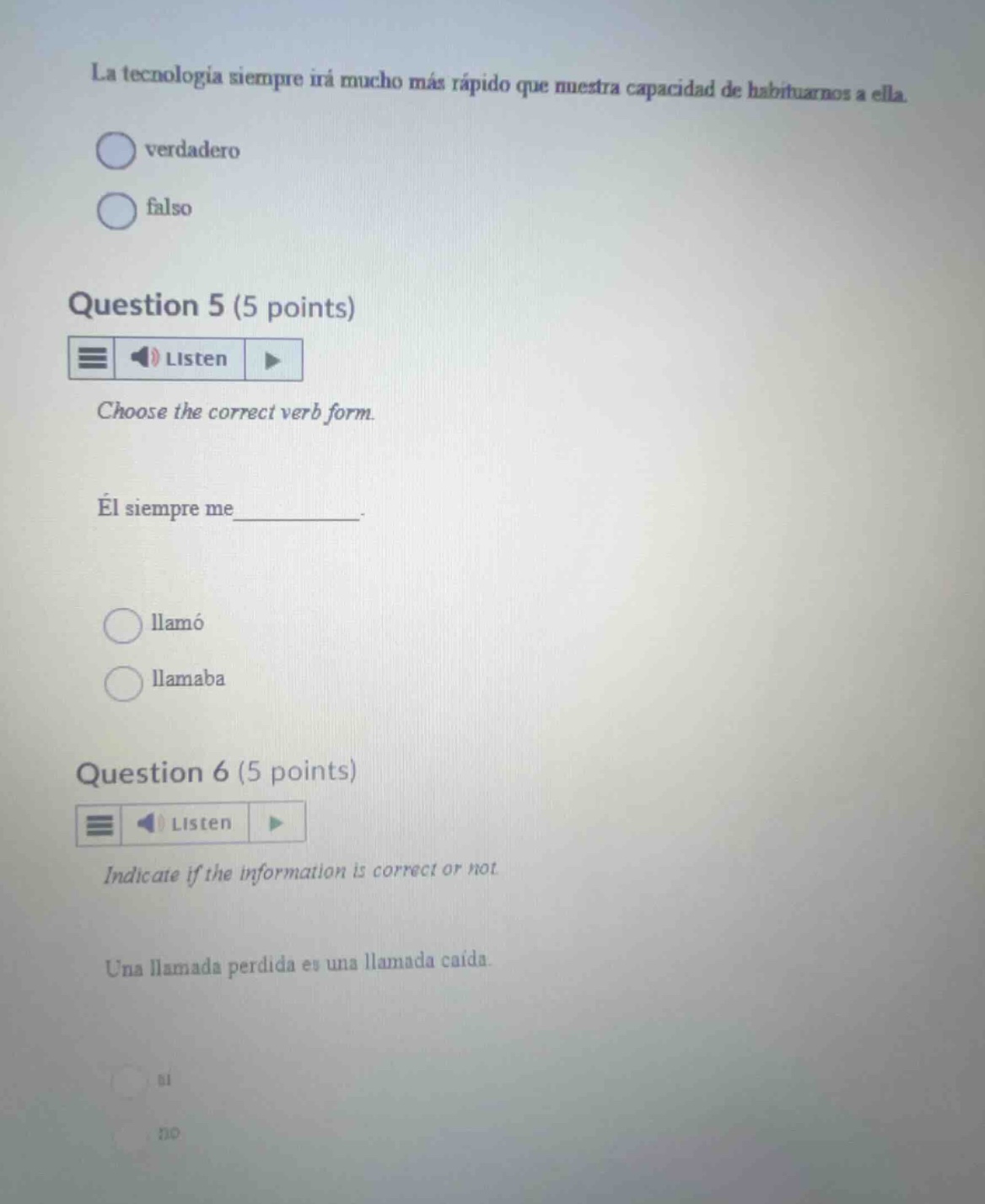
la tecnología siempre irá mucho más rápido que nuestra capacidad de habituarnos a ella.
verdadero
falso
question 5 (5 points)
choose the correct verb form.
él siempre me ______.
llamó
llamaba
question 6 (5 points)
indicate if the information is correct or not.
una llamada perdida es una llamada caída.
sí
no
<pre_analysis>
{
"quality": "clear",
"question_count": 3,
"skills_matched": [
"direct_cot",
"multiple_choice_formatter",
"explain_then_answer",
"quick"
],
"needs_drawing": false,
"concepts_used": [
"Spanish Reading Comprehension",
"Spanish Verb Conjugation",
"Spanish Preterite vs Imperfect",
"Technology Vocabulary"
],
"new_concepts": [],
"current_concepts": [
"Spanish Reading Comprehension",
"Spanish Verb Conjugation",
"Spanish Preterite vs Imperfect",
"Technology Vocabulary"
]
}
</pre_analysis>
<reasoning>
Analyze the statement about technology
The statement is: "La tecnología siempre irá mucho más rápido que nuestra capacidad de habituarnos a ella" (Technology will always go much faster than our ability to get used to it). This is a widely accepted philosophical and sociological truth regarding technological acceleration and human adaptation.
Determine the correct verb form for Question 5
The sentence is: "Él siempre me ________."
The adverb "siempre" (always) indicates a habitual or repeated action in the past. In Spanish, habitual past actions are expressed using the imperfect tense ("llamaba") rather than the preterite tense ("llamó"), which is used for completed, single-event actions.
Analyze the statement for Question 6
The statement is: "Una llamada perdida es una llamada caída."
"Una llamada perdida" means a missed call (a call that was not answered). "Una llamada caída" means a dropped call (a call that was disconnected due to technical issues). These two terms refer to different situations, so the statement is incorrect (no).
</reasoning>
<answer>
Question 4
<mcq-correct>verdadero</mcq-correct>
<mcq-option>falso</mcq-option>
Question 5
<mcq-option>llamó</mcq-option>
<mcq-correct>llamaba</mcq-correct>
Question 6
<mcq-option>sí</mcq-option>
<mcq-correct>no</mcq-correct>
</answer>
<post_analysis>
{
"subject": "Others",
"question_type": "Multiple Choice",
"knowledge_point": [
"Others",
"Spanish",
"Spanish Grammar and Vocabulary"
]
}
</post_analysis>
Snap & solve any problem in the app
Get step-by-step solutions on Sovi AI
Photo-based solutions with guided steps
Explore more problems and detailed explanations
<pre_analysis>
{
"quality": "clear",
"question_count": 3,
"skills_matched": [
"direct_cot",
"multiple_choice_formatter",
"explain_then_answer",
"quick"
],
"needs_drawing": false,
"concepts_used": [
"Spanish Reading Comprehension",
"Spanish Verb Conjugation",
"Spanish Preterite vs Imperfect",
"Technology Vocabulary"
],
"new_concepts": [],
"current_concepts": [
"Spanish Reading Comprehension",
"Spanish Verb Conjugation",
"Spanish Preterite vs Imperfect",
"Technology Vocabulary"
]
}
</pre_analysis>
<reasoning>
Analyze the statement about technology
The statement is: "La tecnología siempre irá mucho más rápido que nuestra capacidad de habituarnos a ella" (Technology will always go much faster than our ability to get used to it). This is a widely accepted philosophical and sociological truth regarding technological acceleration and human adaptation.
Determine the correct verb form for Question 5
The sentence is: "Él siempre me ________."
The adverb "siempre" (always) indicates a habitual or repeated action in the past. In Spanish, habitual past actions are expressed using the imperfect tense ("llamaba") rather than the preterite tense ("llamó"), which is used for completed, single-event actions.
Analyze the statement for Question 6
The statement is: "Una llamada perdida es una llamada caída."
"Una llamada perdida" means a missed call (a call that was not answered). "Una llamada caída" means a dropped call (a call that was disconnected due to technical issues). These two terms refer to different situations, so the statement is incorrect (no).
</reasoning>
<answer>
Question 4
<mcq-correct>verdadero</mcq-correct>
<mcq-option>falso</mcq-option>
Question 5
<mcq-option>llamó</mcq-option>
<mcq-correct>llamaba</mcq-correct>
Question 6
<mcq-option>sí</mcq-option>
<mcq-correct>no</mcq-correct>
</answer>
<post_analysis>
{
"subject": "Others",
"question_type": "Multiple Choice",
"knowledge_point": [
"Others",
"Spanish",
"Spanish Grammar and Vocabulary"
]
}
</post_analysis>