Sovi.AI - AI Math Tutor

Scan to solve math questions

QUESTION IMAGE

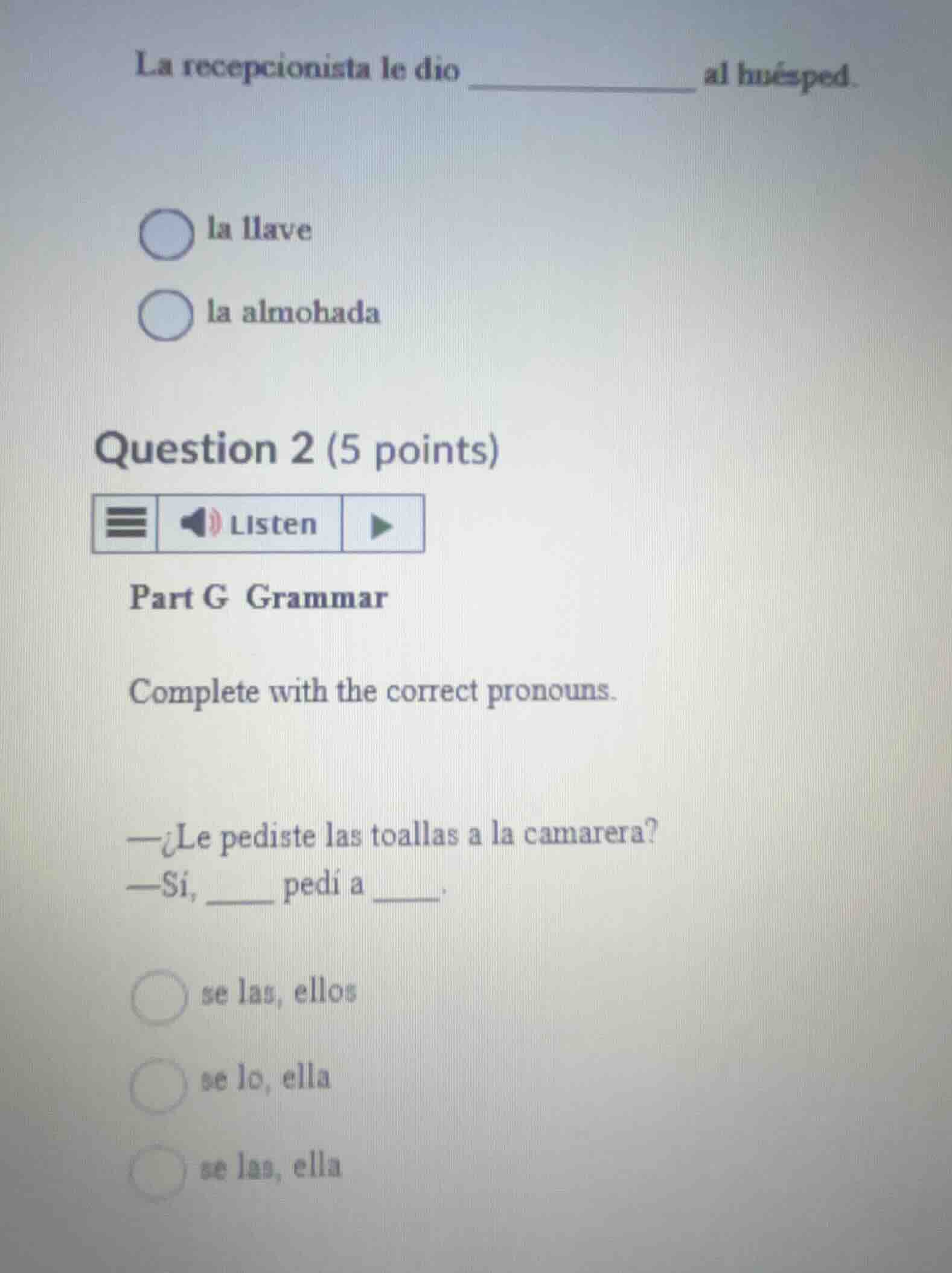
la recepcionista le dio ________ al huésped. - la llave - la almohada q…

Question

la recepcionista le dio ________ al huésped.

  • la llave
  • la almohada

question 2 (5 points)
part g grammar

complete with the correct pronouns.

-¿le pediste las toallas a la camarera?
-sí, __ pedí a __.

  • se las, ellos
  • se lo, ella
  • se las, ella

Explanation:

Response

<pre_analysis>
{
"quality": "clear",
"question_count": 2,
"skills_matched": [
"direct_cot",
"multiple_choice_formatter",
"explain_then_answer",
"quick"
],
"needs_drawing": false,
"concepts_used": [],
"new_concepts": [
"Spanish Hotel Vocabulary",
"Spanish Double Object Pronouns"
],
"current_concepts": [
"Spanish Hotel Vocabulary",
"Spanish Double Object Pronouns"
]
}
</pre_analysis>

<reasoning>

Question 1: Analyze the context and vocabulary

The sentence is: "La recepcionista le dio ______ al huésped." (The receptionist gave ______ to the guest.)

  • "la llave" means "the key", which is a standard item a receptionist gives to a hotel guest.
  • "la almohada" means "the pillow", which is typically provided by housekeeping, not directly at the reception desk.

Therefore, "la llave" is the most logical choice.

Question 2: Analyze the grammatical structure

The prompt asks to complete the sentence with the correct pronouns:
"—¿Le pediste las toallas a la camarera? (Did you ask the maid for the towels?)
—Sí, __ pedí a ." (Yes, I asked for __.)

  • The direct object is "las toallas" (feminine plural), which is replaced by the direct object pronoun "las".
  • The indirect object is "a la camarera" (third-person singular), which is replaced by the indirect object pronoun "le".
  • When combining indirect and direct object pronouns where both start with 'l' (le/les + lo/la/los/las), the indirect pronoun "le" changes to "se". Thus, "le las" becomes "se las".
  • The prepositional object pronoun clarifying "a la camarera" (to her) is "ella".

Therefore, the correct combination is "se las, ella".
</reasoning>

<answer>

Question 1

<mcq-correct>la llave</mcq-correct>
<mcq-option>la almohada</mcq-option>

Question 2

<mcq-option>se las, ellos</mcq-option>
<mcq-option>se lo, ella</mcq-option>
<mcq-correct>se las, ella</mcq-correct>
</answer>

<post_analysis>
{
"subject": "Others",
"question_type": "Multiple Choice",
"knowledge_point": [
"Others",
"Spanish",
"Spanish Grammar and Vocabulary"
]
}
</post_analysis>

Answer:

<pre_analysis>
{
"quality": "clear",
"question_count": 2,
"skills_matched": [
"direct_cot",
"multiple_choice_formatter",
"explain_then_answer",
"quick"
],
"needs_drawing": false,
"concepts_used": [],
"new_concepts": [
"Spanish Hotel Vocabulary",
"Spanish Double Object Pronouns"
],
"current_concepts": [
"Spanish Hotel Vocabulary",
"Spanish Double Object Pronouns"
]
}
</pre_analysis>

<reasoning>

Question 1: Analyze the context and vocabulary

The sentence is: "La recepcionista le dio ______ al huésped." (The receptionist gave ______ to the guest.)

  • "la llave" means "the key", which is a standard item a receptionist gives to a hotel guest.
  • "la almohada" means "the pillow", which is typically provided by housekeeping, not directly at the reception desk.

Therefore, "la llave" is the most logical choice.

Question 2: Analyze the grammatical structure

The prompt asks to complete the sentence with the correct pronouns:
"—¿Le pediste las toallas a la camarera? (Did you ask the maid for the towels?)
—Sí, __ pedí a ." (Yes, I asked for __.)

  • The direct object is "las toallas" (feminine plural), which is replaced by the direct object pronoun "las".
  • The indirect object is "a la camarera" (third-person singular), which is replaced by the indirect object pronoun "le".
  • When combining indirect and direct object pronouns where both start with 'l' (le/les + lo/la/los/las), the indirect pronoun "le" changes to "se". Thus, "le las" becomes "se las".
  • The prepositional object pronoun clarifying "a la camarera" (to her) is "ella".

Therefore, the correct combination is "se las, ella".
</reasoning>

<answer>

Question 1

<mcq-correct>la llave</mcq-correct>
<mcq-option>la almohada</mcq-option>

Question 2

<mcq-option>se las, ellos</mcq-option>
<mcq-option>se lo, ella</mcq-option>
<mcq-correct>se las, ella</mcq-correct>
</answer>

<post_analysis>
{
"subject": "Others",
"question_type": "Multiple Choice",
"knowledge_point": [
"Others",
"Spanish",
"Spanish Grammar and Vocabulary"
]
}
</post_analysis>