QUESTION IMAGE
Question
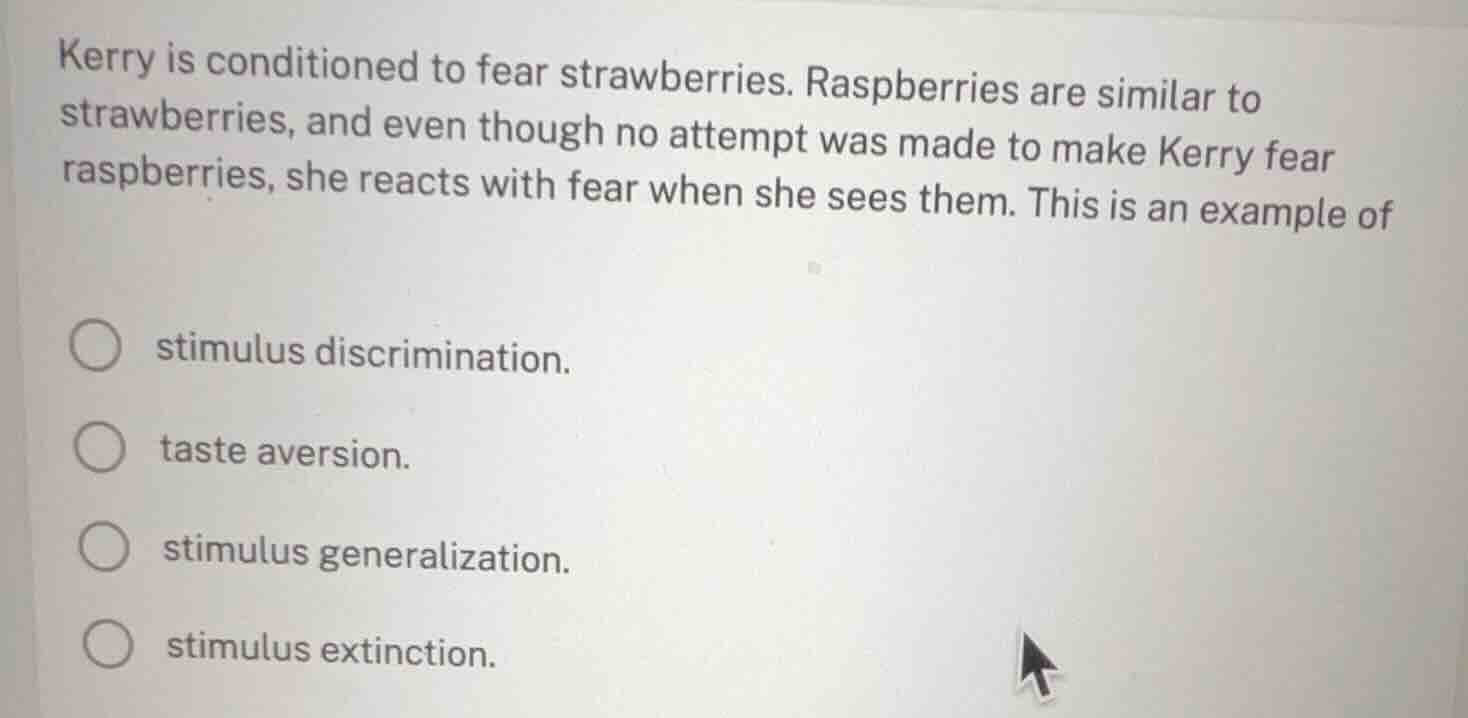
kerry is conditioned to fear strawberries. raspberries are similar to strawberries, and even though no attempt was made to make kerry fear raspberries, she reacts with fear when she sees them. this is an example of
stimulus discrimination.
taste aversion.
stimulus generalization.
stimulus extinction.
<pre_analysis>
{
"quality": "clear",
"question_count": 1,
"skills_matched": [
"direct_cot",
"multiple_choice_formatter",
"explain_then_answer",
"tutor",
"mastery_adaptive_brevity"
],
"needs_drawing": false,
"concepts_used": [
"Classical Conditioning"
],
"new_concepts": [
"Stimulus Generalization",
"Stimulus Discrimination"
],
"current_concepts": [
"Classical Conditioning",
"Stimulus Generalization",
"Stimulus Discrimination",
"Taste Aversion"
]
}
</pre_analysis>
<reasoning>
Analyze the scenario
Using the Classical Conditioning knowledge point, we identify that Kerry has been conditioned to fear a specific conditioned stimulus (strawberries). When she is presented with a new, similar stimulus (raspberries) that she was never directly conditioned to fear, she still exhibits the conditioned response (fear).
Define the psychological phenomenon
The tendency to respond to stimuli that are similar to the original conditioned stimulus is called stimulus generalization. This occurs because the subject transfers the learned response to similar objects or situations without additional training.
Evaluate the options
- Stimulus discrimination: The ability to differentiate between a conditioned stimulus and other similar but irrelevant stimuli. This is the opposite of what is happening here.
- Taste aversion: An active avoidance of a specific food flavor after it is paired with illness. Kerry is exhibiting fear, not taste aversion, and the response is generalized to another fruit.
- Stimulus generalization: The correct term for responding with fear to a similar stimulus (raspberries) as the conditioned stimulus (strawberries).
- Stimulus extinction: The gradual weakening and disappearance of a conditioned response when the conditioned stimulus is repeatedly presented without the unconditioned stimulus. This does not apply to this scenario.
</reasoning>
<answer>
<mcq-option>stimulus discrimination.</mcq-option>
<mcq-option>taste aversion.</mcq-option>
<mcq-correct>stimulus generalization.</mcq-correct>
<mcq-option>stimulus extinction.</mcq-option>
</answer>
<post_analysis>
{
"subject": "Social Science",
"question_type": "Multiple Choice",
"knowledge_point": [
"Social Science",
"Psychology",
"Classical Conditioning"
]
}
</post_analysis>
Snap & solve any problem in the app
Get step-by-step solutions on Sovi AI
Photo-based solutions with guided steps
Explore more problems and detailed explanations
<pre_analysis>
{
"quality": "clear",
"question_count": 1,
"skills_matched": [
"direct_cot",
"multiple_choice_formatter",
"explain_then_answer",
"tutor",
"mastery_adaptive_brevity"
],
"needs_drawing": false,
"concepts_used": [
"Classical Conditioning"
],
"new_concepts": [
"Stimulus Generalization",
"Stimulus Discrimination"
],
"current_concepts": [
"Classical Conditioning",
"Stimulus Generalization",
"Stimulus Discrimination",
"Taste Aversion"
]
}
</pre_analysis>
<reasoning>
Analyze the scenario
Using the Classical Conditioning knowledge point, we identify that Kerry has been conditioned to fear a specific conditioned stimulus (strawberries). When she is presented with a new, similar stimulus (raspberries) that she was never directly conditioned to fear, she still exhibits the conditioned response (fear).
Define the psychological phenomenon
The tendency to respond to stimuli that are similar to the original conditioned stimulus is called stimulus generalization. This occurs because the subject transfers the learned response to similar objects or situations without additional training.
Evaluate the options
- Stimulus discrimination: The ability to differentiate between a conditioned stimulus and other similar but irrelevant stimuli. This is the opposite of what is happening here.
- Taste aversion: An active avoidance of a specific food flavor after it is paired with illness. Kerry is exhibiting fear, not taste aversion, and the response is generalized to another fruit.
- Stimulus generalization: The correct term for responding with fear to a similar stimulus (raspberries) as the conditioned stimulus (strawberries).
- Stimulus extinction: The gradual weakening and disappearance of a conditioned response when the conditioned stimulus is repeatedly presented without the unconditioned stimulus. This does not apply to this scenario.
</reasoning>
<answer>
<mcq-option>stimulus discrimination.</mcq-option>
<mcq-option>taste aversion.</mcq-option>
<mcq-correct>stimulus generalization.</mcq-correct>
<mcq-option>stimulus extinction.</mcq-option>
</answer>
<post_analysis>
{
"subject": "Social Science",
"question_type": "Multiple Choice",
"knowledge_point": [
"Social Science",
"Psychology",
"Classical Conditioning"
]
}
</post_analysis>