QUESTION IMAGE
Question
jurvin enterprises is a manufacturing company with no beginning inventories. a subset of the transactions it recorded during a recent month is shown below.
a. purchased $94,000 in raw materials for cash.
b. $89,000 in raw materials were used in production. of this amount, $78,000 was direct materials and the remainder was indirect materials.
c. paid employees $132,000 cash. of this amount, $112,000 was direct labor and the remainder was indirect labor.
d. paid $143,000 for additional manufacturing overhead costs.
e. applied manufacturing overhead of $152,000 to production using the companys predetermined overhead rate.
f. all of the jobs in process at the end of the month were completed.
g. all of the completed jobs were shipped to customers.
h. any underapplied or overapplied overhead was closed to cost of goods sold.
required:
- post the above transactions to t-accounts.
- calculate the adjusted cost of goods sold for the period.
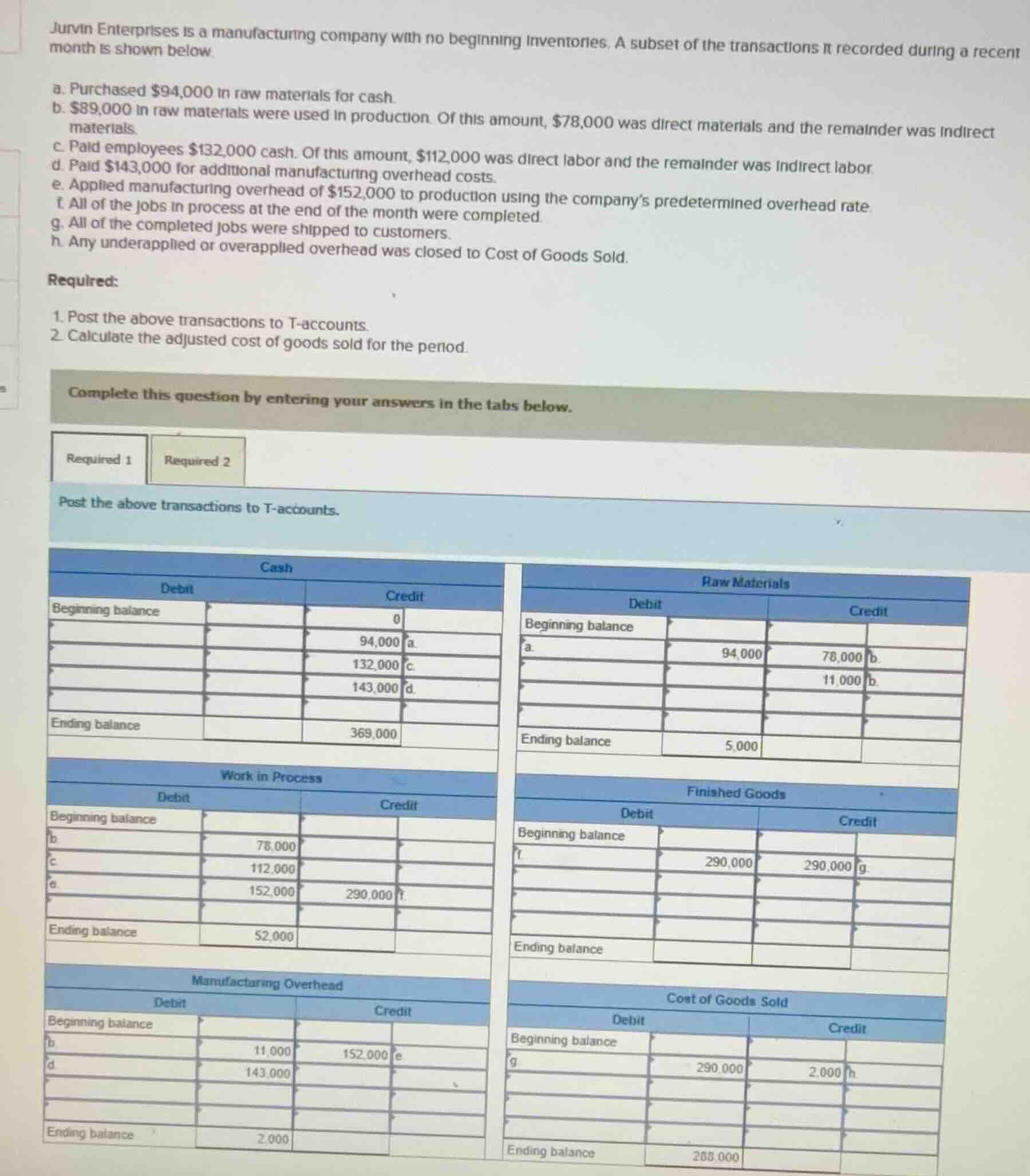
Analyze the Manufacturing Overhead T-Account
We need to determine the underapplied or overapplied manufacturing overhead by analyzing the Manufacturing Overhead T-account.
Using the Manufacturing Overhead T-Account and T-Account Analysis knowledge points:
- Debit side (Actual Overhead incurred):
- Indirect materials (from transaction b): \(\$11,000\)
- Indirect labor (from transaction c): \(\$132,000 - \$112,000 = \$20,000\)
- Additional manufacturing overhead costs (from transaction d): \(\$143,000\)
- Total Actual Overhead = \(\$11,000 + \$20,000 + \$143,000 = \$174,000\)
- Credit side (Applied Overhead):
- Applied manufacturing overhead (from transaction e): \(\$152,000\)
- Overhead Balance:
- Since Actual Overhead (\(\$174,000\)) is greater than Applied Overhead (\(\$152,000\)), the overhead is underapplied.
- Underapplied Overhead = \(\$174,000 - \$152,000 = \$22,000\) (Debit balance of \(\$22,000\) before adjustment).
Note: The image shows an incorrect debit entry of \(\$143,000\) under transaction d but misses the indirect labor debit of \(\$20,000\) in the Manufacturing Overhead T-account, resulting in an incorrect ending balance of \(\$2,000\) in the screenshot. We will calculate the correct adjusted Cost of Goods Sold based on the proper accounting flow.
Calculate the Unadjusted Cost of Goods Sold
Using the Work in Process T-Account and Cost Flow Analysis knowledge points:
- Work in Process (WIP) Debit entries:
- Direct materials (transaction b): \(\$78,000\)
- Direct labor (transaction c): \(\$112,000\)
- Applied overhead (transaction e): \(\$152,000\)
- Total additions to WIP = \(\$78,000 + \$112,000 + \$152,000 = \$342,000\)
- Cost of Goods Manufactured (COGM):
- Since there are no beginning inventories and all jobs were completed (transaction f), the ending WIP balance is \(\$0\).
- COGM = \(\$342,000\) (transferred to Finished Goods).
- Unadjusted Cost of Goods Sold (COGS):
- Since all completed jobs were shipped to customers (transaction g), the unadjusted COGS is equal to COGM.
- Unadjusted COGS = \(\$342,000\).
Adjust Cost of Goods Sold for Underapplied Overhead
Using the Cost Flow Analysis knowledge point:
- Since the manufacturing overhead is underapplied by \(\$22,000\), actual overhead costs were higher than what was applied to the products.
- To close this variance to Cost of Goods Sold (transaction h), we must increase Cost of Goods Sold by the underapplied amount:

Snap & solve any problem in the app
Get step-by-step solutions on Sovi AI
Photo-based solutions with guided steps
Explore more problems and detailed explanations
Question 1
The completed T-accounts with correct balances are:
- Cash: Ending Balance = \(\$0\) (Beginning) - \(\$94,000\) (a) - \(\$132,000\) (c) - \(\$143,000\) (d) = \(\$369,000\) (Credit balance)
- Raw Materials: Ending Balance = \(\$94,000\) (a) - \(\$89,000\) (b) = \(\$5,000\) (Debit balance)
- Work in Process: Ending Balance = \(\$0\) (Beginning) + \(\$78,000\) (b) + \(\$112,000\) (c) + \(\$152,000\) (e) - \(\$342,000\) (f) = \(\$0\)
- Finished Goods: Ending Balance = \(\$0\) (Beginning) + \(\$342,000\) (f) - \(\$342,000\) (g) = \(\$0\)
- Manufacturing Overhead: Ending Balance (before adjustment) = \(\$11,000\) (b) + \(\$20,000\) (c) + \(\$143,000\) (d) - \(\$152,000\) (e) = \(\$22,000\) (Debit balance, representing underapplied overhead)
- Cost of Goods Sold (Unadjusted): \(\$342,000\) (g)
Question 2
The adjusted cost of goods sold for the period is \(\$364,000\).