QUESTION IMAGE
Question
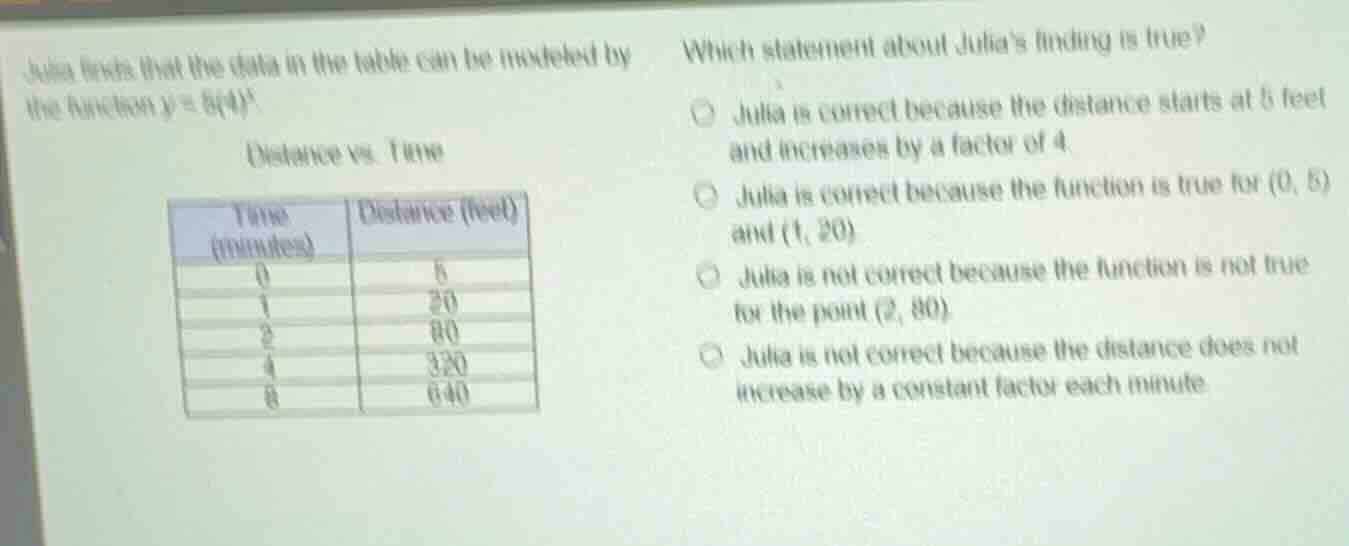
julia finds that the data in the table can be modeled by the function \\(y = 5(4)^x\\).
distance vs. time
\
which statement about julias finding is true?
- julia is correct because the distance starts at 5 feet and increases by a factor of 4.
- julia is correct because the function is true for \\((0, 5)\\) and \\((1, 20)\\).
- julia is not correct because the function is not true for the point \\((2, 80)\\).
- julia is not correct because the distance does not increase by a constant factor each minute.
Evaluate the proposed function at given data points
Using the Exponential Modeling knowledge point
Let the proposed function be \(y = 5(4)^x\), where \(x\) represents time in minutes and \(y\) represents distance in feet. We evaluate this function for the values of \(x\) given in the table:
- For \(x = 0\): \(y = 5(4)^0 = 5(1) = 5\). The table shows \(y = 5\).
- For \(x = 1\): \(y = 5(4)^1 = 20\). The table shows \(y = 20\).
- For \(x = 2\): \(y = 5(4)^2 = 5(16) = 80\). The table shows \(y = 80\).
- For \(x = 4\): \(y = 5(4)^4 = 5(256) = 1280\). The table shows \(y = 320\).
- For \(x = 8\): \(y = 5(4)^8 = 5(65536) = 327680\). The table shows \(y = 640\).
Analyze the rate of change in the table
We examine the relationship between the time intervals and the distance values in the table:
- From \(x = 0\) to \(x = 1\) (interval of \(1\) minute): distance increases from \(5\) to \(20\) (multiplied by \(4\)).
- From \(x = 1\) to \(x = 2\) (interval of \(1\) minute): distance increases from \(20\) to \(80\) (multiplied by \(4\)).
- From \(x = 2\) to \(x = 4\) (interval of \(2\) minutes): distance increases from \(80\) to \(320\) (multiplied by \(4\)).
- From \(x = 4\) to \(x = 8\) (interval of \(4\) minutes): distance increases from \(320\) to \(640\) (multiplied by \(2\)).
Since the time intervals in the left column are not uniform (\(1, 1, 2, 4\)), the distance does not increase by a constant factor of \(4\) each minute. Specifically, between minutes \(2\) and \(4\), and minutes \(4\) and \(8\), the growth rate per minute changes. Therefore, the data cannot be modeled by the single exponential function \(y = 5(4)^x\).
Match with the correct statement
The fourth option states: "Julia is not correct because the distance does not increase by a constant factor each minute." This matches our analysis that the exponential model is incorrect because the constant growth factor per unit time does not hold across the entire dataset.

Snap & solve any problem in the app
Get step-by-step solutions on Sovi AI
Photo-based solutions with guided steps
Explore more problems and detailed explanations
- Julia is correct because the distance starts at 5 feet and increases by a factor of 4
- Julia is correct because the function is true for (0, 5) and (1, 20)
- Julia is not correct because the function is not true for the point (2, 80)
- Julia is not correct because the distance does not increase by a constant factor each minute (Correct answer)