QUESTION IMAGE
Question
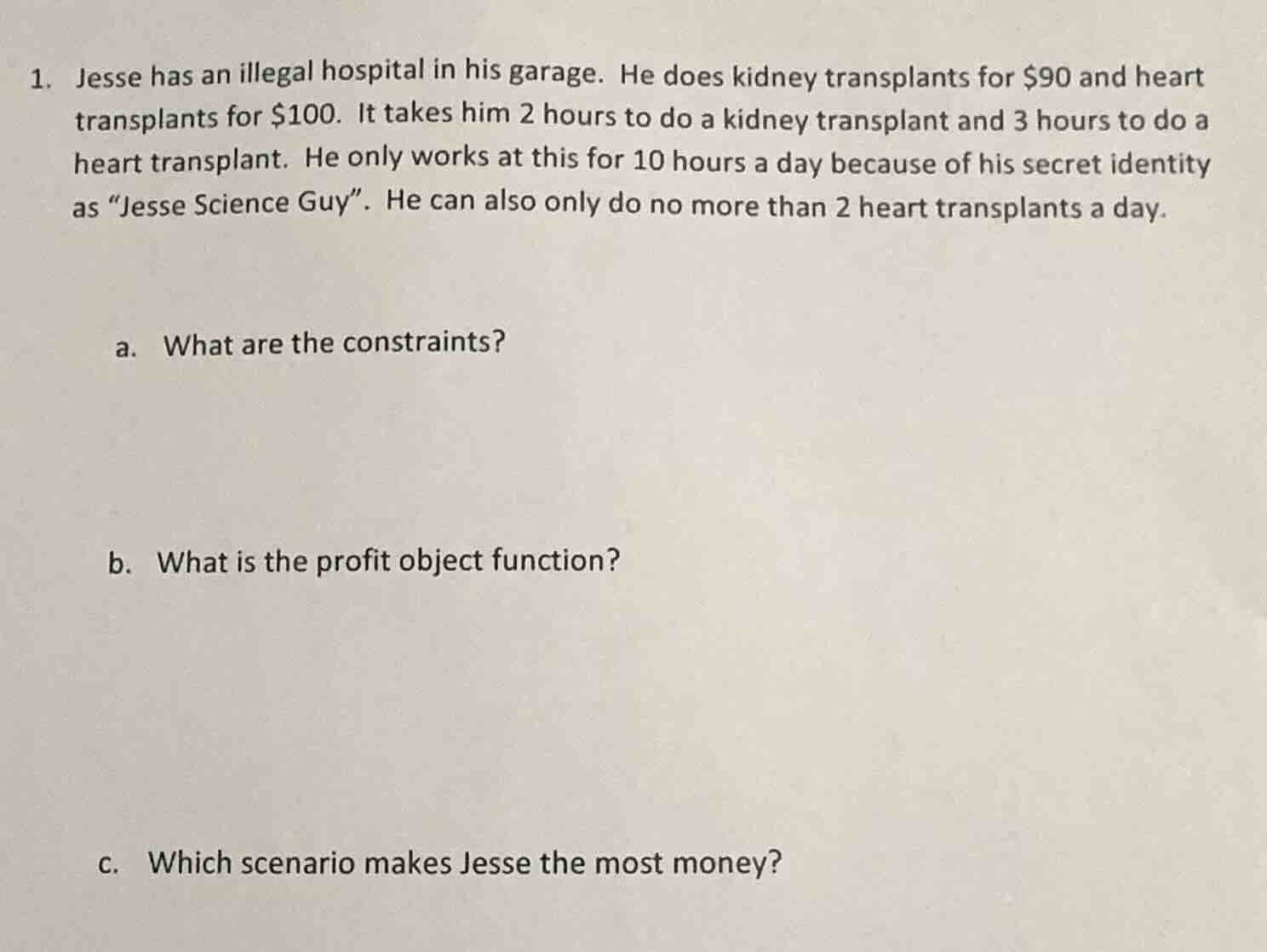
- jesse has an illegal hospital in his garage. he does kidney transplants for $90 and heart transplants for $100. it takes him 2 hours to do a kidney transplant and 3 hours to do a heart transplant. he only works at this for 10 hours a day because of his secret identity as \jesse science guy\. he can also only do no more than 2 heart transplants a day.
a. what are the constraints?
b. what is the profit object function?
c. which scenario makes jesse the most money?
Part a: Constraints
Let \( x \) be the number of kidney transplants and \( y \) be the number of heart transplants.
Step 1: Non - negativity constraint
Since the number of transplants cannot be negative, we have:
\( x\geq0 \), \( y\geq0 \) (and \( x,y \) are integers as they represent the number of transplants)
Step 2: Time constraint
Each kidney transplant takes 2 hours and each heart transplant takes 3 hours, and the total working time per day is 10 hours. So:
\( 2x + 3y\leq10 \)
Step 3: Heart transplant limit constraint
He can do no more than 2 heart transplants a day:
\( y\leq2 \)
Part b: Profit objective function
The profit from each kidney transplant is $90 and from each heart transplant is $100. Let \( P \) be the total profit. Then the profit function is:
\( P = 90x+100y \)
Part c: Optimal scenario
We need to find the integer values of \( x \) and \( y \) that satisfy the constraints \( x\geq0,y\geq0,2x + 3y\leq10,y\leq2 \) and maximize \( P = 90x + 100y \).
Step 1: Analyze possible values of \( y \)
Since \( y\leq2 \) and \( y\geq0 \), we consider \( y = 0,1,2 \).
- Case 1: \( y = 0 \)
Substitute \( y = 0 \) into the time constraint \( 2x+3(0)\leq10\Rightarrow2x\leq10\Rightarrow x\leq5 \).
Profit \( P=90x + 100(0)=90x \). When \( x = 5 \), \( P=90\times5=450 \).
- Case 2: \( y = 1 \)
Substitute \( y = 1 \) into the time constraint \( 2x+3(1)\leq10\Rightarrow2x\leq7\Rightarrow x\leq3.5 \). Since \( x \) is an integer, \( x = 3 \).
Profit \( P=90\times3+100\times1=270 + 100=370 \). (If \( x = 3 \), \( 2\times3+3\times1=9\leq10 \); if \( x = 4 \), \( 2\times4 + 3\times1=11>10 \), so \( x = 3 \) is the maximum for \( y = 1 \))
- Case 3: \( y = 2 \)
Substitute \( y = 2 \) into the time constraint \( 2x+3(2)\leq10\Rightarrow2x+6\leq10\Rightarrow2x\leq4\Rightarrow x\leq2 \).
Profit \( P=90x+100\times2=90x + 200 \). When \( x = 2 \), \( P=90\times2+200=180 + 200=380 \). (If \( x = 2 \), \( 2\times2+3\times2=4 + 6=10\leq10 \))
Comparing the profits from each case: \( 450>380>370 \). So the scenario where \( x = 5 \) (5 kidney transplants) and \( y = 0 \) (0 heart transplants) gives the maximum profit.
Final Answers
a. Constraints
- \( x\geq0,y\geq0 \) ( \( x,y \) are non - negative integers)
- \( 2x + 3y\leq10 \)
- \( y\leq2 \)
b. Profit function
\( P = 90x + 100y \)
c. Optimal scenario
The scenario with \( x = 5 \) kidney transplants and \( y = 0 \) heart transplants (or \( x = 2 \) kidney transplants and \( y = 2 \) heart transplants? Wait, no, in case \( y = 2 \), \( x = 2 \) gives \( P = 380 \), but when \( y = 0 \), \( x = 5 \) gives \( P = 450 \); wait, let's re - check the time constraint for \( y = 2 \) and \( x = 2 \): \( 2\times2+3\times2=4 + 6 = 10 \), which is within the time limit. But when \( y = 0 \), \( x = 5 \): \( 2\times5+3\times0 = 10 \), also within the time limit. And \( 90\times5=450 \) is greater than \( 90\times2+100\times2=180 + 200 = 380 \). Wait, I made a mistake earlier. When \( y = 2 \), \( 2x+3\times2\leq10\Rightarrow2x\leq4\Rightarrow x\leq2 \). So \( x = 2 \), \( y = 2 \): \( P=90\times2 + 100\times2=180 + 200 = 380 \). When \( y = 0 \), \( x = 5 \): \( P = 450 \). When \( y = 1 \), \( x = 3 \): \( P=270+100 = 370 \). Wait, but also, when \( y = 2 \), can \( x = 2 \), and when \( y = 2 \), is there a better \( x \)? No, because \( 2x\leq4\Rightarrow x\leq2 \). But wait, let's check another possibility. If \( y = 2 \), \( 2x+3y = 2x + 6\leq10\Rightarrow2x\leq4\Rightarrow x\leq2 \). But what if we take \( y = 2 \) and \( x = 2 \), prof…

Snap & solve any problem in the app
Get step-by-step solutions on Sovi AI
Photo-based solutions with guided steps
Explore more problems and detailed explanations
Part a: Constraints
Let \( x \) be the number of kidney transplants and \( y \) be the number of heart transplants.
Step 1: Non - negativity constraint
Since the number of transplants cannot be negative, we have:
\( x\geq0 \), \( y\geq0 \) (and \( x,y \) are integers as they represent the number of transplants)
Step 2: Time constraint
Each kidney transplant takes 2 hours and each heart transplant takes 3 hours, and the total working time per day is 10 hours. So:
\( 2x + 3y\leq10 \)
Step 3: Heart transplant limit constraint
He can do no more than 2 heart transplants a day:
\( y\leq2 \)
Part b: Profit objective function
The profit from each kidney transplant is $90 and from each heart transplant is $100. Let \( P \) be the total profit. Then the profit function is:
\( P = 90x+100y \)
Part c: Optimal scenario
We need to find the integer values of \( x \) and \( y \) that satisfy the constraints \( x\geq0,y\geq0,2x + 3y\leq10,y\leq2 \) and maximize \( P = 90x + 100y \).
Step 1: Analyze possible values of \( y \)
Since \( y\leq2 \) and \( y\geq0 \), we consider \( y = 0,1,2 \).
- Case 1: \( y = 0 \)
Substitute \( y = 0 \) into the time constraint \( 2x+3(0)\leq10\Rightarrow2x\leq10\Rightarrow x\leq5 \).
Profit \( P=90x + 100(0)=90x \). When \( x = 5 \), \( P=90\times5=450 \).
- Case 2: \( y = 1 \)
Substitute \( y = 1 \) into the time constraint \( 2x+3(1)\leq10\Rightarrow2x\leq7\Rightarrow x\leq3.5 \). Since \( x \) is an integer, \( x = 3 \).
Profit \( P=90\times3+100\times1=270 + 100=370 \). (If \( x = 3 \), \( 2\times3+3\times1=9\leq10 \); if \( x = 4 \), \( 2\times4 + 3\times1=11>10 \), so \( x = 3 \) is the maximum for \( y = 1 \))
- Case 3: \( y = 2 \)
Substitute \( y = 2 \) into the time constraint \( 2x+3(2)\leq10\Rightarrow2x+6\leq10\Rightarrow2x\leq4\Rightarrow x\leq2 \).
Profit \( P=90x+100\times2=90x + 200 \). When \( x = 2 \), \( P=90\times2+200=180 + 200=380 \). (If \( x = 2 \), \( 2\times2+3\times2=4 + 6=10\leq10 \))
Comparing the profits from each case: \( 450>380>370 \). So the scenario where \( x = 5 \) (5 kidney transplants) and \( y = 0 \) (0 heart transplants) gives the maximum profit.
Final Answers
a. Constraints
- \( x\geq0,y\geq0 \) ( \( x,y \) are non - negative integers)
- \( 2x + 3y\leq10 \)
- \( y\leq2 \)
b. Profit function
\( P = 90x + 100y \)
c. Optimal scenario
The scenario with \( x = 5 \) kidney transplants and \( y = 0 \) heart transplants (or \( x = 2 \) kidney transplants and \( y = 2 \) heart transplants? Wait, no, in case \( y = 2 \), \( x = 2 \) gives \( P = 380 \), but when \( y = 0 \), \( x = 5 \) gives \( P = 450 \); wait, let's re - check the time constraint for \( y = 2 \) and \( x = 2 \): \( 2\times2+3\times2=4 + 6 = 10 \), which is within the time limit. But when \( y = 0 \), \( x = 5 \): \( 2\times5+3\times0 = 10 \), also within the time limit. And \( 90\times5=450 \) is greater than \( 90\times2+100\times2=180 + 200 = 380 \). Wait, I made a mistake earlier. When \( y = 2 \), \( 2x+3\times2\leq10\Rightarrow2x\leq4\Rightarrow x\leq2 \). So \( x = 2 \), \( y = 2 \): \( P=90\times2 + 100\times2=180 + 200 = 380 \). When \( y = 0 \), \( x = 5 \): \( P = 450 \). When \( y = 1 \), \( x = 3 \): \( P=270+100 = 370 \). Wait, but also, when \( y = 2 \), can \( x = 2 \), and when \( y = 2 \), is there a better \( x \)? No, because \( 2x\leq4\Rightarrow x\leq2 \). But wait, let's check another possibility. If \( y = 2 \), \( 2x+3y = 2x + 6\leq10\Rightarrow2x\leq4\Rightarrow x\leq2 \). But what if we take \( y = 2 \) and \( x = 2 \), profit is 380. If \( y = 1 \), \( x = 3 \), profit is 370. If \( y = 0 \), \( x = 5 \), profit is 450. But wait, is there a case where \( y = 2 \) and \( x = 2 \), or \( y = 1 \) and \( x = 3 \), or \( y = 0 \) and \( x = 5 \). But also, let's check \( y = 2 \), \( x = 2 \): total time 10 hours. \( y = 0 \), \( x = 5 \): total time 10 hours. Now, let's check if there are other integer solutions. For example, when \( y = 2 \), \( x = 2 \): profit 380. When \( y = 1 \), \( x = 3 \): profit 370. When \( y = 0 \), \( x = 5 \): profit 450. But wait, another case: when \( y = 2 \), \( x = 2 \); when \( y = 2 \), \( x = 1 \): \( P=90\times1+100\times2=290 \), which is less than 380. When \( y = 2 \), \( x = 0 \): \( P = 200 \). When \( y = 1 \), \( x = 4 \): \( 2\times4+3\times1=11>10 \), which is not allowed. When \( y = 0 \), \( x = 5 \): profit 450. But wait, let's check the time constraint again for \( y = 0 \), \( x = 5 \): \( 2\times5=10 \), which is equal to the total time. For \( y = 2 \), \( x = 2 \): \( 2\times2 + 3\times2=10 \), also equal to the total time. Now, the profit for \( y = 0 \), \( x = 5 \) is 450, for \( y = 2 \), \( x = 2 \) is 380. So the maximum profit is when \( x = 5 \) and \( y = 0 \). Wait, but let's check the profit per hour. Kidney transplant: $90 per 2 hours = $45 per hour. Heart transplant: $100 per 3 hours≈$33.33 per hour. So it's more profitable to do kidney transplants. So we should maximize the number of kidney transplants. Since kidney transplants take less time per dollar of profit, we want to do as many kidney transplants as possible. When \( y = 0 \), we can do 5 kidney transplants (25 = 10 hours), which gives a profit of 905 = 450. If we do 2 heart transplants (taking 6 hours), we have 4 hours left for kidney transplants, which is 2 kidney transplants (22 = 4 hours), so profit is 1002+902 = 200 + 180 = 380, which is less than 450. If we do 1 heart transplant (3 hours), we have 7 hours left for kidney transplants, which is 3 kidney transplants (23 = 6 hours, with 1 hour left unused), profit is 100 + 270 = 370, less than 450. So the best scenario is 5 kidney transplants and 0 heart transplants.
Final Answers
a. The constraints are \( x\geq0,y\geq0 \) ( \( x,y \) are integers), \( 2x + 3y\leq10 \), and \( y\leq2 \).
b. The profit function is \( P = 90x + 100y \).
c. The scenario that makes Jesse the most money is doing 5 kidney transplants and 0 heart transplants (or in boxed form for the profit - but the question asks for the scenario, so the number of transplants: 5 kidney transplants and 0 heart transplants).