QUESTION IMAGE
Question
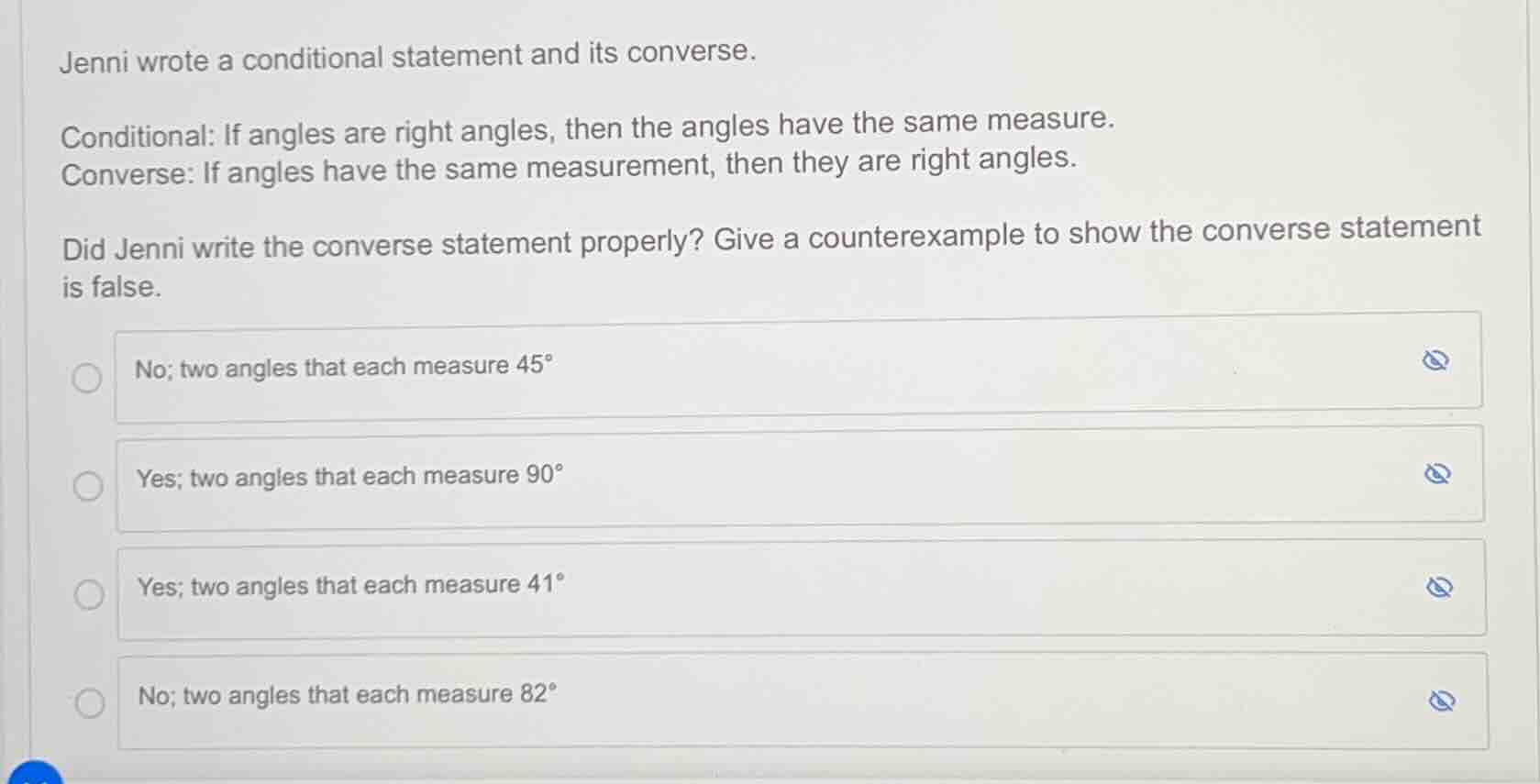
jenni wrote a conditional statement and its converse.
conditional: if angles are right angles, then the angles have the same measure.
converse: if angles have the same measurement, then they are right angles.
did jenni write the converse statement properly? give a counterexample to show the converse statement is false.
no; two angles that each measure \\(45^\circ\\)
yes; two angles that each measure \\(90^\circ\\)
yes; two angles that each measure \\(41^\circ\\)
no; two angles that each measure \\(82^\circ\\)
Analyze the converse statement
The original conditional statement is: "If angles are right angles, then the angles have the same measure."
The converse statement written by Jenni is: "If angles have the same measurement, then they are right angles."
We need to evaluate if Jenni wrote the converse statement properly.
Using Converse Statement and Conditional Logic, the converse of a statement "If \(P\), then \(Q\)" is "If \(Q\), then \(P\)".
Jenni correctly swapped the hypothesis and conclusion, so she did write the converse statement properly. Thus, the answer to the first question must be "Yes".
Find a counterexample
The second part of the prompt asks for a counterexample to show that the converse statement is false.
Using Counterexample, a counterexample must satisfy the hypothesis of the converse statement (the angles have the same measurement) but violate the conclusion (they are not right angles).
Let's evaluate the options:
- "two angles that each measure \(45^\circ\)": These angles have the same measure (satisfies hypothesis) but are not right angles (violates conclusion). This is a valid counterexample.
- "two angles that each measure \(90^\circ\)": These are right angles, so they do not disprove the statement.
- "two angles that each measure \(41^\circ\)": These have the same measure and are not right angles, which is a valid counterexample.
Match with the given options
We look at the choices that start with "Yes" (since she wrote the converse properly) and provide a valid counterexample:
- "Yes; two angles that each measure \(90^\circ\)" (Incorrect counterexample)
- "Yes; two angles that each measure \(41^\circ\)" (Correct converse and valid counterexample)
Therefore, the correct option is the third one.

Snap & solve any problem in the app
Get step-by-step solutions on Sovi AI
Photo-based solutions with guided steps
Explore more problems and detailed explanations
- No; two angles that each measure \(45^\circ\)
- Yes; two angles that each measure \(90^\circ\)
- Yes; two angles that each measure \(41^\circ\) (Correct answer)
- No; two angles that each measure \(82^\circ\)