Sovi.AI - AI Math Tutor

Scan to solve math questions

QUESTION IMAGE

james has a job analyzing page layouts. he often needs to measure the s…

Question

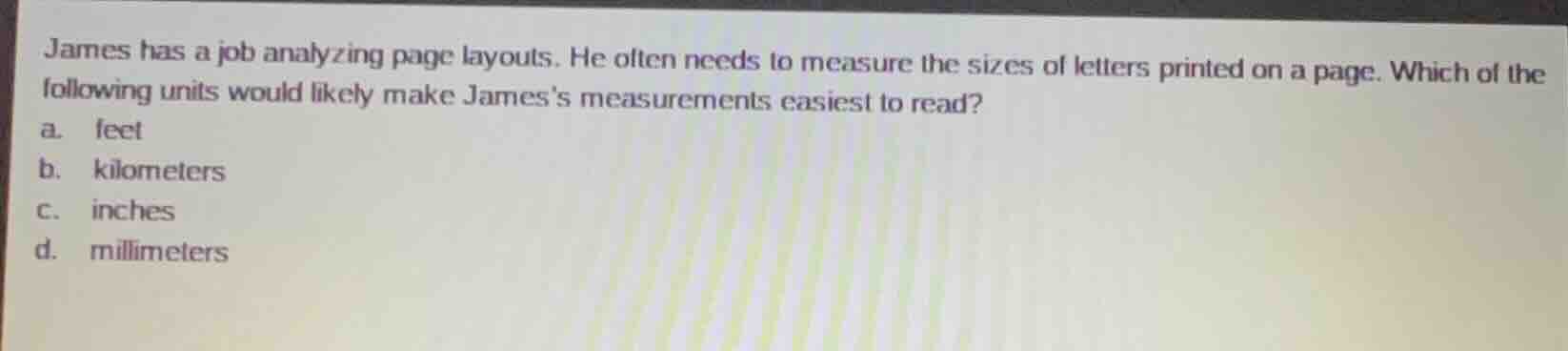
james has a job analyzing page layouts. he often needs to measure the sizes of letters printed on a page. which of the following units would likely make jamess measurements easiest to read?
a. feet
b. kilometers
c. inches
d. millimeters

Explanation:

Response

<pre_analysis>
{
"quality": "clear",
"question_count": 1,
"skills_matched": [
"direct_cot",
"multiple_choice_formatter",
"explain_then_answer",
"quick"
],
"needs_drawing": false,
"concepts_used": [],
"new_concepts": [
"Measurement Scale",
"Appropriate Units"
],
"current_concepts": [
"Measurement Scale",
"Appropriate Units"
]
}
</pre_analysis>

<reasoning>

Analyze the scale of the object being measured

The object to be measured is the size of printed letters on a page. Printed letters are extremely small, typically measuring only a few millimeters in height or width.

Evaluate the given unit options

  • feet: Too large. A letter would be a tiny fraction of a foot (e.g., \(0.01\text{ ft}\)), which is hard to read.
  • kilometers: Extremely large. Used for geographic distances, completely impractical for page layouts.
  • inches: Still too large. A standard letter is usually less than \(0.1\text{ inches}\) tall, leading to awkward decimal values.
  • millimeters: Highly appropriate. A typical printed letter is about \(2\text{ to }4\text{ mm}\) tall, which gives clean, easy-to-read whole numbers.

</reasoning>

<answer>
<mcq-option>a. feet</mcq-option>
<mcq-option>b. kilometers</mcq-option>
<mcq-option>c. inches</mcq-option>
<mcq-correct>d. millimeters</mcq-correct>
</answer>

<post_analysis>
{
"subject": "Mathematics",
"question_type": "Multiple Choice",
"knowledge_point": [
"Mathematics",
"Geometry",
"Measurement Scale"
]
}
</post_analysis>

Answer:

<pre_analysis>
{
"quality": "clear",
"question_count": 1,
"skills_matched": [
"direct_cot",
"multiple_choice_formatter",
"explain_then_answer",
"quick"
],
"needs_drawing": false,
"concepts_used": [],
"new_concepts": [
"Measurement Scale",
"Appropriate Units"
],
"current_concepts": [
"Measurement Scale",
"Appropriate Units"
]
}
</pre_analysis>

<reasoning>

Analyze the scale of the object being measured

The object to be measured is the size of printed letters on a page. Printed letters are extremely small, typically measuring only a few millimeters in height or width.

Evaluate the given unit options

  • feet: Too large. A letter would be a tiny fraction of a foot (e.g., \(0.01\text{ ft}\)), which is hard to read.
  • kilometers: Extremely large. Used for geographic distances, completely impractical for page layouts.
  • inches: Still too large. A standard letter is usually less than \(0.1\text{ inches}\) tall, leading to awkward decimal values.
  • millimeters: Highly appropriate. A typical printed letter is about \(2\text{ to }4\text{ mm}\) tall, which gives clean, easy-to-read whole numbers.

</reasoning>

<answer>
<mcq-option>a. feet</mcq-option>
<mcq-option>b. kilometers</mcq-option>
<mcq-option>c. inches</mcq-option>
<mcq-correct>d. millimeters</mcq-correct>
</answer>

<post_analysis>
{
"subject": "Mathematics",
"question_type": "Multiple Choice",
"knowledge_point": [
"Mathematics",
"Geometry",
"Measurement Scale"
]
}
</post_analysis>