QUESTION IMAGE
Question
ip: graphing linear equations
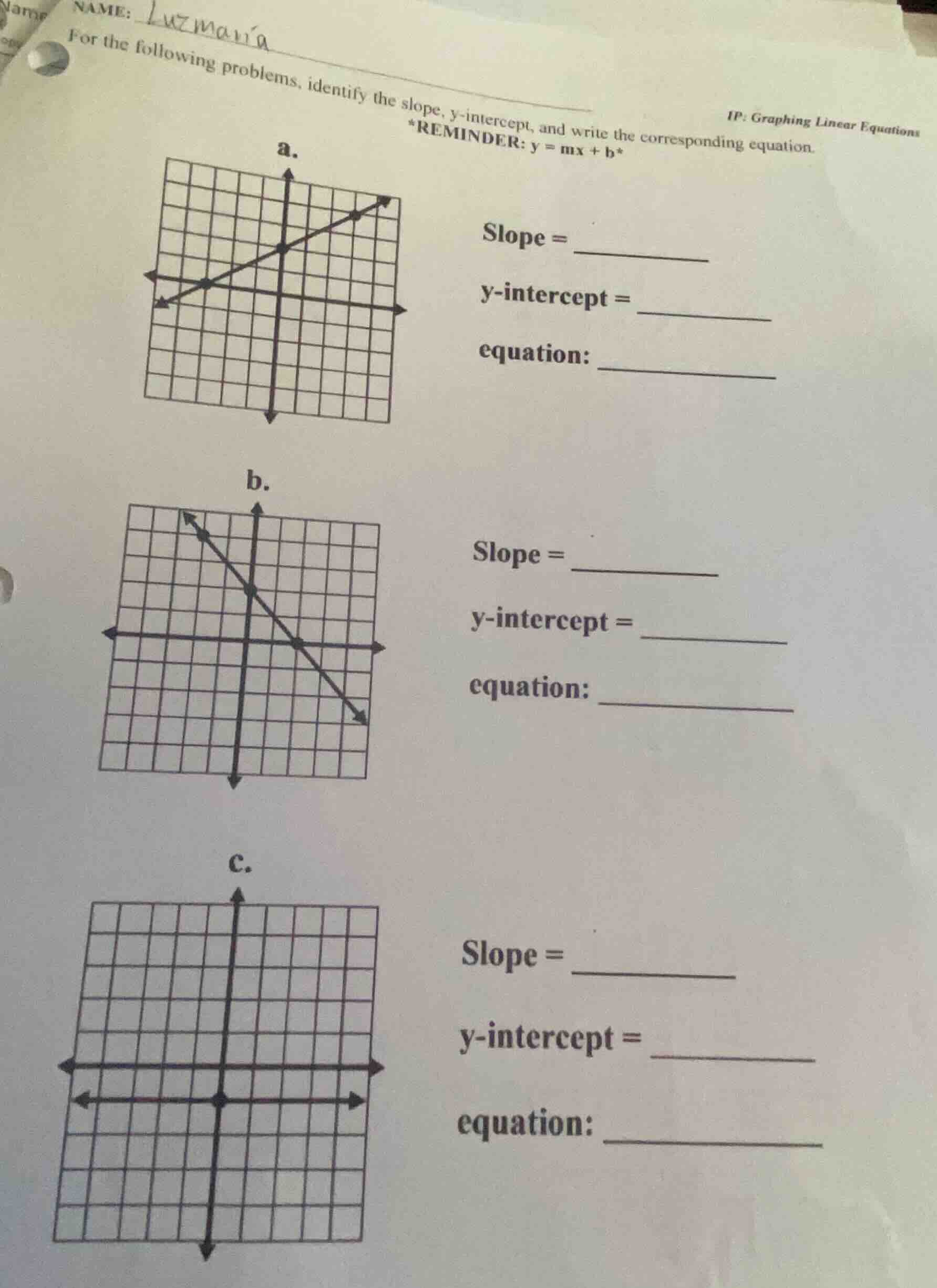
for the following problems, identify the slope, y-intercept, and write the corresponding equation.
reminder: \\(y = mx + b\\)
a.
slope = _______
y-intercept = _______
equation: _______
b.
slope = _______
y-intercept = _______
equation: _______
c.
slope = _______
y-intercept = _______
equation: _______
Identify y-intercepts from the graphs
For each graph, we locate where the line crosses the vertical y-axis to find the y-intercept \(b\).
- For graph a, the line crosses the y-axis at \(2\) units above the origin. Thus, the y-intercept is \(2\) (or as a point, \((0, 2)\)).
- For graph b, the line crosses the y-axis at \(1\) unit above the origin. Thus, the y-intercept is \(1\) (or as a point, \((0, 1)\)).
- For graph c, the line is horizontal and lies exactly on the x-axis, crossing the y-axis at the origin \(0\). Thus, the y-intercept is \(0\) (or as a point, \((0, 0)\)).
Calculate slopes from the graphs
We find the slope \(m = \frac{\text{rise}}{\text{run}}\) by identifying two points with integer coordinates on each line.
- For graph a, the line passes through \((0, 2)\) and \((2, 3)\).
- For graph b, the line passes through \((0, 1)\) and \((1, -1)\).
- For graph c, the line is horizontal. Any two points, such as \((0, 0)\) and \((1, 0)\), give:
Write the corresponding linear equations
Using the slope-intercept form \(y = mx + b\), we substitute the slope \(m\) and y-intercept \(b\) for each line.
- For graph a:
Using Linear Equation Solving principles:
- For graph b:
- For graph c:

Snap & solve any problem in the app
Get step-by-step solutions on Sovi AI
Photo-based solutions with guided steps
Explore more problems and detailed explanations
Question a
Slope = <blank>\(\frac{1}{2}\)</blank>
y-intercept = <blank>\(2\)</blank>
equation: <blank>\(y = \frac{1}{2}x + 2\)</blank>
Question b
Slope = <blank>\(-2\)</blank>
y-intercept = <blank>\(1\)</blank>
equation: <blank>\(y = -2x + 1\)</blank>
Question c
Slope = <blank>\(0\)</blank>
y-intercept = <blank>\(0\)</blank>
equation: <blank>\(y = 0\)</blank>