QUESTION IMAGE
Question
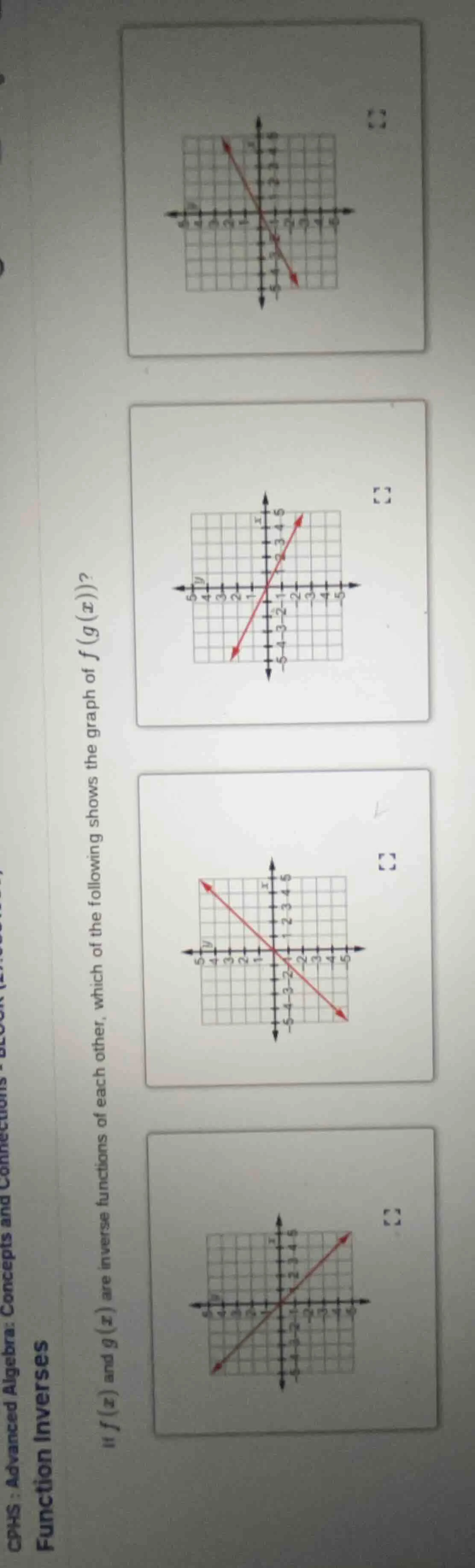
if ( f(x) ) and ( g(x) ) are inverse functions of each other, which of the following shows the graph of ( f(g(x)) )?
To solve the problem of identifying the graph of \( f(g(x)) \) when \( f(x) \) and \( g(x) \) are inverse functions, we use the property of inverse functions: if \( f \) and \( g \) are inverses, then \( f(g(x)) = x \) and \( g(f(x)) = x \). This means the composition \( f(g(x)) \) should be the identity function \( y = x \), whose graph is a straight line with a slope of 1 passing through the origin.
Step 1: Recall the property of inverse functions
If \( f(x) \) and \( g(x) \) are inverse functions, then \( f(g(x)) = x \) for all \( x \) in the domain of \( g \), and \( g(f(x)) = x \) for all \( x \) in the domain of \( f \). The function \( y = x \) is a linear function with a slope of 1 and a y-intercept of 0.
Step 2: Analyze the graphs
We need to find the graph that represents the line \( y = x \). A line with a slope of 1 (rising 1 unit for every 1 unit it runs) and passing through the origin (0,0) is the identity function.
Looking at the given graphs, we identify the one with a slope of 1 and passing through the origin. This graph will be the one where the line has a 45-degree angle with both the x-axis and y-axis, passing through (0,0), (1,1), (-1,-1), etc.
Step 3: Identify the correct graph
Among the provided options, the graph that matches \( y = x \) (slope 1, passing through the origin) is the one that represents \( f(g(x)) \) since \( f(g(x)) = x \) when \( f \) and \( g \) are inverses.

Snap & solve any problem in the app
Get step-by-step solutions on Sovi AI
Photo-based solutions with guided steps
Explore more problems and detailed explanations
The graph representing \( f(g(x)) \) is the one with the line \( y = x \) (slope 1, passing through the origin). Typically, this is a line with a 45° angle, passing through points like (0,0), (1,1), (-1,-1), etc. (Identify the specific graph from the options that matches this description, e.g., if one of the graphs is the line \( y = x \), that is the answer.)