QUESTION IMAGE
Question
introduction
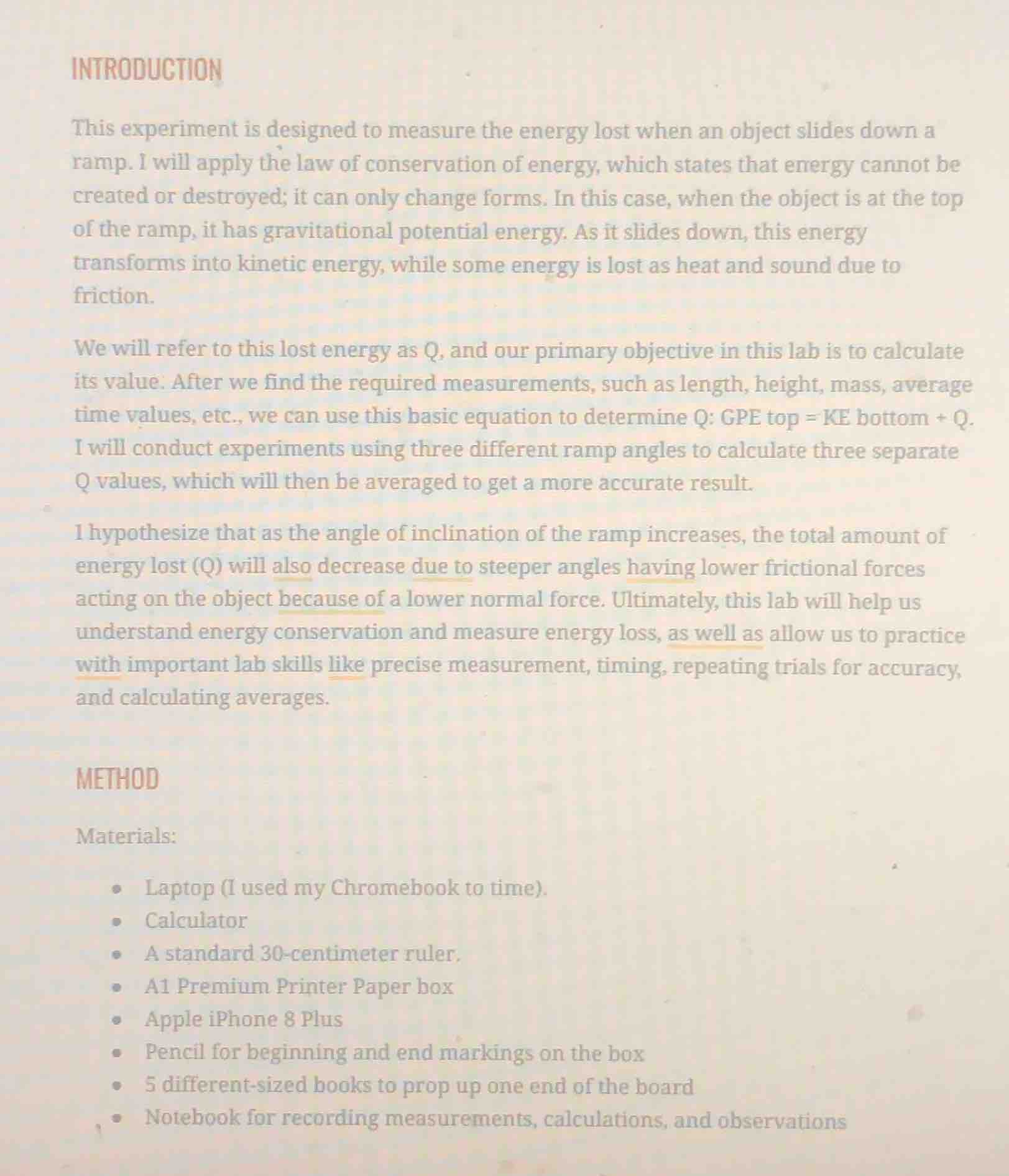
this experiment is designed to measure the energy lost when an object slides down a ramp. i will apply the law of conservation of energy, which states that energy cannot be created or destroyed; it can only change forms. in this case, when the object is at the top of the ramp, it has gravitational potential energy. as it slides down, this energy transforms into kinetic energy, while some energy is lost as heat and sound due to friction.
we will refer to this lost energy as q, and our primary objective in this lab is to calculate its value. after we find the required measurements, such as length, height, mass, average time values, etc., we can use this basic equation to determine q: gpe top = ke bottom + q. i will conduct experiments using three different ramp angles to calculate three separate q values, which will then be averaged to get a more accurate result.
i hypothesize that as the angle of inclination of the ramp increases, the total amount of energy lost (q) will also decrease due to steeper angles having lower frictional forces acting on the object because of a lower normal force. ultimately, this lab will help us understand energy conservation and measure energy loss, as well as allow us to practice with important lab skills like precise measurement, timing, repeating trials for accuracy, and calculating averages.
method
materials:
- laptop (i used my chromebook to time).
- calculator
- a standard 30-centimeter ruler.
- a1 premium printer paper box
- apple iphone 8 plus
- pencil for beginning and end markings on the box
- 5 different-sized books to prop up one end of the board
- notebook for recording measurements, calculations, and observations
Identify the core objective of the experiment
Using the Conservation of Energy knowledge point
- The experiment aims to measure the energy lost as heat and sound due to friction, denoted as \(Q\), when an object slides down a ramp.
- The governing equation is:
Analyze the student's hypothesis
Using the Conservation of Energy knowledge point
- The hypothesis states that as the angle of inclination of the ramp increases, the total energy lost (\(Q\)) decreases.
- This is because a steeper angle results in a lower normal force (\(F_N = mg \cos\theta\)), which in turn reduces the frictional force (\(f_k = \mu_k F_N\)).
Summarize the experimental method and materials
- The method involves measuring physical parameters (length, height, mass, time) across three different ramp angles.
- Materials listed include a laptop (Chromebook) for timing, a calculator, a 30-cm ruler, a paper box, an iPhone, a pencil, books for propping the board, and a notebook.

Snap & solve any problem in the app
Get step-by-step solutions on Sovi AI
Photo-based solutions with guided steps
Explore more problems and detailed explanations
Based on the provided lab introduction and method, here is the analysis of the experiment:
- Objective: To measure and calculate the energy lost due to friction (\(Q\)) as an object slides down a ramp using the conservation of energy equation:
- Hypothesis: A steeper ramp angle (greater inclination) will result in less energy lost (\(Q\)) because a larger angle reduces the normal force, thereby decreasing the frictional force acting on the sliding object.
- Setup: The experiment uses books to adjust the ramp angle and a variety of standard tools (ruler, laptop/phone for timing, notebook) to record the mass, height, length, and travel time of the sliding object.