QUESTION IMAGE
Question
introduction to economic
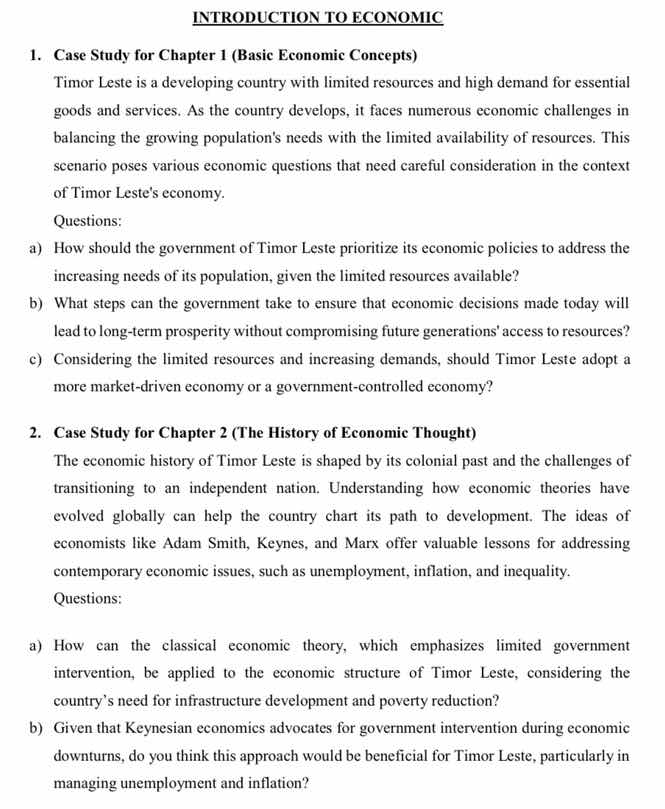
- case study for chapter 1 (basic economic concepts)
timor leste is a developing country with limited resources and high demand for essential goods and services. as the country develops, it faces numerous economic challenges in balancing the growing populations needs with the limited availability of resources. this scenario poses various economic questions that need careful consideration in the context of timor lestes economy.
questions:
a) how should the government of timor leste prioritize its economic policies to address the increasing needs of its population, given the limited resources available?
b) what steps can the government take to ensure that economic decisions made today will lead to long-term prosperity without compromising future generations access to resources?
c) considering the limited resources and increasing demands, should timor leste adopt a more market-driven economy or a government-controlled economy?
- case study for chapter 2 (the history of economic thought)
the economic history of timor leste is shaped by its colonial past and the challenges of transitioning to an independent nation. understanding how economic theories have evolved globally can help the country chart its path to development. the ideas of economists like adam smith, keynes, and marx offer valuable lessons for addressing contemporary economic issues, such as unemployment, inflation, and inequality.
questions:
a) how can the classical economic theory, which emphasizes limited government intervention, be applied to the economic structure of timor leste, considering the countrys need for infrastructure development and poverty reduction?
b) given that keynesian economics advocates for government intervention during economic downturns, do you think this approach would be beneficial for timor leste, particularly in managing unemployment and inflation?
Analyze Case Study 1: Basic Economic Concepts
- 1a (Resource Allocation): Prioritize investment in human capital (education, healthcare) and basic infrastructure to maximize the productivity of limited resources.
- 1b (Sustainable Development): Establish a sovereign wealth fund (like the Petroleum Fund) to manage resource revenues, invest in renewable sectors, and enforce environmental regulations.
- 1c (Economic Systems): Adopt a mixed economic system that leverages market efficiencies for private sector growth while maintaining government intervention to provide public goods and social safety nets.
Analyze Case Study 2: History of Economic Thought
- 2a (Classical Theory): Apply classical principles by reducing regulatory barriers to encourage foreign direct investment and private enterprise, while keeping the state responsible for essential public infrastructure.
- 2b (Keynesian Economics): Implement countercyclical fiscal policies, such as public works programs funded by petroleum revenues, to stimulate demand, create jobs, and stabilize the economy during downturns.

Snap & solve any problem in the app
Get step-by-step solutions on Sovi AI
Photo-based solutions with guided steps
Explore more problems and detailed explanations
Question 1
a) Prioritizing Economic Policies
The government of Timor-Leste should prioritize investments in human capital (education, healthcare, and vocational training) and essential public infrastructure (water, electricity, and roads). This builds a productive workforce and lowers transaction costs, maximizing the utility of its limited resources.
b) Ensuring Long-Term Prosperity
The government can manage resource revenues through a transparent sovereign wealth fund (such as the existing Petroleum Fund) to save for future generations, while diversifying the economy into sustainable sectors like agriculture, eco-tourism, and renewable energy.
c) Market-Driven vs. Government-Controlled Economy
Timor-Leste should adopt a mixed economic system. This model utilizes market mechanisms to drive efficiency, innovation, and private sector growth, while retaining government oversight to manage natural resources, build infrastructure, and provide essential social safety nets.
---
Question 2
a) Applying Classical Economic Theory
Classical theory can be applied by streamlining business regulations, protecting property rights, and encouraging private investment to drive economic growth. However, because classical theory minimizes state intervention, the government must still play an active role in funding large-scale infrastructure and poverty reduction programs where private incentives are lacking.
b) Applying Keynesian Economics
Keynesian economics is highly beneficial for Timor-Leste. During economic downturns or periods of high unemployment, the government can use strategic public spending—funded by its sovereign wealth reserves—to build infrastructure, stimulate demand, create jobs, and stabilize macroeconomic fluctuations.