QUESTION IMAGE
Question
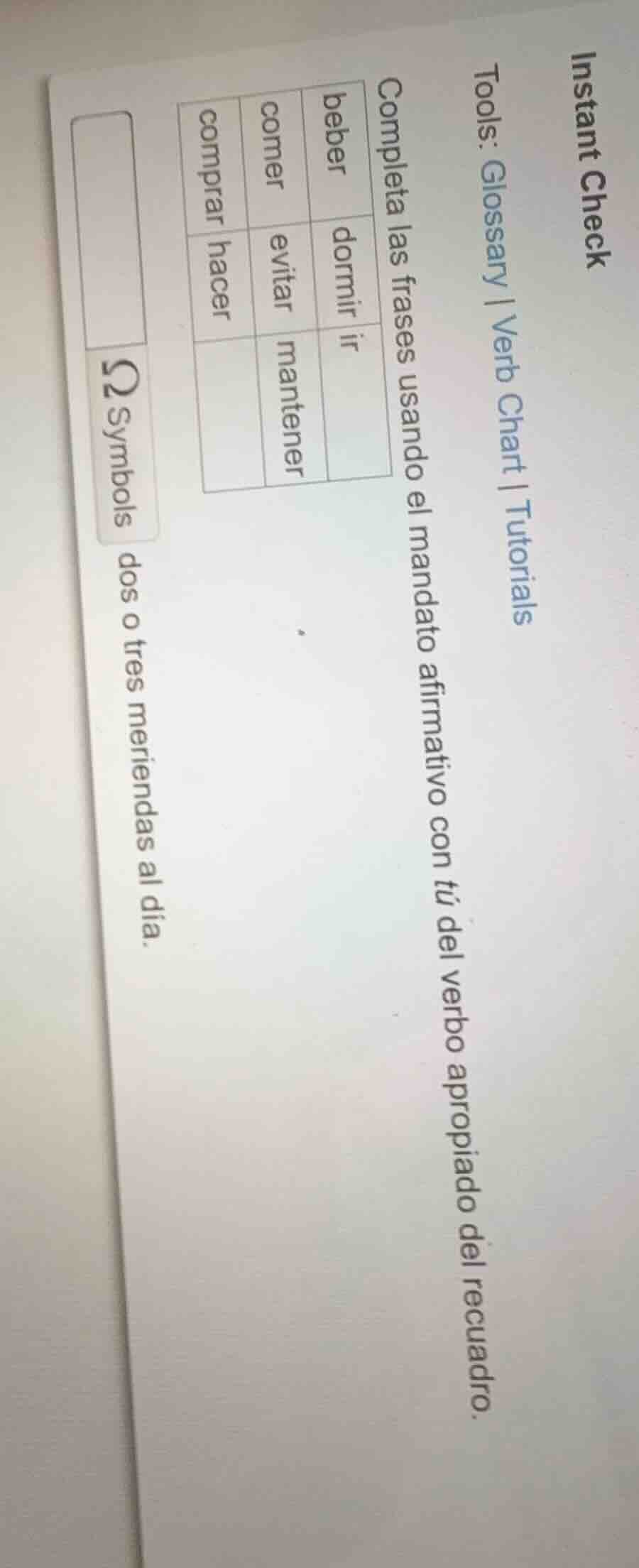
instant check tools: glossary | verb chart | tutorials completa las frases usando el mandato afirmativo con tú del verbo apropiado del recuadro. beber dormir ir comer evitar mantener comprar hacer ω symbols dos o tres meriendas al día.
The sentence is "dos o tres meriendas al día" and we need to choose a verb from the table to form a command (tú form, affirmative). The verb "comer" makes sense here as we are talking about having (eating) snacks. The tú command for "comer" is "come". Wait, but let's check the context. Wait, the task is to complete the phrase with the appropriate verb's tú affirmative command. Let's list the verbs: beber, dormir, ir, comer, evitar, mantener, comprar, hacer. The phrase is about having snacks, so "comer" (to eat) is appropriate. The tú affirmative command for "comer" is "Come" (since for -er verbs, the tú command is remove -er and add -e? Wait, no: "comer" is a regular -er verb. The tú command for regular -er verbs is: take the infinitive, remove -er, add -e. Wait, "comer" → "come" (tú command: Come dos o tres meriendas al día). Wait, but maybe "hacer"? No, "hacer meriendas" is to make snacks, but "comer meriendas" is to eat snacks. So the correct verb is "comer", and its tú command is "Come". Wait, but let's confirm the verb conjugation. For "comer", the tú affirmative command is "come" (from the verb chart: regular -er verbs: tú command is infinitive without -er + -e). So the phrase would be "Come dos o tres meriendas al día."

Snap & solve any problem in the app
Get step-by-step solutions on Sovi AI
Photo-based solutions with guided steps
Explore more problems and detailed explanations
Come dos o tres meriendas al día. (Using the verb "comer" in its tú affirmative command form "come")