QUESTION IMAGE
Question
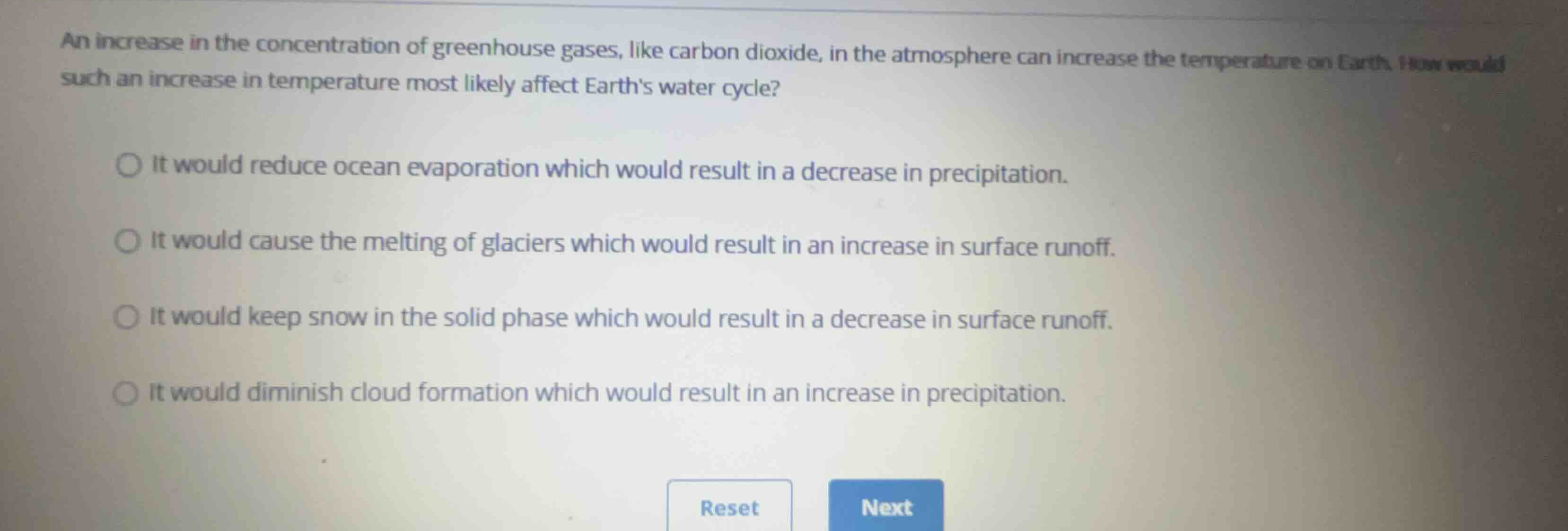
an increase in the concentration of greenhouse gases, like carbon dioxide, in the atmosphere can increase the temperature on earth. how would such an increase in temperature most likely affect earths water cycle?
it would reduce ocean evaporation which would result in a decrease in precipitation.
it would cause the melting of glaciers which would result in an increase in surface runoff.
it would keep snow in the solid phase which would result in a decrease in surface runoff.
it would diminish cloud formation which would result in an increase in precipitation.
Analyze the question prompt
The question asks how an increase in global temperature, caused by rising greenhouse gas concentrations, would most likely affect Earth's water cycle.
Evaluate the first option
The first option states: "It would reduce ocean evaporation which would result in a decrease in precipitation."
Higher temperatures increase the kinetic energy of water molecules, which leads to more evaporation, not less. Therefore, this option is incorrect.
Evaluate the second option
The second option states: "It would cause the melting of glaciers which would result in an increase in surface runoff."
Higher global temperatures cause solid ice in glaciers to melt into liquid water. This liquid water flows over the land surface as surface runoff into rivers, lakes, and oceans. This is a direct and scientifically accurate consequence of warming.
Evaluate the third option
The third option states: "It would keep snow in the solid phase which would result in a decrease in surface runoff."
Higher temperatures promote the melting of snow into liquid water rather than keeping it in the solid phase. Therefore, this option is incorrect.
Evaluate the fourth option
The fourth option states: "It would diminish cloud formation which would result in an increase in precipitation."
Increased evaporation generally leads to more water vapor in the atmosphere, which can increase cloud formation and precipitation. Furthermore, diminished cloud formation would not lead to an increase in precipitation. Therefore, this option is incorrect.

Snap & solve any problem in the app
Get step-by-step solutions on Sovi AI
Photo-based solutions with guided steps
Explore more problems and detailed explanations
- It would reduce ocean evaporation which would result in a decrease in precipitation.
- It would cause the melting of glaciers which would result in an increase in surface runoff. (Correct answer)
- It would keep snow in the solid phase which would result in a decrease in surface runoff.
- It would diminish cloud formation which would result in an increase in precipitation.