QUESTION IMAGE
Question
inclined planes
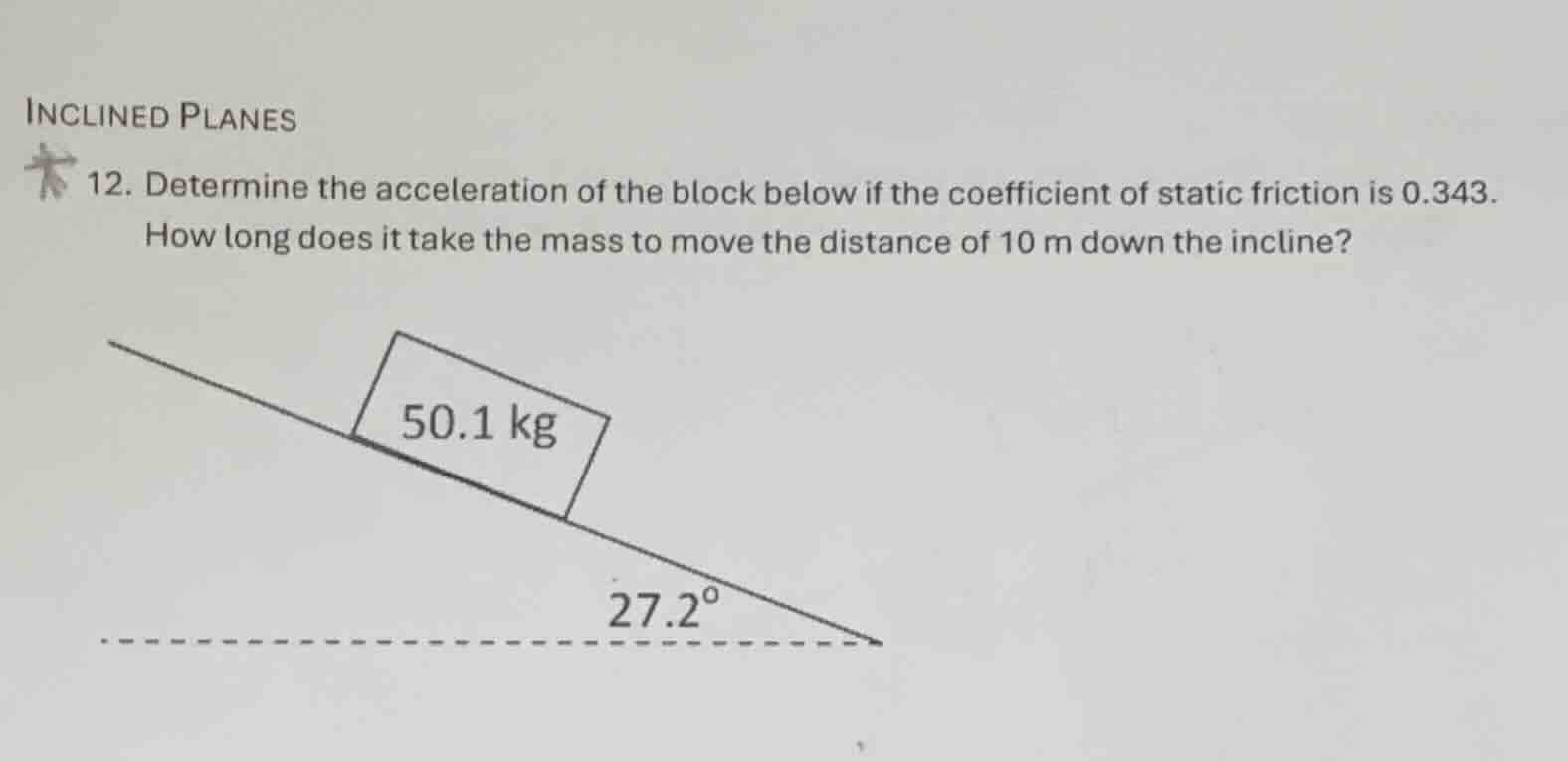
- determine the acceleration of the block below if the coefficient of static friction is 0.343.
how long does it take the mass to move the distance of 10 m down the incline?
Analyze forces and check for motion
We first determine if the block moves. The forces acting on the block of mass \(m = 50.1\text{ kg}\) on an incline of angle \(\theta = 27.2^\circ\) are gravity, the normal force, and friction.
The component of gravity pulling the block down the incline is:
The normal force perpendicular to the incline is:
The maximum static friction force resisting motion is:
We compare the parallel gravitational force to the maximum static friction force. Since \(m g\) is common to both, we compare \(\sin\theta\) and \(\mu_s \cos\theta\), or equivalently, \(\tan\theta\) and \(\mu_s\):
Since \(\tan(27.2^\circ) = 0.514 > \mu_s = 0.343\), the gravitational force down the incline exceeds the maximum static friction force. Therefore, the block will slide down the incline.
Calculate acceleration using kinetic friction
Since the block is in motion, we must use the coefficient of kinetic friction \(\mu_k\). However, the problem only provides a single coefficient of friction, labeled as the "coefficient of static friction" \(\mu_s = 0.343\). In introductory physics problems where only one coefficient is given, we assume \(\mu_k = \mu_s = 0.343\) to calculate the acceleration during motion.
Using Newton's Second Law along the incline:
Dividing both sides by \(m\) yields the acceleration \(a\):
Using \(g = 9.8\text{ m/s}^2\):
Calculate the time to travel down the incline
We use the kinematic equation for a block starting from rest (\(v_0 = 0\)) to find the time \(t\) to travel a distance \(d = 10\text{ m}\):
Solving for \(t\):
Substituting the values \(d = 10\text{ m}\) and \(a \approx 1.49\text{ m/s}^2\):

Snap & solve any problem in the app
Get step-by-step solutions on Sovi AI
Photo-based solutions with guided steps
Explore more problems and detailed explanations
The acceleration of the block is \(1.49\text{ m/s}^2\) down the incline.
The time it takes for the block to move a distance of \(10\text{ m}\) is \(3.66\text{ s}\).