QUESTION IMAGE
Question
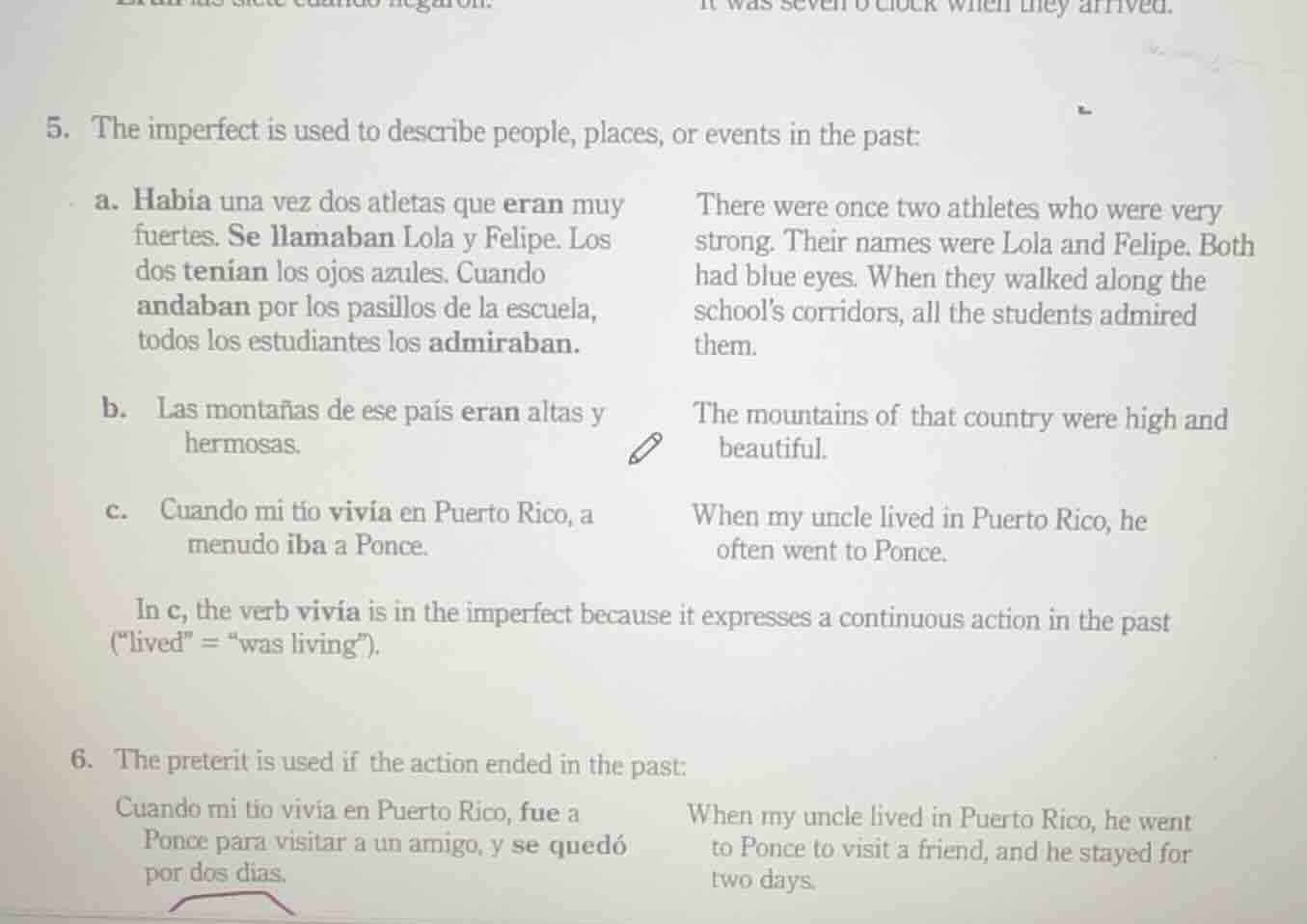
- the imperfect is used to describe people, places, or events in the past:
a. había una vez dos atletas que eran muy fuertes. se llamaban lola y felipe. los dos tenían los ojos azules. cuando andaban por los pasillos de la escuela, todos los estudiantes los admiraban. there were once two athletes who were very strong. their names were lola and felipe. both had blue eyes. when they walked along the school’s corridors, all the students admired them.
b. las montañas de ese país eran altas y hermosas. the mountains of that country were high and beautiful.
c. cuando mi tío vivía en puerto rico, a menudo iba a ponce. when my uncle lived in puerto rico, he often went to ponce.
in c, the verb vivía is in the imperfect because it expresses a continuous action in the past (\lived\ = \was living\).
- the preterit is used if the action ended in the past:
cuando mi tío vivía en puerto rico, fue a ponce para visitar a un amigo, y se quedó por dos días. when my uncle lived in puerto rico, he went to ponce to visit a friend, and he stayed for two days.
Since the problem is about Spanish verb tenses (imperfect and preterit) and their usage in describing past actions, the subfield under Arts would be Linguistics (specifically Spanish grammar and tense usage). As this is a question about explaining or identifying tense usage, we'll use the Answer - Explanation Format.
The problem focuses on Spanish grammar, specifically the imperfect and preterit tenses. The imperfect is used for ongoing or descriptive past actions (e.g., "vivía" in example c shows a continuous past action of living), while the preterit is for completed past actions (e.g., "fue" and "quedó" in the preterit example show actions that ended). The subfield that best applies is Linguistics (within Arts) as it deals with language structure, grammar, and tense usage in Spanish.

Snap & solve any problem in the app
Get step-by-step solutions on Sovi AI
Photo-based solutions with guided steps
Explore more problems and detailed explanations
The subfield is Linguistics (under Arts), focusing on Spanish verb tenses (imperfect and preterit) and their application in describing past actions.