QUESTION IMAGE
Question
imagine that you discovered the following information about the three domains of life:
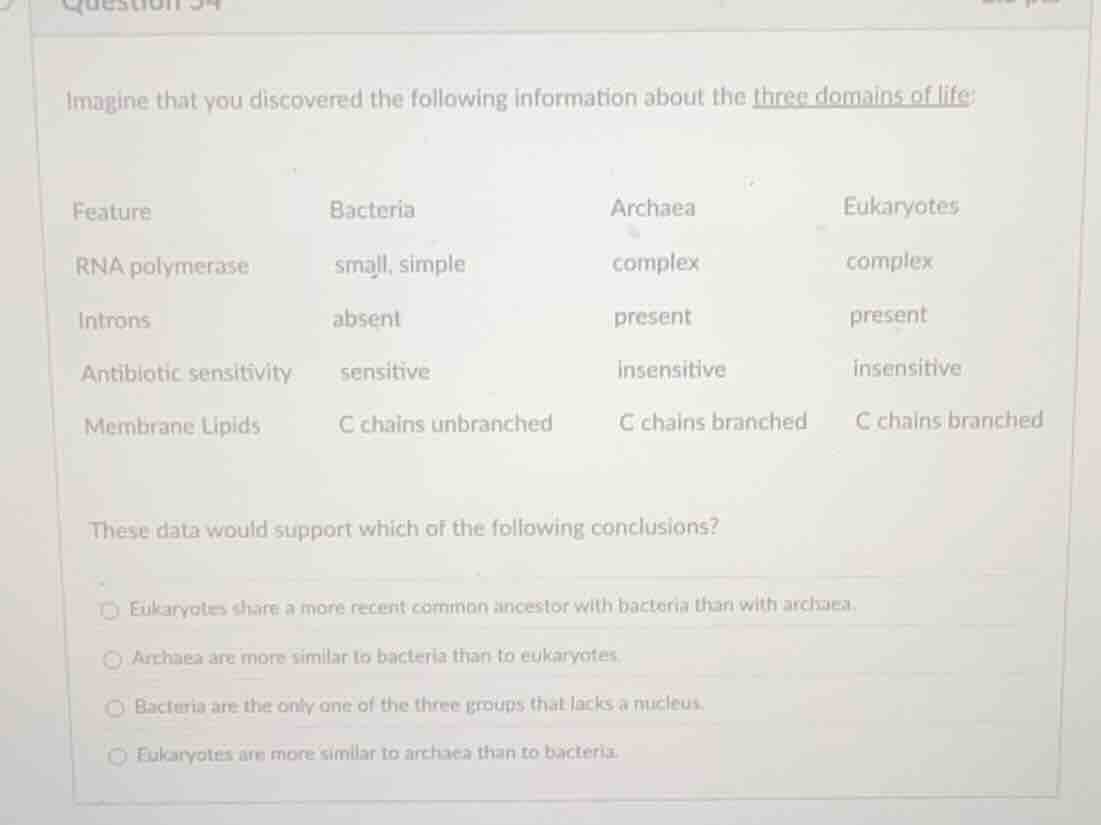
| feature | bacteria | archaea | eukaryotes |
|---|---|---|---|
| introns | absent | present | present |
| antibiotic sensitivity | sensitive | insensitive | insensitive |
| membrane lipids | c chains unbranched | c chains branched | c chains branched |
these data would support which of the following conclusions?
- eukaryotes share a more recent common ancestor with bacteria than with archaea.
- archaea are more similar to bacteria than to eukaryotes.
- bacteria are the only one of the three groups that lacks a nucleus.
- eukaryotes are more similar to archaea than to bacteria.
Analyze the provided data table
The table compares features across the three domains of life:
- RNA polymerase: Bacteria (small, simple), Archaea (complex), Eukaryotes (complex).
- Introns: Bacteria (absent), Archaea (present), Eukaryotes (present).
- Antibiotic sensitivity: Bacteria (sensitive), Archaea (insensitive), Eukaryotes (insensitive).
- Membrane Lipids: Bacteria (C chains unbranched), Archaea (C chains branched), Eukaryotes (C chains branched).
Compare shared characteristics
We evaluate how many shared derived or similar traits exist between the groups:
- Archaea and Eukaryotes share complex RNA polymerase, presence of introns, insensitivity to antibiotics, and branched carbon chains in membrane lipids (4 out of 4 features).
- Bacteria differ from both Archaea and Eukaryotes in all four of these listed features.
Evaluate the given options
- Option 1: "Eukaryotes share a more recent common ancestor with bacteria than with archaea." This is contradicted by the data, which show Eukaryotes are much more similar to Archaea.
- Option 2: "Archaea are more similar to bacteria than to eukaryotes." This is contradicted by the data, which show Archaea share all four traits with Eukaryotes.
- Option 3: "Bacteria are the only one of the three groups that lacks a nucleus." The presence or absence of a nucleus is not listed in the provided data table.
- Option 4: "Eukaryotes are more similar to archaea than to bacteria." This is directly supported by the data because Eukaryotes and Archaea share all four listed features, while Bacteria differ.
Connect to phylogenetic concepts
Using the Phylogenetic Trees concept, we look for shared derived characters (synapomorphies) to infer evolutionary relationships. The high degree of similarity in fundamental molecular machinery between Archaea and Eukaryotes supports their closer evolutionary relationship compared to Bacteria.

Snap & solve any problem in the app
Get step-by-step solutions on Sovi AI
Photo-based solutions with guided steps
Explore more problems and detailed explanations
- (A) Eukaryotes share a more recent common ancestor with bacteria than with archaea.
- (B) Archaea are more similar to bacteria than to eukaryotes.
- (C) Bacteria are the only one of the three groups that lacks a nucleus.
- (D) Eukaryotes are more similar to archaea than to bacteria. (Correct answer)