QUESTION IMAGE
Question
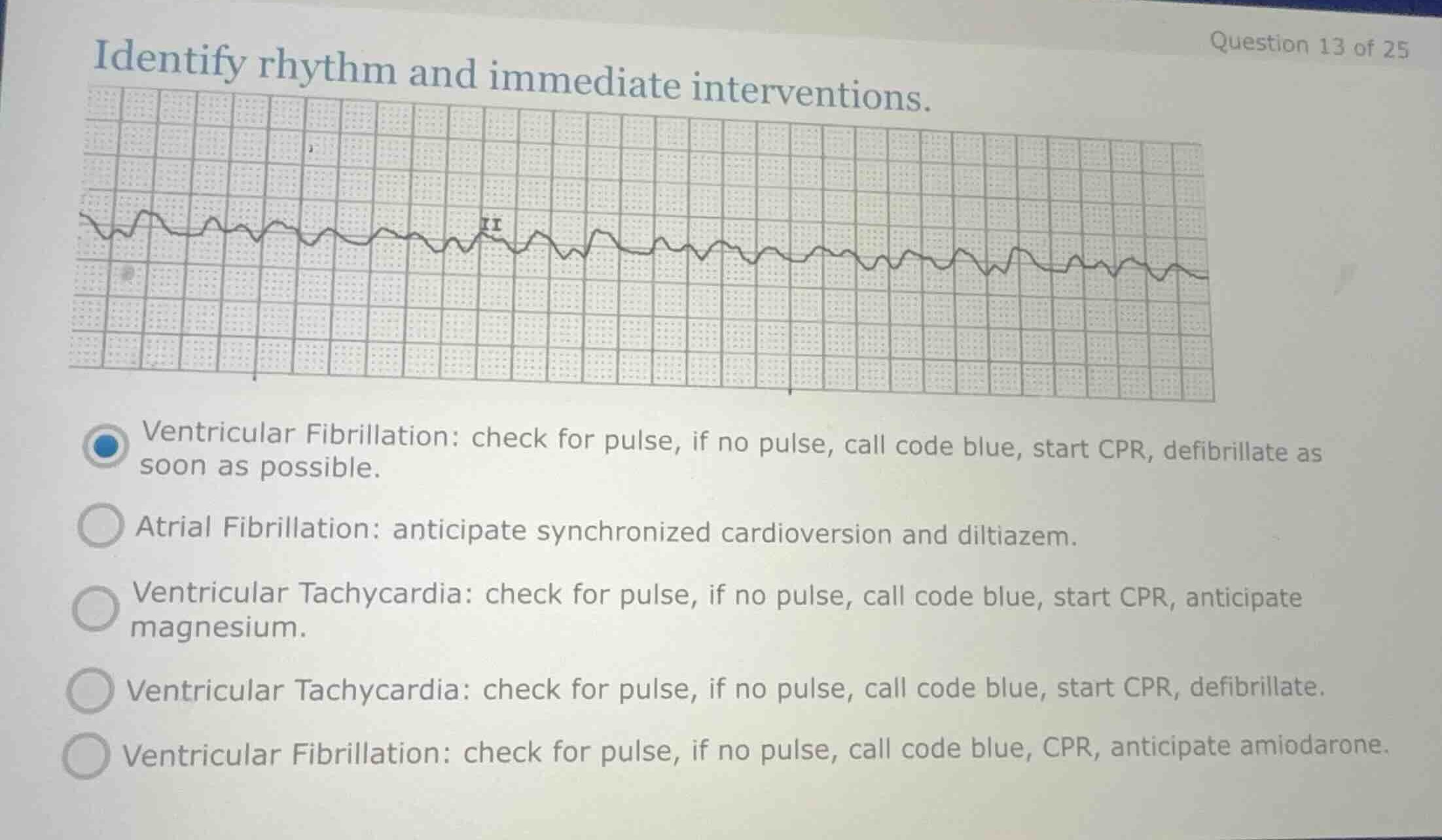
identify rhythm and immediate interventions.
ventricular fibrillation: check for pulse, if no pulse, call code blue, start cpr, defibrillate as soon as possible.
atrial fibrillation: anticipate synchronized cardioversion and diltiazem.
ventricular tachycardia: check for pulse, if no pulse, call code blue, start cpr, anticipate magnesium.
ventricular tachycardia: check for pulse, if no pulse, call code blue, start cpr, defibrillate.
ventricular fibrillation: check for pulse, if no pulse, call code blue, cpr, anticipate amiodarone.
Analyze the ECG rhythm strip
The ECG strip shows a chaotic, irregular, and disorganized wavy line with no identifiable P waves, QRS complexes, or T waves. This presentation is characteristic of coarse Ventricular Fibrillation (VF).
Determine immediate clinical interventions
For a patient in Ventricular Fibrillation, the immediate clinical protocol involves:
- Checking for a pulse.
- If pulseless, calling a Code Blue, starting high-quality CPR, and defibrillating (delivering an unsynchronized shock) as soon as a defibrillator is available.
Match with the correct option
The first option correctly identifies the rhythm as Ventricular Fibrillation and outlines the correct immediate sequence of interventions: check for pulse, if no pulse, call code blue, start CPR, defibrillate as soon as possible.

Snap & solve any problem in the app
Get step-by-step solutions on Sovi AI
Photo-based solutions with guided steps
Explore more problems and detailed explanations
- Ventricular Fibrillation: check for pulse, if no pulse, call code blue, start CPR, defibrillate as soon as possible. (Correct answer)
- Atrial Fibrillation: anticipate synchronized cardioversion and diltiazem.
- Ventricular Tachycardia: check for pulse, if no pulse, call code blue, start CPR, anticipate magnesium.
- Ventricular Tachycardia: check for pulse, if no pulse, call code blue, start CPR, defibrillate.
- Ventricular Fibrillation: check for pulse, if no pulse, call code blue, CPR, anticipate amiodarone.