QUESTION IMAGE
Question
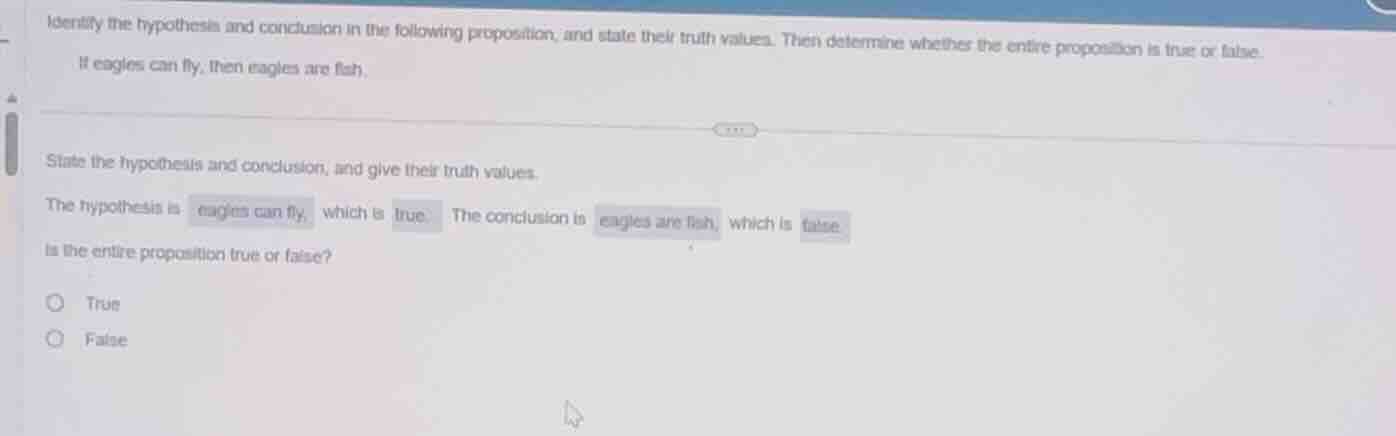
identify the hypothesis and conclusion in the following proposition, and state their truth values. then determine whether the entire proposition is true or false.
if eagles can fly, then eagles are fish.
state the hypothesis and conclusion, and give their truth values.
the hypothesis is eagles can fly, which is true. the conclusion is eagles are fish, which is false.
is the entire proposition true or false?
true
false
Identify the hypothesis and conclusion
In a conditional statement of the form "If \(p\), then \(q\)", the statement \(p\) is the hypothesis and the statement \(q\) is the conclusion.
For the proposition "If eagles can fly, then eagles are fish":
- The Hypothesis and Conclusion are:
- Hypothesis: "eagles can fly"
- Conclusion: "eagles are fish"
Determine individual truth values
We analyze the real-world Truth Values of each component:
- The hypothesis "eagles can fly" is true because eagles are birds capable of flight.
- The conclusion "eagles are fish" is false because eagles are birds, not fish.
Evaluate the entire proposition
Using the rules of Conditional Statements, a conditional statement \(p
ightarrow q\) is only false when the hypothesis \(p\) is true and the conclusion \(q\) is false.
Since our hypothesis is true and our conclusion is false, the entire conditional proposition is false.

Snap & solve any problem in the app
Get step-by-step solutions on Sovi AI
Photo-based solutions with guided steps
Explore more problems and detailed explanations
- True
- False (Correct answer)