QUESTION IMAGE
Question
b) identify the domain, range, asymptote, x-intercept, and transformations of each function.
f(x): domain:
g(x): domain:
c) compare and contrast the end behavior of these functions.
Identify the parent function and equations
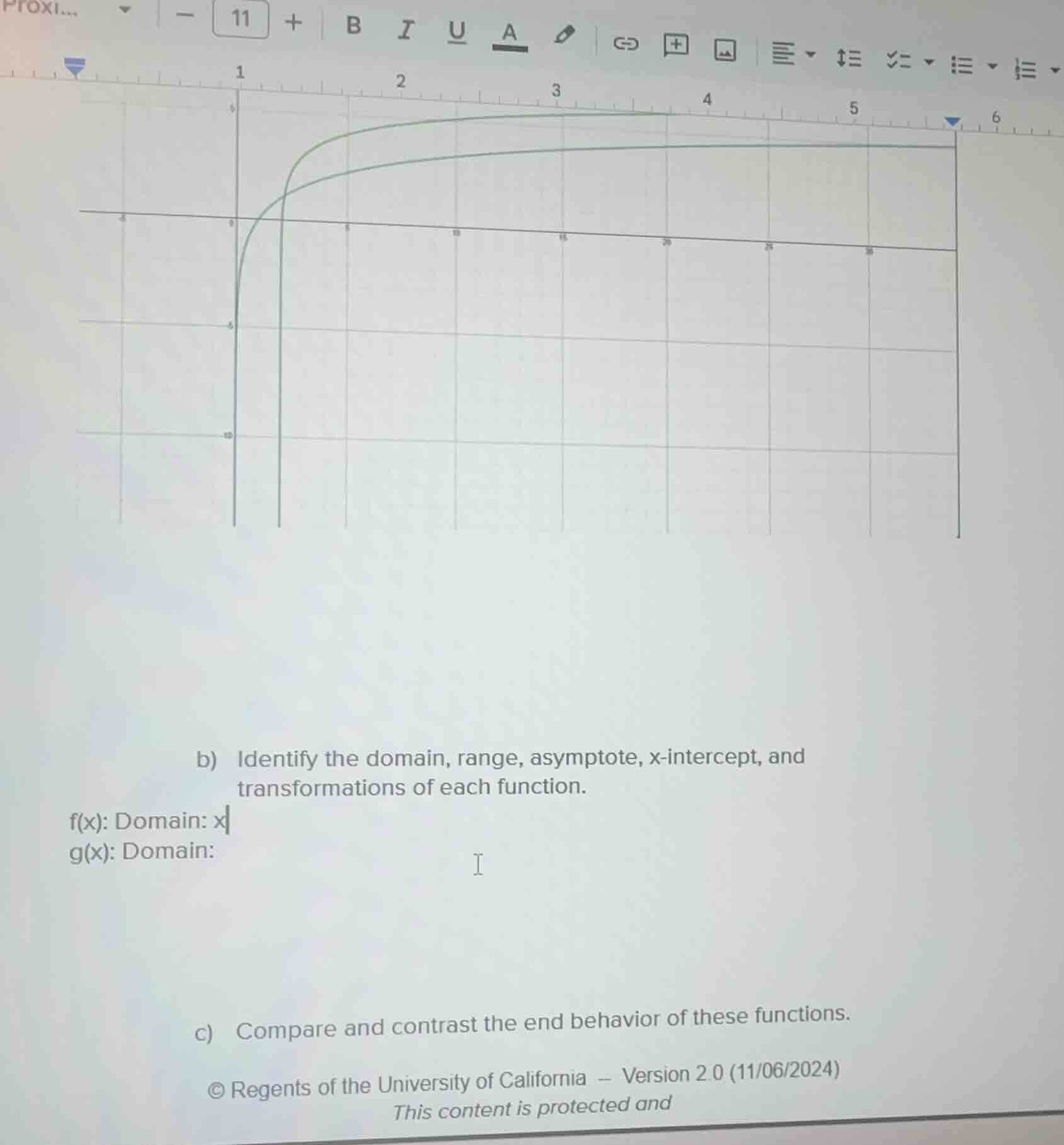
We analyze the two logarithmic curves shown in the graph.
The standard parent logarithmic function is \(y = \log_b(x)\) with a vertical asymptote at \(x = 0\) and an x-intercept at \((1, 0)\).
Looking at the graph:
- One curve (let's denote it as \(f(x)\)) has a vertical asymptote at \(x = 0\) (the y-axis) and passes through the x-intercept \((1, 0)\). This is the parent logarithmic function, likely \(f(x) = \log_b(x)\) or specifically \(f(x) = \ln(x)\) or \(f(x) = \log(x)\).
- The other curve (let's denote it as \(g(x)\)) is shifted horizontally to the right. Its vertical asymptote is at \(x = 2\), and its x-intercept is at \((3, 0)\). This represents a horizontal translation of the parent function by 2 units to the right, so \(g(x) = f(x - 2)\).
Determine domain and range of each function
For logarithmic functions of the form \(y = \log(x - h)\):
- The domain is restricted by the argument being strictly positive: \(x - h > 0 \implies x > h\).
- The range of any logarithmic function is all real numbers: \((-\infty, \infty)\).
For \(f(x)\):
- Vertical asymptote is at \(x = 0\).
- Domain: \(x > 0\) or \((0, \infty)\).
- Range: All real numbers, \((-\infty, \infty)\).
For \(g(x)\):
- Vertical asymptote is at \(x = 2\).
- Domain: \(x > 2\) or \((2, \infty)\).
- Range: All real numbers, \((-\infty, \infty)\).
Identify asymptotes, intercepts, and transformations
For \(f(x)\):
- Vertical Asymptote: \(x = 0\)
- x-intercept: \((1, 0)\)
- Transformations: None (it is the parent function).
For \(g(x)\):
- Vertical Asymptote: \(x = 2\)
- x-intercept: \((3, 0)\)
- Transformations: Shifted horizontally to the right by 2 units.
Compare and contrast end behavior
Logarithmic functions of the form \(y = \log(x - h)\) have the following end behavior:
- As \(x\) approaches the vertical asymptote from the right (\(x \to h^+\)), the function decreases without bound: \(y \to -\infty\).
- As \(x\) increases without bound (\(x \to \infty\)), the function increases without bound: \(y \to \infty\).
Comparing \(f(x)\) and \(g(x)\):
- Similarities: Both functions have the same right-end behavior. As \(x \to \infty\), both \(f(x) \to \infty\) and \(g(x) \to \infty\).
- Differences: Their left-end behaviors approach different vertical asymptotes. For \(f(x)\), as \(x \to 0^+\), \(f(x) \to -\infty\). For \(g(x)\), as \(x \to 2^+\), \(g(x) \to -\infty\).

Snap & solve any problem in the app
Get step-by-step solutions on Sovi AI
Photo-based solutions with guided steps
Explore more problems and detailed explanations
Question b
- \(f(x)\) (Parent Function):
- Domain: \(x > 0\) (or \((0, \infty)\))
- Range: All real numbers (or \((-\infty, \infty)\))
- Asymptote: Vertical asymptote at \(x = 0\)
- x-intercept: \((1, 0)\)
- Transformations: None (parent function)
- \(g(x)\) (Shifted Function):
- Domain: \(x > 2\) (or \((2, \infty)\))
- Range: All real numbers (or \((-\infty, \infty)\))
- Asymptote: Vertical asymptote at \(x = 2\)
- x-intercept: \((3, 0)\)
- Transformations: Shifted horizontally to the right by 2 units
---
Question c
- Similarities: Both functions share the same right-end behavior: as \(x \to \infty\), both \(f(x) \to \infty\) and \(g(x) \to \infty\).
- Differences: Their left-end behaviors approach different vertical boundaries:
- For \(f(x)\), as \(x \to 0^+\), \(f(x) \to -\infty\).
- For \(g(x)\), as \(x \to 2^+\), \(g(x) \to -\infty\).