QUESTION IMAGE
Question
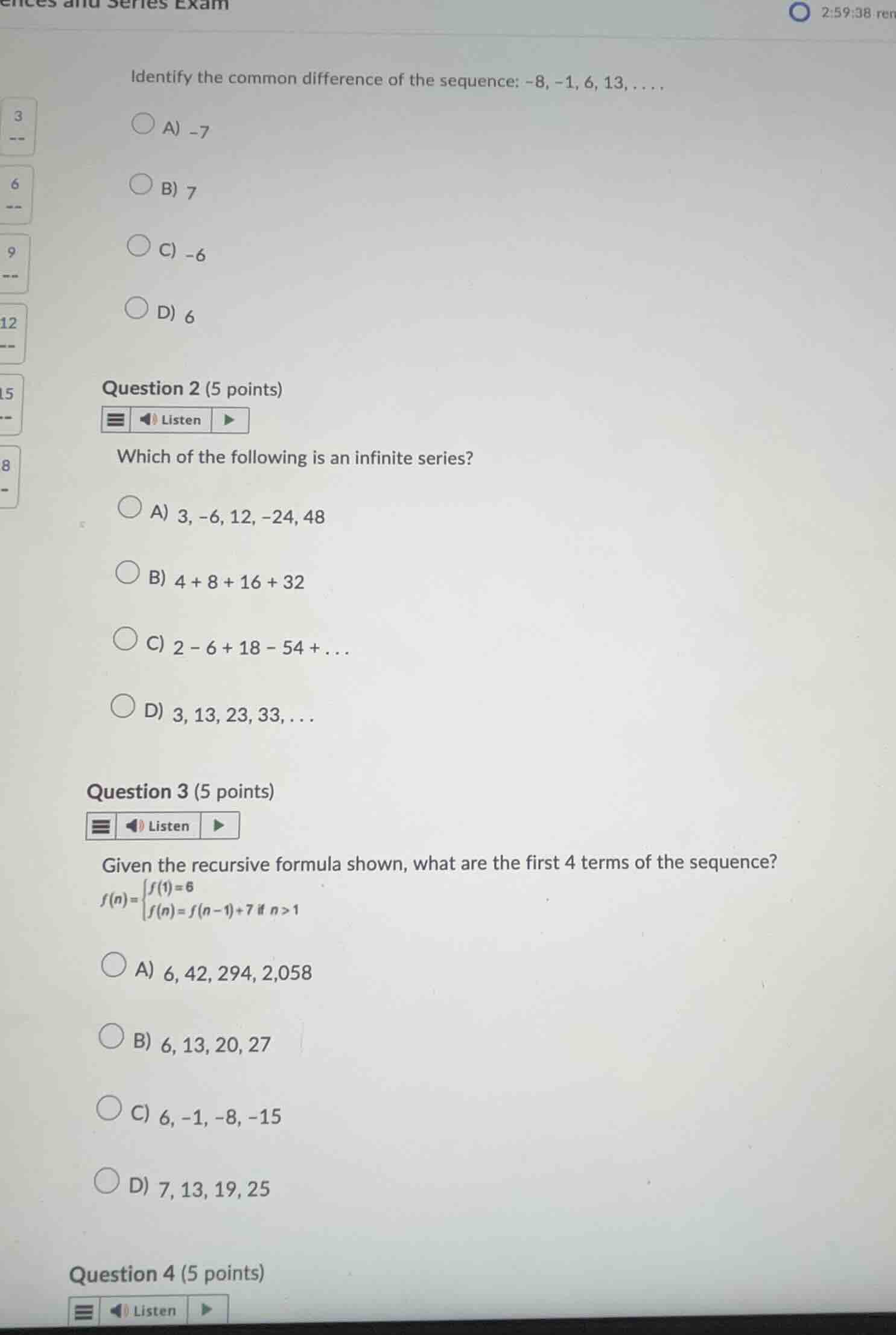
identify the common difference of the sequence: \\(-8, -1, 6, 13, \dots\\)
a) \\(-7\\)
b) \\(7\\)
c) \\(-6\\)
d) \\(6\\)
question 2 (5 points)
which of the following is an infinite series?
a) \\(3, -6, 12, -24, 48\\)
b) \\(4 + 8 + 16 + 32\\)
c) \\(2 - 6 + 18 - 54 + \dots\\)
d) \\(3, 13, 23, 33, \dots\\)
question 3 (5 points)
given the recursive formula shown, what are the first 4 terms of the sequence?
\\f(n) = \
\\
a) \\(6, 42, 294, 2,058\\)
b) \\(6, 13, 20, 27\\)
c) \\(6, -1, -8, -15\\)
d) \\(7, 13, 19, 25\\)
Calculate the common difference of the sequence
Identify the infinite series
An infinite series is the sum of infinitely many terms, indicated by addition/subtraction signs and ellipsis \(...\).
- Option A: Finite sequence (comma-separated, no ellipsis)
- Option B: Finite series (addition, no ellipsis)
- Option C: Infinite series (addition/subtraction, with ellipsis)
- Option D: Infinite sequence (comma-separated, with ellipsis)
Calculate the first 4 terms of the recursive sequence

Snap & solve any problem in the app
Get step-by-step solutions on Sovi AI
Photo-based solutions with guided steps
Explore more problems and detailed explanations
Question 1
- (A) -7
- (B) 7 (Correct answer)
- (C) -6
- (D) 6
Question 2
- (A) 3, -6, 12, -24, 48
- (B) 4 + 8 + 16 + 32
- (C) 2 - 6 + 18 - 54 + ... (Correct answer)
- (D) 3, 13, 23, 33, ...
Question 3
- (A) 6, 42, 294, 2,058
- (B) 6, 13, 20, 27 (Correct answer)
- (C) 6, -1, -8, -15
- (D) 7, 13, 19, 25