QUESTION IMAGE
Question
identify the choice that best answers the question.
the following question has two parts. answer part a first, and then part b.
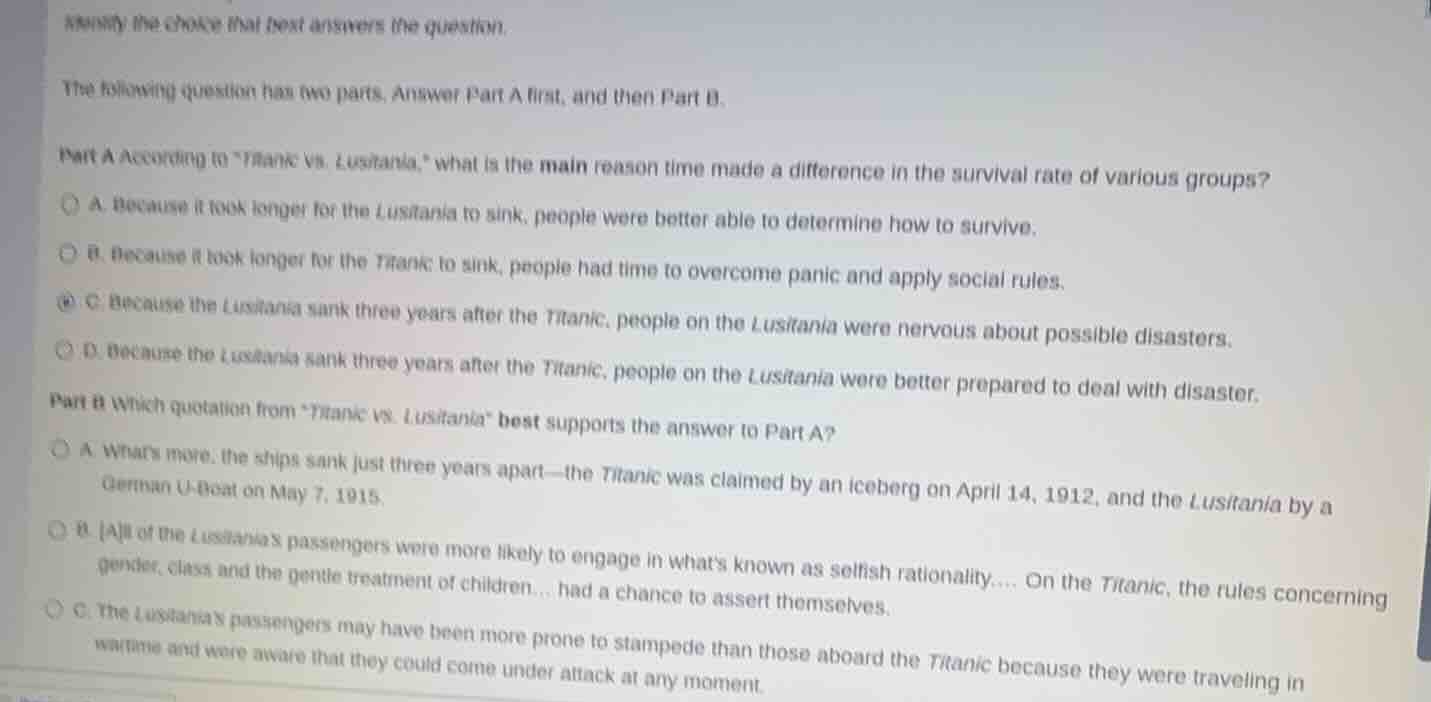
part a according to \titanic vs. lusitania,\ what is the main reason time made a difference in the survival rate of various groups?
a. because it took longer for the lusitania to sink, people were better able to determine how to survive.
b. because it took longer for the titanic to sink, people had time to overcome panic and apply social rules.
c. because the lusitania sank three years after the titanic, people on the lusitania were nervous about possible disasters.
d. because the lusitania sank three years after the titanic, people on the lusitania were better prepared to deal with disaster.
part b which quotation from \titanic vs. lusitania\ best supports the answer to part a?
a. whats more, the ships sank just three years apart-the titanic was claimed by an iceberg on april 14, 1912, and the lusitania by a german u-boat on may 7, 1915.
b. all of the lusitanias passengers were more likely to engage in whats known as selfish rationality.... on the titanic, the rules concerning gender, class and the gentle treatment of children... had a chance to assert themselves.
c. the lusitanias passengers may have been more prone to stampede than those aboard the titanic because they were traveling in wartime and were aware that they could come under attack at any moment.
Analyze Part A question
The question asks for the main reason time made a difference in the survival rate of various groups on the Titanic versus the Lusitania. We need to evaluate how the duration of the sinking affected human behavior and social order.
Evaluate Part A options
Using Reading Comprehension and Disaster Behavior Analysis:
- Option A suggests the Lusitania took longer to sink, which is historically and textually incorrect (the Lusitania sank in about 18 minutes, whereas the Titanic took over 2 hours).
- Option B states that because the Titanic took longer to sink, people had time to overcome panic and apply social rules (such as "women and children first"). This aligns with sociological analyses of these two disasters.
- Options C and D focus on the three-year gap between the sinkings, which does not explain how the duration of the sinking itself ("time made a difference") affected behavior during the event.
Thus, Option B is the correct choice for Part A.
Analyze Part B question
Part B asks for the quotation from "Titanic vs. Lusitania" that best supports the answer to Part A (that the longer sinking time on the Titanic allowed social rules to override selfish panic).
Evaluate Part B options
Using Textual Evidence:
- Option A merely states the dates and causes of the two sinkings.
- Option B directly contrasts the behavior on the two ships: passengers on the fast-sinking Lusitania behaved with "selfish rationality," whereas on the slow-sinking Titanic, "the rules concerning gender, class and the gentle treatment of children... had a chance to assert themselves." This directly supports the idea that the extra time on the Titanic allowed social rules to prevail.
- Option C discusses the threat of wartime attack on the Lusitania, which is a different factor from the duration of the sinking itself.
Thus, Option B is the correct choice for Part B.

Snap & solve any problem in the app
Get step-by-step solutions on Sovi AI
Photo-based solutions with guided steps
Explore more problems and detailed explanations
Question 1
- A. Because it took longer for the Lusitania to sink, people were better able to determine how to survive.
- B. Because it took longer for the Titanic to sink, people had time to overcome panic and apply social rules. (Correct answer)
- C. Because the Lusitania sank three years after the Titanic, people on the Lusitania were nervous about possible disasters.
- D. Because the Lusitania sank three years after the Titanic, people on the Lusitania were better prepared to deal with disaster.
Question 2
- A. What's more, the ships sank just three years apart—the Titanic was claimed by an iceberg on April 14, 1912, and the Lusitania by a German U-Boat on May 7, 1915.
- B. [A]ll of the Lusitania's passengers were more likely to engage in what's known as selfish rationality.... On the Titanic, the rules concerning gender, class and the gentle treatment of children... had a chance to assert themselves. (Correct answer)
- C. The Lusitania's passengers may have been more prone to stampede than those aboard the Titanic because they were traveling in wartime and were aware that they could come under attack at any moment.