QUESTION IMAGE
Question
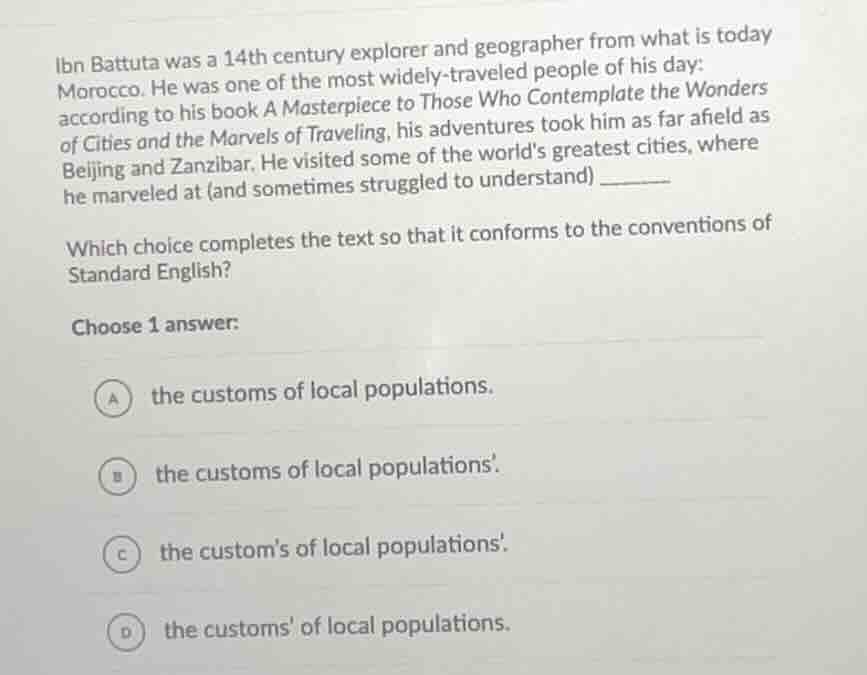
ibn battuta was a 14th century explorer and geographer from what is today morocco. he was one of the most widely-traveled people of his day: according to his book a masterpiece to those who contemplate the wonders of cities and the marvels of traveling, his adventures took him as far afield as beijing and zanzibar. he visited some of the worlds greatest cities, where he marveled at (and sometimes struggled to understand) _______
which choice completes the text so that it conforms to the conventions of standard english?
choose 1 answer:
a the customs of local populations.
b the customs of local populations.
c the customs of local populations.
d the customs of local populations.
Analyze the sentence structure
The sentence ends with the prepositional phrase "marveled at (and sometimes struggled to understand) _______." Both "marveled at" and "struggled to understand" require a direct object to complete their meaning. The blank must contain a simple plural noun phrase acting as this object, with no possessive punctuation needed.
Evaluate the noun forms
The intended meaning is "the customs of local populations."
- "customs" is a simple plural noun acting as the direct object. It should not have an apostrophe.
- "populations" is a simple plural noun inside the prepositional phrase "of local populations." It should not have an apostrophe.
Match with the options
- (A) "the customs of local populations." correctly uses plural nouns without unnecessary apostrophes.
- (B) "the customs of local populations'." incorrectly adds a possessive apostrophe to "populations".
- (C) "the custom's of local populations'." incorrectly adds possessive apostrophes to both "custom" and "populations".
- (D) "the customs' of local populations." incorrectly adds a possessive apostrophe to "customs".

Snap & solve any problem in the app
Get step-by-step solutions on Sovi AI
Photo-based solutions with guided steps
Explore more problems and detailed explanations
- (A) the customs of local populations. (Correct answer)
- (B) the customs of local populations'.
- (C) the custom's of local populations'.
- (D) the customs' of local populations.