QUESTION IMAGE
Question
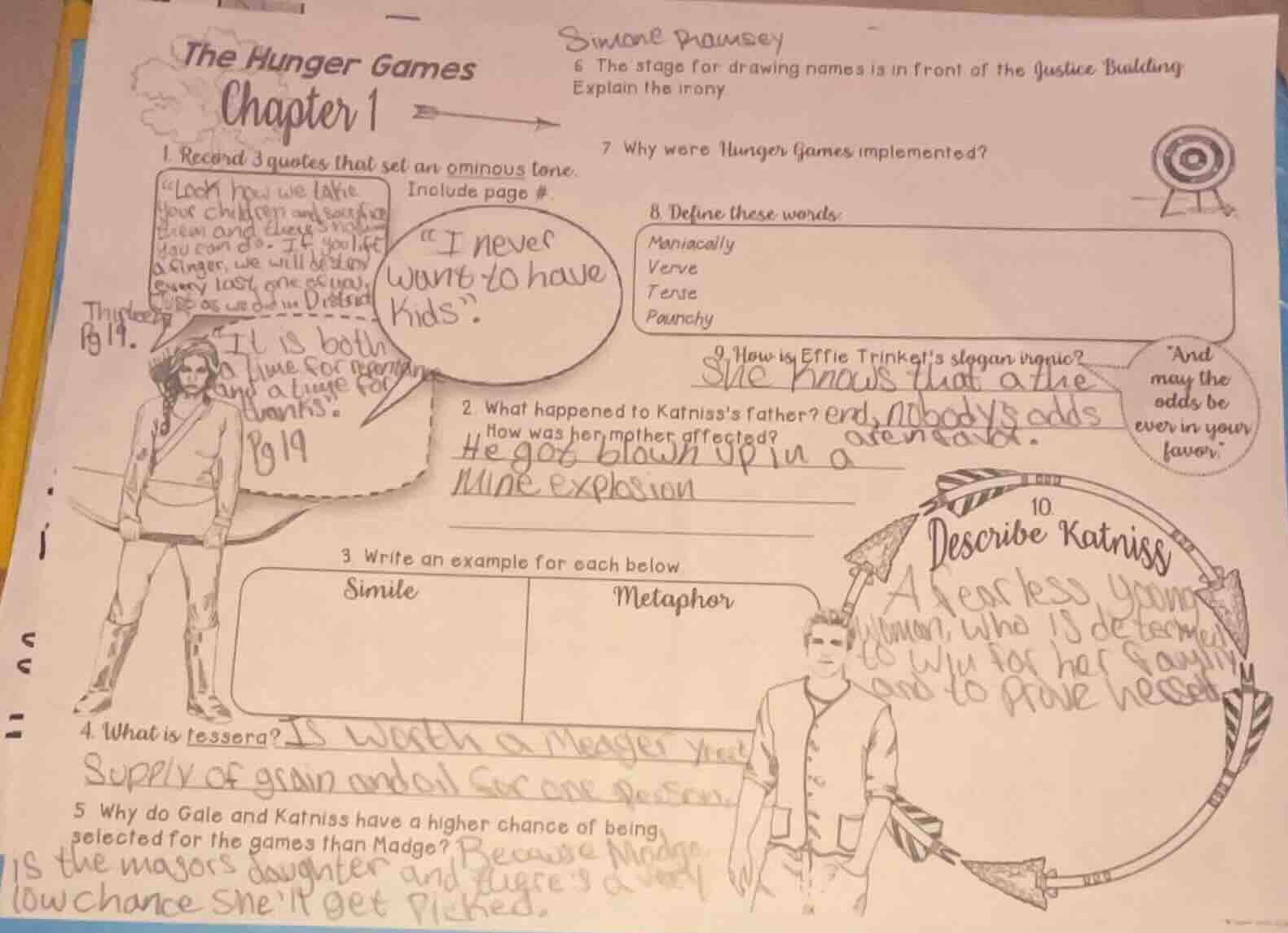
the hunger games chapter 1
- record 3 quotes that set an ominous tone. include page #.
- what happened to katnisss father? how was her mother affected?
- write an example for each below
simile
metaphor
- what is tessera?
- why do gale and katniss have a higher chance of being selected for the games than madge?
- the stage for drawing names is in front of the justice building explain the irony
- why were hunger games implemented?
- define these words:
maniacally
verve
tense
paunchy
- how is effie trinkets slogan ironic?
- describe katniss
To answer these questions about The Hunger Games Chapter 1, we analyze each:
1. Record 3 quotes (ominous tone, with page #)
- “Look how we take your children and sacrifice them and there’s nothing you can do. If you lift a finger, we will destroy every last one of you. Just as we did in District Thirteen.” (p.19) – Threat of violence, oppressive tone.
- “I never want to have kids.” – Implies fear of the Games’ impact on families.
- “It is both a time for mourning and a time for thanks.” (p.19) – Contradiction (mourning/thanks) hints at forced, hollow traditions.
2. What happened to Katniss’s father? How did her mother react?
- Father: He died in a mine explosion (canon: coal mine in District 12).
- Mother: She fell into severe depression (emotional collapse, unable to care for Katniss/ Prim initially).
3. Simile & Metaphor Examples (from Chapter 1)
- Simile: “The reaping system is as random as the flip of a coin” (or similar; similes use “like”/“as”). Example: “Her face is as pale as a ghost” (if in text) – compares paleness to a ghost.
- Metaphor: “The Capitol is a hungry beast” (implies the Capitol devours districts, no “like”/“as”). Example: “The Hunger Games are a knife to the throat of every district” – compares the Games to a threatening weapon.
4. What is tessera?
Tessera is a form of government aid in Panem: a family can trade one extra entry in the Hunger Games reaping for a year’s supply of grain and oil (per person, per tessera). It increases the chance of being selected but provides basic food.
5. Why do Gale/Katniss have a higher chance than Madge?
Madge is the mayor’s daughter. Her family likely doesn’t need tessera (they can afford food), so she has fewer reaping entries (only the mandatory ones). Gale and Katniss take tessera to survive, so they have more entries (extra ones for each tessera), increasing their odds of being chosen.
6. Irony of the “drawing names” stage (Justice Building)
The Justice Building is supposed to represent fairness/justice, but the Hunger Games reaping is unjust (oppressive, rigged by class/tessera, and forces children to fight to the death). The “justice” of the building is ironic because the reaping itself is a tool of tyranny, not justice.
7. Why were the Hunger Games implemented?
The Games were created by the Capitol to punish the districts (especially District 13) for rebelling against their rule. They also serve to:
- Enforce the Capitol’s dominance (remind districts of their powerlessness).
- Entertain the Capitol (a televised, violent spectacle).
- Keep districts divided (prevent future uprisings by instilling fear).
8. Define the words:
- Maniacally: In a wild, frenzied, or insane manner (e.g., a maniacal laugh).
- Verve: Enthusiasm, energy, or spirit (e.g., “She spoke with verve”).
- Tense: Stressed, nervous, or rigid (e.g., “The room was tense with fear”).
- Paunchy: Having a protruding belly (overweight, pot-bellied).
9. Irony of Effie Trinket’s slogan: “And may the odds be ever in your favor”
Effie works for the Capitol, which designs the Games to be unfair (tessera, class bias, rigged outcomes). Her slogan (“odds in your favor”) is ironic because the system is designed to make the odds against most tributes (especially poor/district ones). She knows the odds are stacked, yet she says it cheerfully, highlighting the Capitol’s hypocrisy.
10. Describe Katniss (Chapter 1)
Katniss is a resourceful, protective, and resilient 16-year-old from District 12.…

Snap & solve any problem in the app
Get step-by-step solutions on Sovi AI
Photo-based solutions with guided steps
Explore more problems and detailed explanations
To answer these questions about The Hunger Games Chapter 1, we analyze each:
1. Record 3 quotes (ominous tone, with page #)
- “Look how we take your children and sacrifice them and there’s nothing you can do. If you lift a finger, we will destroy every last one of you. Just as we did in District Thirteen.” (p.19) – Threat of violence, oppressive tone.
- “I never want to have kids.” – Implies fear of the Games’ impact on families.
- “It is both a time for mourning and a time for thanks.” (p.19) – Contradiction (mourning/thanks) hints at forced, hollow traditions.
2. What happened to Katniss’s father? How did her mother react?
- Father: He died in a mine explosion (canon: coal mine in District 12).
- Mother: She fell into severe depression (emotional collapse, unable to care for Katniss/ Prim initially).
3. Simile & Metaphor Examples (from Chapter 1)
- Simile: “The reaping system is as random as the flip of a coin” (or similar; similes use “like”/“as”). Example: “Her face is as pale as a ghost” (if in text) – compares paleness to a ghost.
- Metaphor: “The Capitol is a hungry beast” (implies the Capitol devours districts, no “like”/“as”). Example: “The Hunger Games are a knife to the throat of every district” – compares the Games to a threatening weapon.
4. What is tessera?
Tessera is a form of government aid in Panem: a family can trade one extra entry in the Hunger Games reaping for a year’s supply of grain and oil (per person, per tessera). It increases the chance of being selected but provides basic food.
5. Why do Gale/Katniss have a higher chance than Madge?
Madge is the mayor’s daughter. Her family likely doesn’t need tessera (they can afford food), so she has fewer reaping entries (only the mandatory ones). Gale and Katniss take tessera to survive, so they have more entries (extra ones for each tessera), increasing their odds of being chosen.
6. Irony of the “drawing names” stage (Justice Building)
The Justice Building is supposed to represent fairness/justice, but the Hunger Games reaping is unjust (oppressive, rigged by class/tessera, and forces children to fight to the death). The “justice” of the building is ironic because the reaping itself is a tool of tyranny, not justice.
7. Why were the Hunger Games implemented?
The Games were created by the Capitol to punish the districts (especially District 13) for rebelling against their rule. They also serve to:
- Enforce the Capitol’s dominance (remind districts of their powerlessness).
- Entertain the Capitol (a televised, violent spectacle).
- Keep districts divided (prevent future uprisings by instilling fear).
8. Define the words:
- Maniacally: In a wild, frenzied, or insane manner (e.g., a maniacal laugh).
- Verve: Enthusiasm, energy, or spirit (e.g., “She spoke with verve”).
- Tense: Stressed, nervous, or rigid (e.g., “The room was tense with fear”).
- Paunchy: Having a protruding belly (overweight, pot-bellied).
9. Irony of Effie Trinket’s slogan: “And may the odds be ever in your favor”
Effie works for the Capitol, which designs the Games to be unfair (tessera, class bias, rigged outcomes). Her slogan (“odds in your favor”) is ironic because the system is designed to make the odds against most tributes (especially poor/district ones). She knows the odds are stacked, yet she says it cheerfully, highlighting the Capitol’s hypocrisy.
10. Describe Katniss (Chapter 1)
Katniss is a resourceful, protective, and resilient 16-year-old from District 12. She:
- Hunts illegally to feed her family (proving self-reliance).
- Cares deeply for her sister Prim (protective nature).
- Is wary of the Capitol (understands the Games’ cruelty).
- Has a practical, survival-driven mindset (e.g., taking tessera, hunting) and is emotionally guarded (due to her father’s death and mother’s depression).
These answers align with the text’s themes (oppression, survival, class inequality) and the context of The Hunger Games world.