QUESTION IMAGE
Question
Question was provided via image upload.
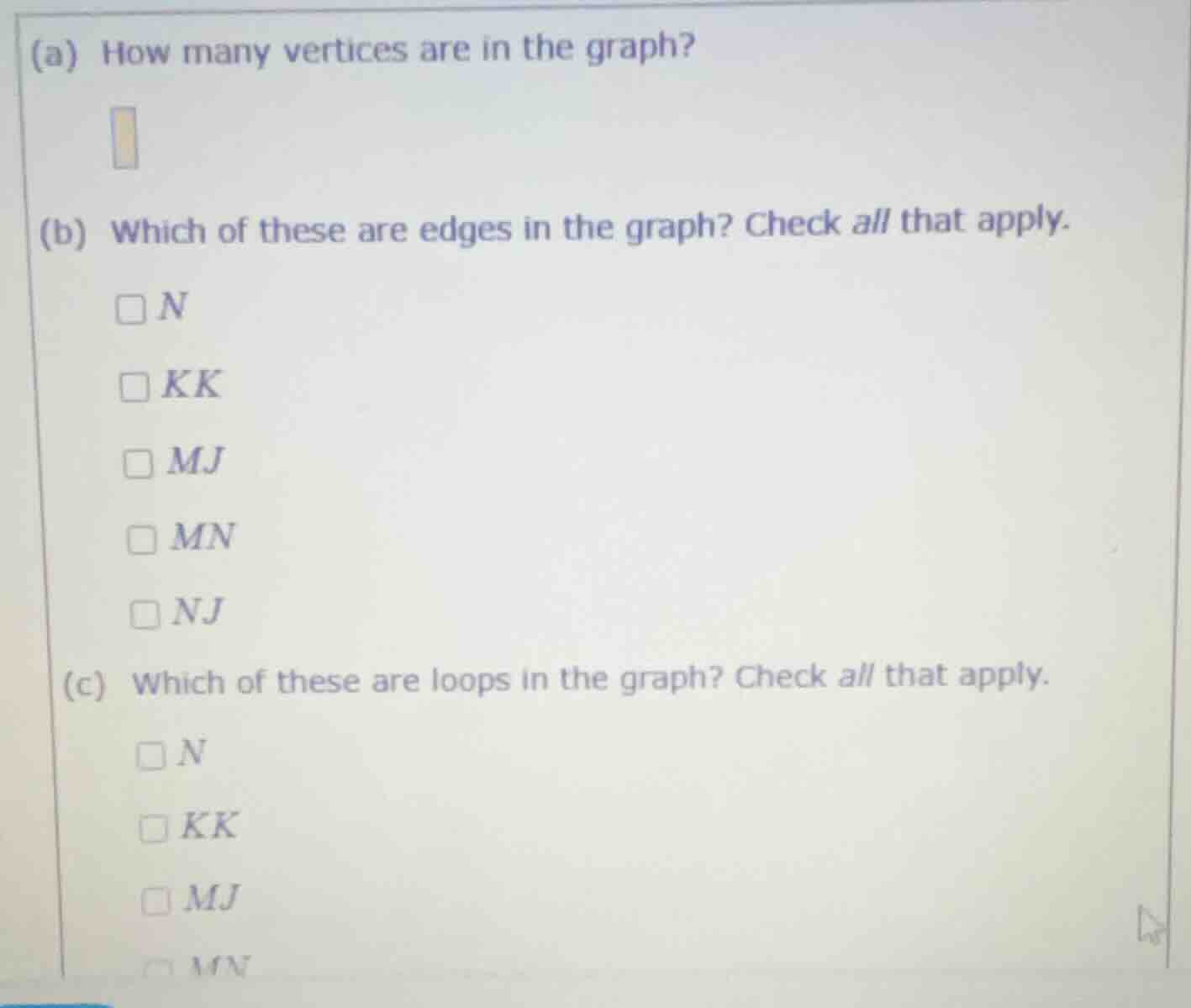
Identify missing visual information
The image contains questions (a), (b), and (c) referring to a "graph," but the visual diagram of the graph itself is not visible in the cropped image.
Analyze available options for clues
The options listed in parts (b) and (c) contain vertex labels:
- \(N\)
- \(K\) (implied by \(KK\))
- \(M\) (implied by \(MJ\), \(MN\))
- \(J\) (implied by \(MJ\), \(NJ\))
This suggests the graph has vertices named \(J, K, M, N\).
Formulate conditional response
Since the graph diagram is missing, a complete and definitive numerical solution for the number of vertices, edges, and loops cannot be determined. The solution must explain how to find these values once the graph is visible:
- The number of vertices is the count of labeled points (nodes) in the diagram.
- An edge is a line connecting two vertices (e.g., \(MN\) is an edge if a line connects vertex \(M\) and vertex \(N\)).
- A loop is an edge that connects a vertex to itself (represented by a double letter like \(KK\)).

Snap & solve any problem in the app
Get step-by-step solutions on Sovi AI
Photo-based solutions with guided steps
Explore more problems and detailed explanations
Because the diagram of the graph is missing from the image, the exact answers cannot be determined. Here is how to solve each part once the graph is visible:
Part (a)
Count the total number of labeled points (nodes) in the graph. For example, if the points are labeled \(J, K, M, N\), the number of vertices is \(4\).
Part (b)
Look at the lines connecting the points:
- \(N\) is a single vertex, so it cannot be an edge.
- \(KK\) is a loop (an edge connecting \(K\) to itself).
- \(MJ\), \(MN\), and \(NJ\) are edges if there is a direct line connecting those respective pairs of vertices in the diagram.
Part (c)
A loop is an edge that starts and ends at the same vertex, represented by a circular line on a single node (such as \(KK\)). Select any option with double letters (like \(KK\)) that has a corresponding loop on that vertex in the diagram.