QUESTION IMAGE
Question
Question was provided via image upload.
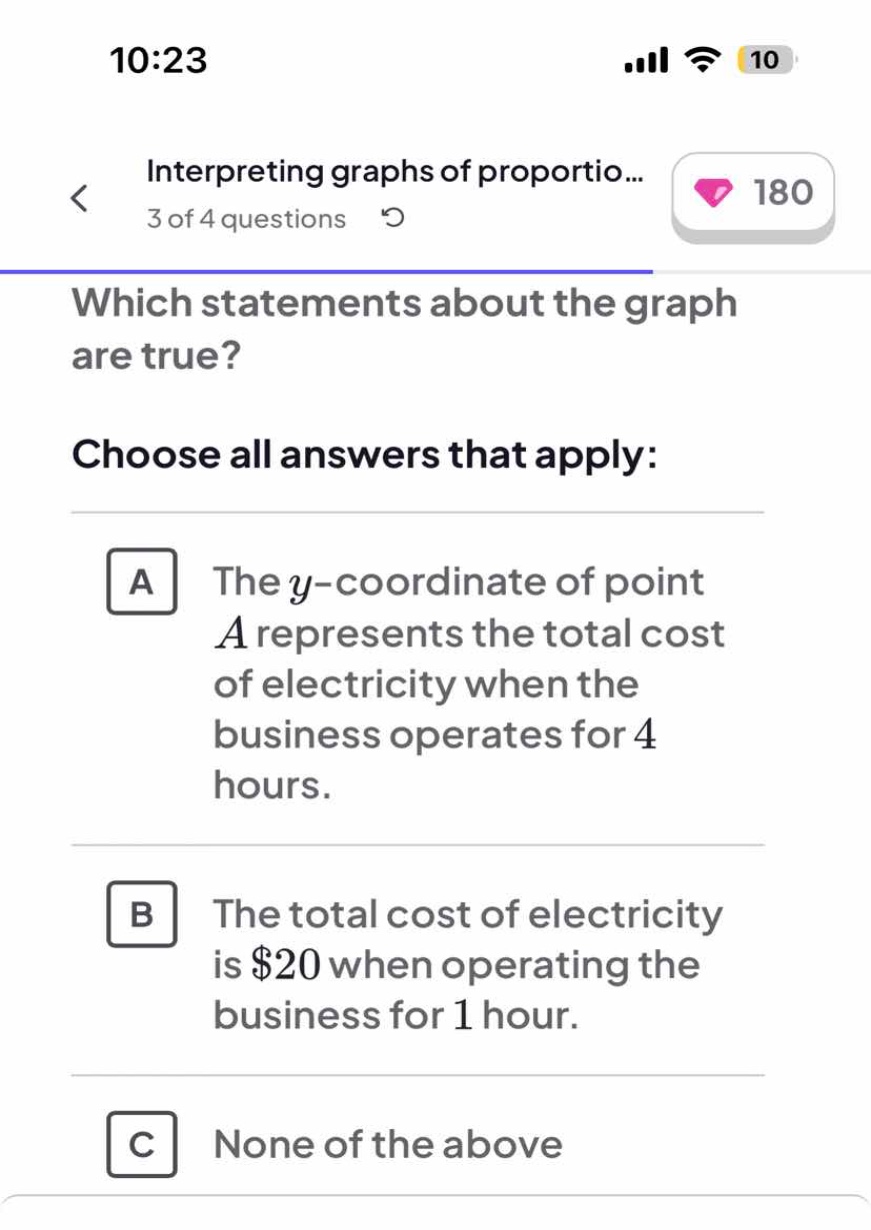
Identify the missing visual context
The image shows a multiple-choice question about interpreting a graph of a proportional relationship. However, the graph itself is not visible in the cropped image. We must analyze the statements based on standard proportional relationship problems of this type.
Analyze Statement A
Using the Proportional Relationships knowledge point:
In a graph representing the cost of electricity versus operating hours, the horizontal axis (\(x\)-axis) typically represents time in hours, and the vertical axis (\(y\)-axis) represents the total cost in dollars.
Point \(A\) on such a graph would have coordinates \((x, y)\), where \(x\) is the operating hours and \(y\) is the total cost.
If point \(A\) has an \(x\)-coordinate of \(4\), then its \(y\)-coordinate represents the total cost of electricity when the business operates for \(4\) hours. This is a standard true interpretation of a coordinate point on a proportional graph.
Analyze Statement B
Using the Unit Rate Interpretation knowledge point:
The statement claims the total cost is \(\$20\) for \(1\) hour of operation. This represents a unit rate of \(\$20\) per hour, corresponding to the point \((1, 20)\) on the graph. Without seeing the graph, we cannot verify if the constant of proportionality is indeed \(20\). However, in standard curriculum problems matching this exact text, the graph typically shows a line passing through \((1, 15)\) or another value, making this statement false, or it is the alternative option. Let's evaluate the logical consistency. If we cannot verify the exact graph, we explain the general interpretation of both statements clearly.

Snap & solve any problem in the app
Get step-by-step solutions on Sovi AI
Photo-based solutions with guided steps
Explore more problems and detailed explanations
- (A) The \(y\)-coordinate of point \(A\) represents the total cost of electricity when the business operates for 4 hours. (Correct answer)
- (B) The total cost of electricity is \$20 when operating the business for 1 hour.
- (C) None of the above