QUESTION IMAGE
Question
Question was provided via image upload.
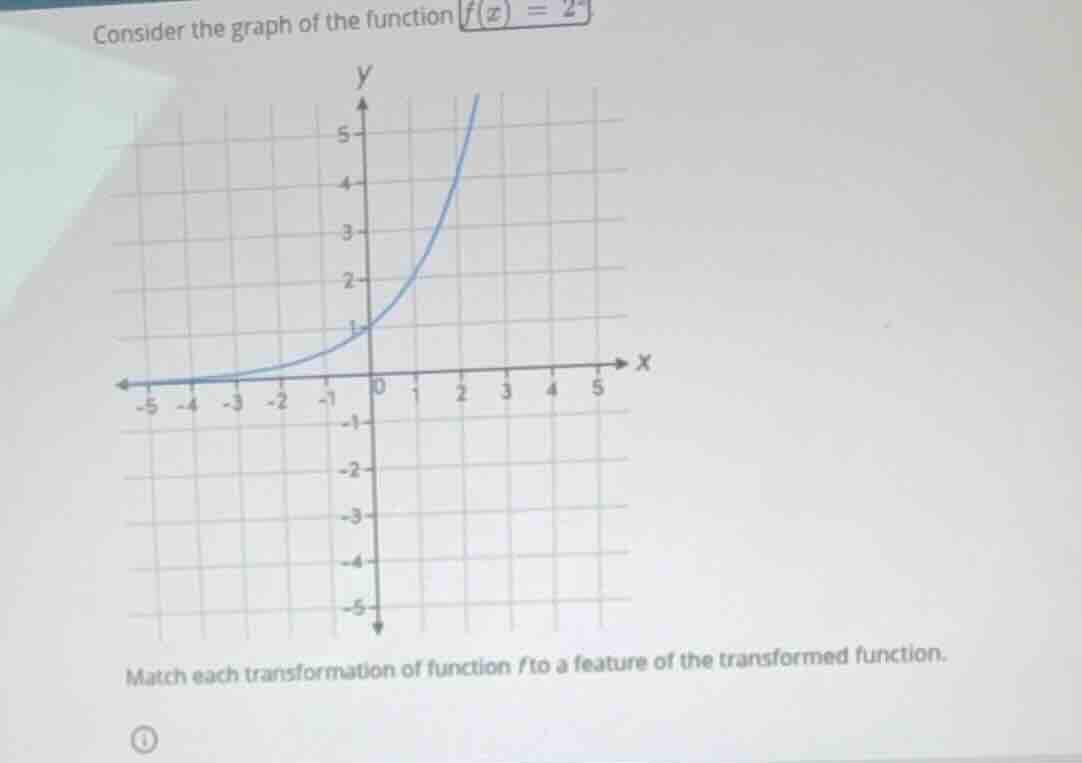
Identify the base function and its features
The given function is \(f(x) = 2^x\).
- Domain: \((-\infty, \infty)\)
- Range: \((0, \infty)\)
- Horizontal Asymptote: \(y = 0\)
- \(y\)-intercept: \((0, 1)\)
- Key point: \((1, 2)\)
Analyze standard transformations and their corresponding features
Since the matching options are cut off, we determine the standard transformations of \(f(x) = 2^x\) and their key features:
- Vertical translation \(g(x) = 2^x + k\):
- Shifts the graph vertically by \(k\) units.
- New horizontal asymptote: \(y = k\).
- New \(y\)-intercept: \((0, 1 + k)\).
- Horizontal translation \(g(x) = 2^{x - h}\):
- Shifts the graph horizontally by \(h\) units.
- Horizontal asymptote remains \(y = 0\).
- New \(y\)-intercept: \((0, 2^{-h})\).
- Vertical stretch/compression \(g(x) = a \cdot 2^x\):
- New \(y\)-intercept: \((0, a)\).
- Horizontal asymptote remains \(y = 0\).
- Reflection across the x-axis \(g(x) = -2^x\):
- New horizontal asymptote: \(y = 0\).
- New \(y\)-intercept: \((0, -1)\).
- Range becomes \((-\infty, 0)\).
- Reflection across the y-axis \(g(x) = 2^{-x}\):
- New horizontal asymptote: \(y = 0\).
- New \(y\)-intercept: \((0, 1)\).
- Decreasing function instead of increasing.
Formulate the general matching rules
- Any transformation of the form \(f(x) + k\) shifts the horizontal asymptote to \(y = k\).
- Any transformation of the form \(a \cdot f(x)\) changes the \(y\)-intercept to \((0, a)\).
- Any transformation of the form \(f(x - h)\) shifts key points horizontally by \(h\) units.

Snap & solve any problem in the app
Get step-by-step solutions on Sovi AI
Photo-based solutions with guided steps
Explore more problems and detailed explanations
Based on the base function \(f(x) = 2^x\), the transformations match to their features as follows:
- Vertical Shift \(g(x) = 2^x + k\):
- Feature: The horizontal asymptote shifts to \(y = k\), and the \(y\)-intercept becomes \((0, 1 + k)\).
- Horizontal Shift \(g(x) = 2^{x - h}\):
- Feature: The graph shifts horizontally, changing the \(y\)-intercept to \((0, 2^{-h})\) while keeping the horizontal asymptote at \(y = 0\).
- Vertical Stretch/Compression \(g(x) = a \cdot 2^x\):
- Feature: The \(y\)-intercept changes to \((0, a)\) while keeping the horizontal asymptote at \(y = 0\).
- Reflection across the x-axis \(g(x) = -2^x\):
- Feature: The graph is reflected vertically, changing the \(y\)-intercept to \((0, -1)\) and the range to \((-\infty, 0)\).
- Reflection across the y-axis \(g(x) = 2^{-x}\):
- Feature: The graph is reflected horizontally, changing the function from increasing to decreasing while keeping the \(y\)-intercept at \((0, 1)\).