QUESTION IMAGE
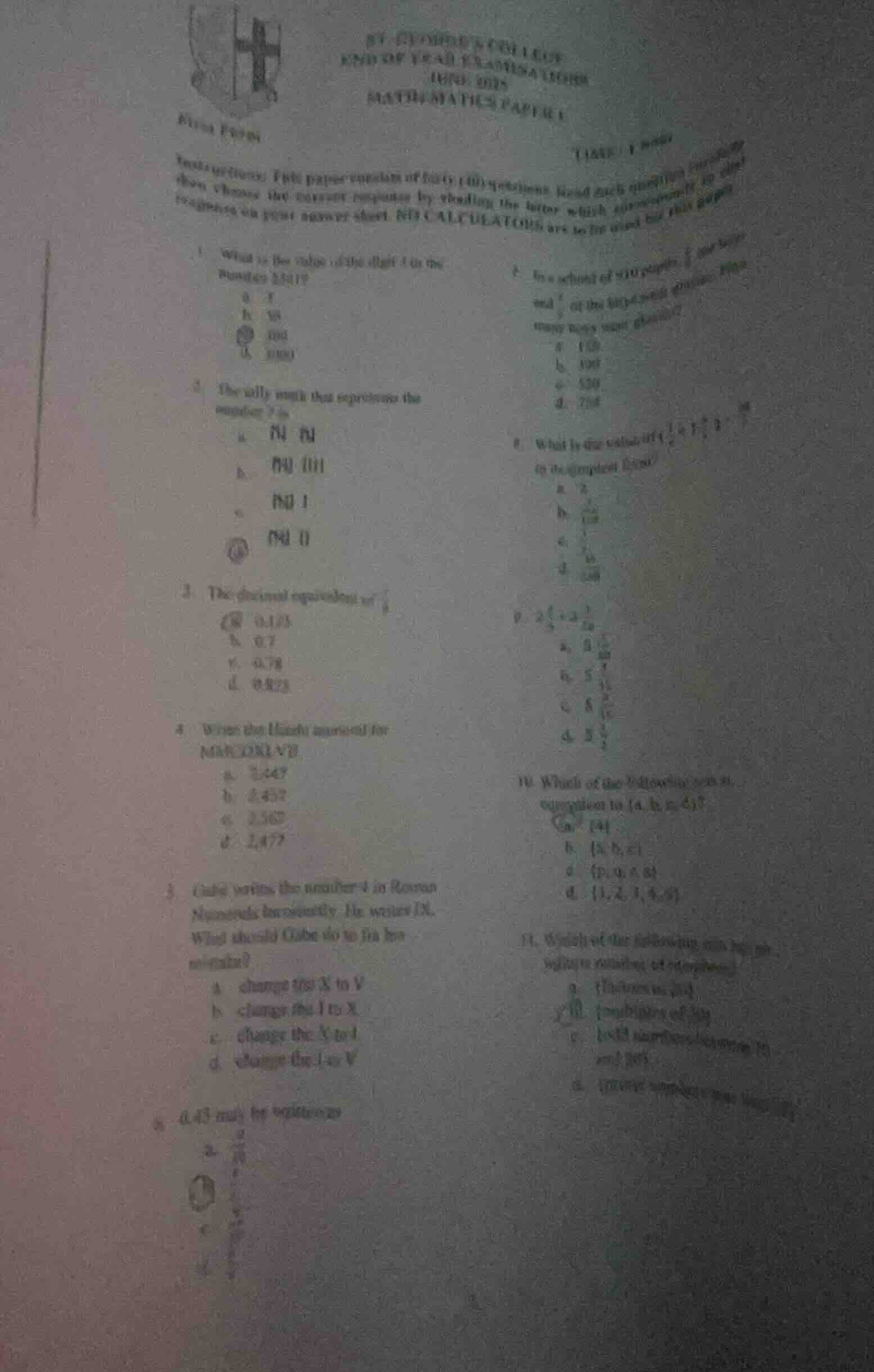
Question
Question was provided via image upload.
Identify place value of digit 4
The number is \(23419\).
The digit \(4\) is in the hundreds place.
Its value is \(4 \times 100 = 400\).
Determine tally marks for 7
A group of five tally marks is represented by four vertical lines crossed by a diagonal line.
The number \(7\) is represented by one group of five and two individual vertical lines.
This matches option (d).
Convert fraction to decimal
The fraction is \(\frac{7}{8}\).
Dividing \(7\) by \(8\) gives \(0.875\).
This matches option (d).
Convert Roman numeral to Hindu-Arabic
The Roman numeral is MMCDXLVII.
- \(\text{MM} = 2000\)
- \(\text{CD} = 400\)
- \(\text{XL} = 40\)
- \(\text{VII} = 7\)
Summing these gives \(2000 + 400 + 40 + 7 = 2447\).
This matches option (a).
Correct Roman numeral error
Gabe wrote IX (which is 9) instead of IV (which is 4).
To correct IX to IV, he needs to change the X to V.
This matches option (a).
Convert decimal to fraction
The decimal is \(0.45\).
As a fraction, this is \(\frac{45}{100}\).
Simplifying by dividing numerator and denominator by 5 gives \(\frac{9}{20}\).
This matches option (b).
Calculate number of boys in school
Total students is \(900\).
The fraction of boys is \(\frac{3}{5}\).
Number of boys is \(\frac{3}{5} \times 900 = 3 \times 180 = 540\).
This matches option (c).
Evaluate fraction expression
The expression is \((\frac{1}{2})^2 \times \frac{2}{3}\).
- \((\frac{1}{2})^2 = \frac{1}{4}\)
- \(\frac{1}{4} \times \frac{2}{3} = \frac{2}{12} = \frac{1}{6}\)
This matches option (b).
Add mixed numbers
The expression is \(2\frac{1}{3} + 2\frac{1}{2}\).
Convert to improper fractions:
- \(2\frac{1}{3} = \frac{7}{3}\)
- \(2\frac{1}{2} = \frac{5}{2}\)
Find a common denominator (6):
- \(\frac{7}{3} = \frac{14}{6}\)
- \(\frac{5}{2} = \frac{15}{6}\)
Add the fractions:
- \(\frac{14}{6} + \frac{15}{6} = \frac{29}{6} = 4\frac{5}{6}\)
This matches option (c).
Identify equivalent set
The set is \(\{a, b, c, d\}\), which has a cardinality of 4.
An equivalent set must have the same number of elements (cardinality of 4).
- Option (a) \(\{4\}\) has 1 element.
- Option (b) \(\{a, b, c\}\) has 3 elements.
- Option (c) \(\{p, q, r, s\}\) has 4 elements.
- Option (d) \(\{1, 2, 3, 4, 5\}\) has 5 elements.
Thus, \(\{p, q, r, s\}\) is equivalent.
This matches option (c).
Identify infinite set
An infinite set has an unlimited number of elements.
- Option (a) \(\{\text{factors of } 20\}\) is finite.
- Option (b) \(\{\text{multiples of } 3\}\) is infinite because multiples go on forever.
- Option (c) \(\{\text{odd numbers between } 10 \text{ and } 20\}\) is finite.
- Option (d) \(\{\text{prime numbers less than } 10\}\) is finite.
Thus, the set of multiples of 3 is infinite.
This matches option (b).

Snap & solve any problem in the app
Get step-by-step solutions on Sovi AI
Photo-based solutions with guided steps
Explore more problems and detailed explanations
Question 1
- (a) 4
- (b) 40
- (c) 400 (Correct answer)
- (d) 1000
Question 2
- (a) 5 + 2 vertical lines
- (b) 4 vertical lines + 3 vertical lines
- (c) 6 vertical lines + 1 vertical line
- (d) 5 vertical lines crossed + 2 vertical lines (Correct answer)
Question 3
- (a) 0.125
- (b) 0.7
- (c) 0.78
- (d) 0.875 (Correct answer)
Question 4
- (a) 2447 (Correct answer)
- (b) 2457
- (c) 2547
- (d) 2477
Question 5
- (a) change the X to V (Correct answer)
- (b) change the I to X
- (c) change the X to I
- (d) change the I to V
Question 6
- (a) \(\frac{4}{5}\)
- (b) \(\frac{9}{20}\) (Correct answer)
- (c) \(\frac{9}{2}\)
- (d) \(\frac{45}{10}\)
Question 7
- (a) 180
- (b) 300
- (c) 540 (Correct answer)
- (d) 720
Question 8
- (a) \(\frac{2}{3}\)
- (b) \(\frac{1}{6}\) (Correct answer)
- (c) \(\frac{1}{12}\)
- (d) \(\frac{1}{18}\)
Question 9
- (a) \(4\frac{2}{5}\)
- (b) \(4\frac{1}{3}\)
- (c) \(4\frac{5}{6}\) (Correct answer)
- (d) \(4\frac{5}{12}\)
Question 10
- (a) \(\{4\}\)
- (b) \(\{a, b, c\}\)
- (c) \(\{p, q, r, s\}\) (Correct answer)
- (d) \(\{1, 2, 3, 4, 5\}\)
Question 11
- (a) \(\{\text{factors of } 20\}\)
- (b) \(\{\text{multiples of } 3\}\) (Correct answer)
- (c) \(\{\text{odd numbers between } 10 \text{ and } 20\}\)
- (d) \(\{\text{prime numbers less than } 10\}\)