QUESTION IMAGE
Question
Question was provided via image upload.
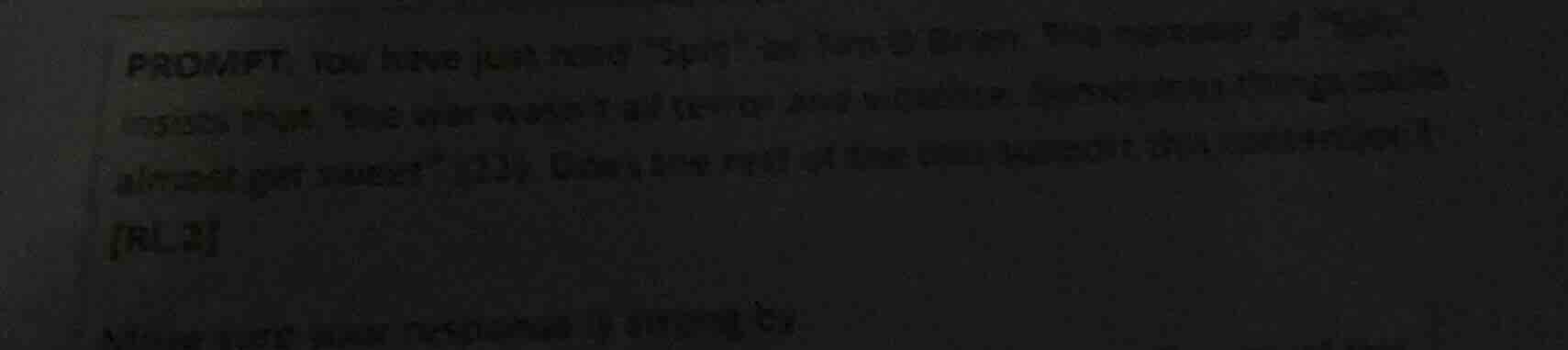
Analyze the prompt and core claim
The prompt references Tim O'Brien's "Spin" from The Things They Carried. The narrator claims: "The war wasn't all terror and violence. Sometimes things could almost get sweet" (33). The question asks whether the rest of the text supports or contradicts this assertion.
Evaluate supporting evidence
O'Brien supports this claim by depicting moments of peace, beauty, and human connection amidst the chaos of Vietnam. Examples include Mitchell Sanders playing checkers (which has clear rules and order, unlike the war), the young boy guiding them through a minefield, and Ted Lavender adopting a puppy. These structured, quiet, or gentle moments provide a "sweet" contrast to the terror.
Evaluate contradicting evidence
Conversely, the text contradicts the claim because these "sweet" moments are fleeting and always shadowed by underlying trauma, grief, and sudden violence. The checkers game is a temporary escape from a chaotic reality, the puppy is eventually killed brutally by Azar, and Lavender is shot dead. The sweetness is an illusion or a coping mechanism rather than a defining characteristic of the war.

Snap & solve any problem in the app
Get step-by-step solutions on Sovi AI
Photo-based solutions with guided steps
Explore more problems and detailed explanations
The rest of "Spin" both supports and contradicts the narrator's claim.
It supports the claim through peaceful, structured, and gentle vignettes—such as Mitchell Sanders playing checkers, which offers a sense of order, and Ted Lavender adopting a puppy—demonstrating that moments of "sweetness" and human connection exist.
However, it contradicts the claim because these moments are fleeting and permanently shadowed by violence and grief; the checkers game is merely a temporary distraction from a chaotic war, and the puppy is ultimately killed, showing that the terror of war always reclaims these brief escapes.