QUESTION IMAGE
Question
Question was provided via image upload.
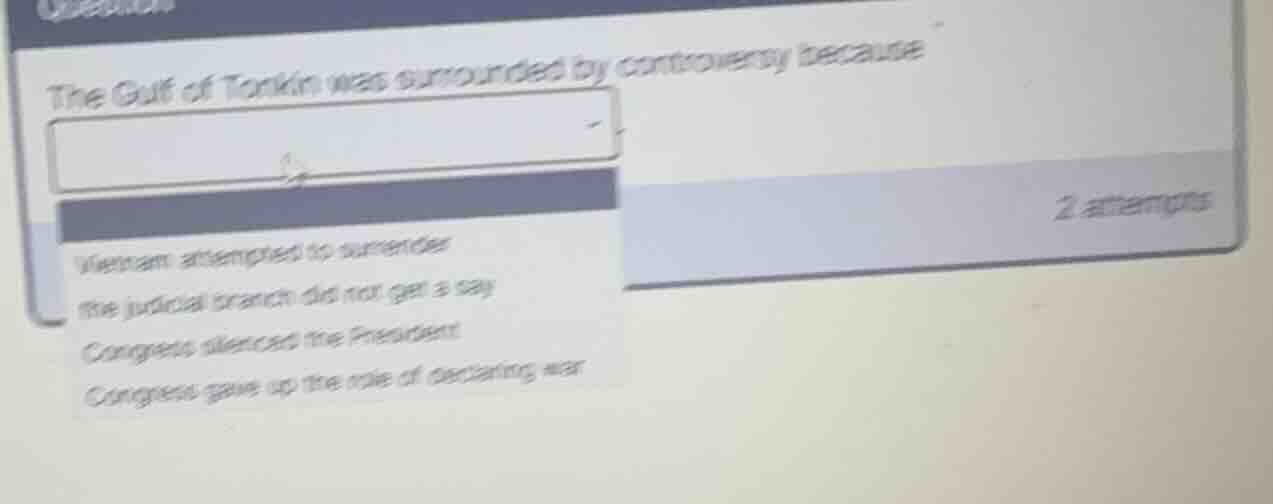
Analyze the historical context of the Gulf of Tonkin Resolution
The Gulf of Tonkin incident in August 1964 led to Congress passing the Gulf of Tonkin Resolution. This resolution granted President Lyndon B. Johnson broad authority to conduct military operations in Southeast Asia without a formal declaration of war. This relates directly to Vietnam War Diplomacy and the constitutional balance of power.
Evaluate the constitutional controversy
Under the US Constitution, only Congress has the power to declare war. By passing the Gulf of Tonkin Resolution, Congress effectively handed over its war-making powers to the executive branch, allowing the President to escalate military involvement unilaterally.
Assess the given options
- "Vietnam attempted to surrender": Incorrect. The incident escalated the conflict.
- "the judicial branch did not get a say": Incorrect. The constitutional tension was between the legislative and executive branches.
- "Congress silenced the President": Incorrect. Congress actually empowered the President.
- "Congress gave up the role of declaring war": Correct. By giving the President open-ended military authority, Congress bypassed its own constitutional duty to declare war.

Snap & solve any problem in the app
Get step-by-step solutions on Sovi AI
Photo-based solutions with guided steps
Explore more problems and detailed explanations
- Vietnam attempted to surrender
- the judicial branch did not get a say
- Congress silenced the President
- Congress gave up the role of declaring war (Correct answer)