QUESTION IMAGE
Question
Question was provided via image upload.
Identify the given information
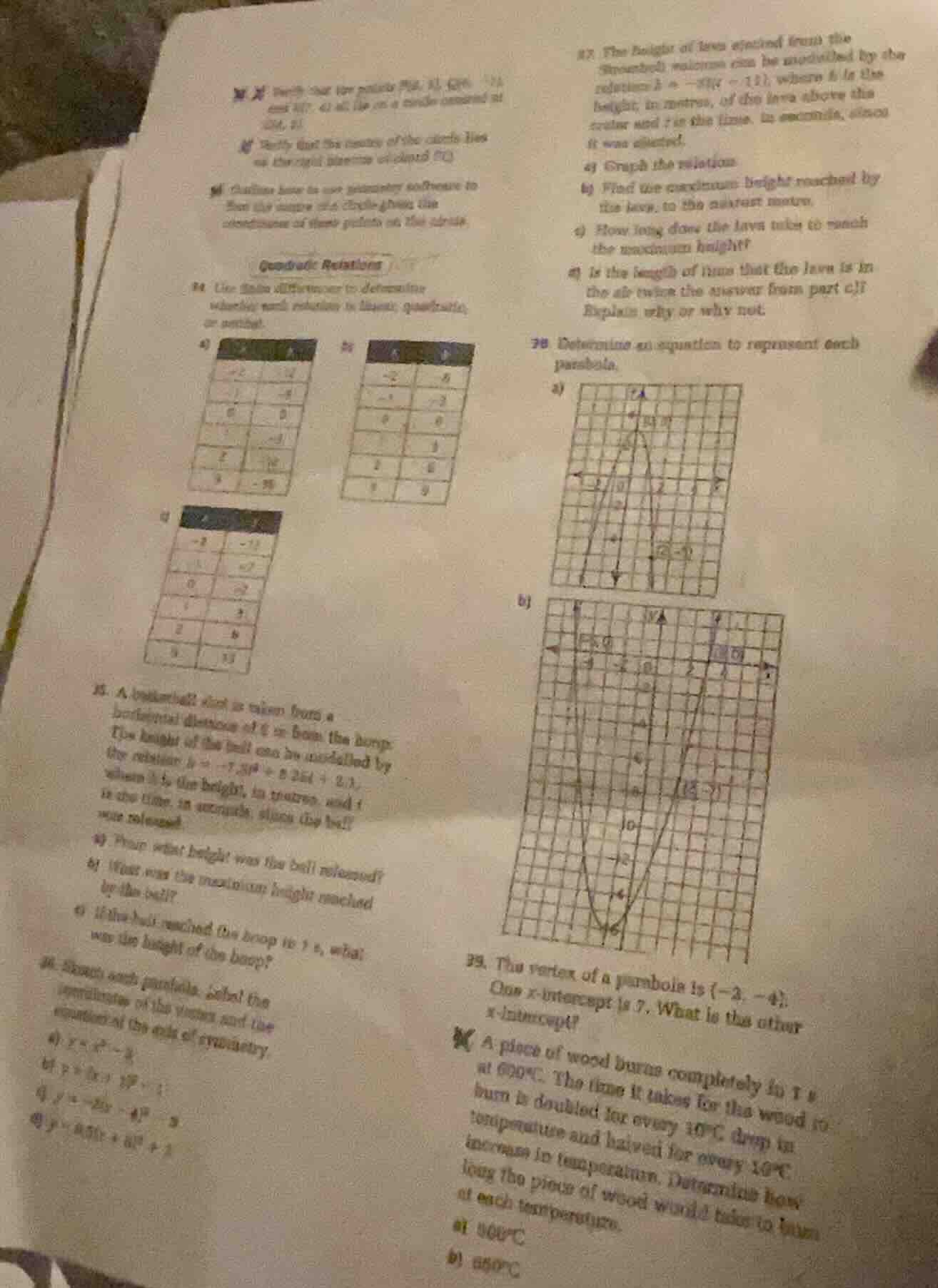
The problem asks: "The vertex of a parabola is \((-3, -4)\). One x-intercept is \(7\). What is the other x-intercept?"
We are given:
- The vertex of the parabola: \((h, k) = (-3, -4)\)
- One x-intercept: \(x_1 = 7\), which corresponds to the point \((7, 0)\)
Apply the symmetry of a parabola
A parabola is perfectly symmetric with respect to its axis of symmetry.
The axis of symmetry is a vertical line passing through the vertex:
For this parabola, the axis of symmetry is:
Calculate the distance to the axis
Since the parabola is symmetric, any two points with the same y-coordinate (such as the two x-intercepts, where \(y = 0\)) must be at equal horizontal distances from the axis of symmetry.
Let's find the horizontal distance from the given x-intercept \(x_1 = 7\) to the axis of symmetry \(x = -3\):
Find the other x-intercept
The other x-intercept \(x_2\) must lie at the same horizontal distance of \(10\) units on the opposite side of the axis of symmetry.
Since \(x_1 = 7\) is to the right of the axis \(x = -3\), the other intercept \(x_2\) must be to the left:

Snap & solve any problem in the app
Get step-by-step solutions on Sovi AI
Photo-based solutions with guided steps
Explore more problems and detailed explanations
The other x-intercept is \(-13\).