QUESTION IMAGE
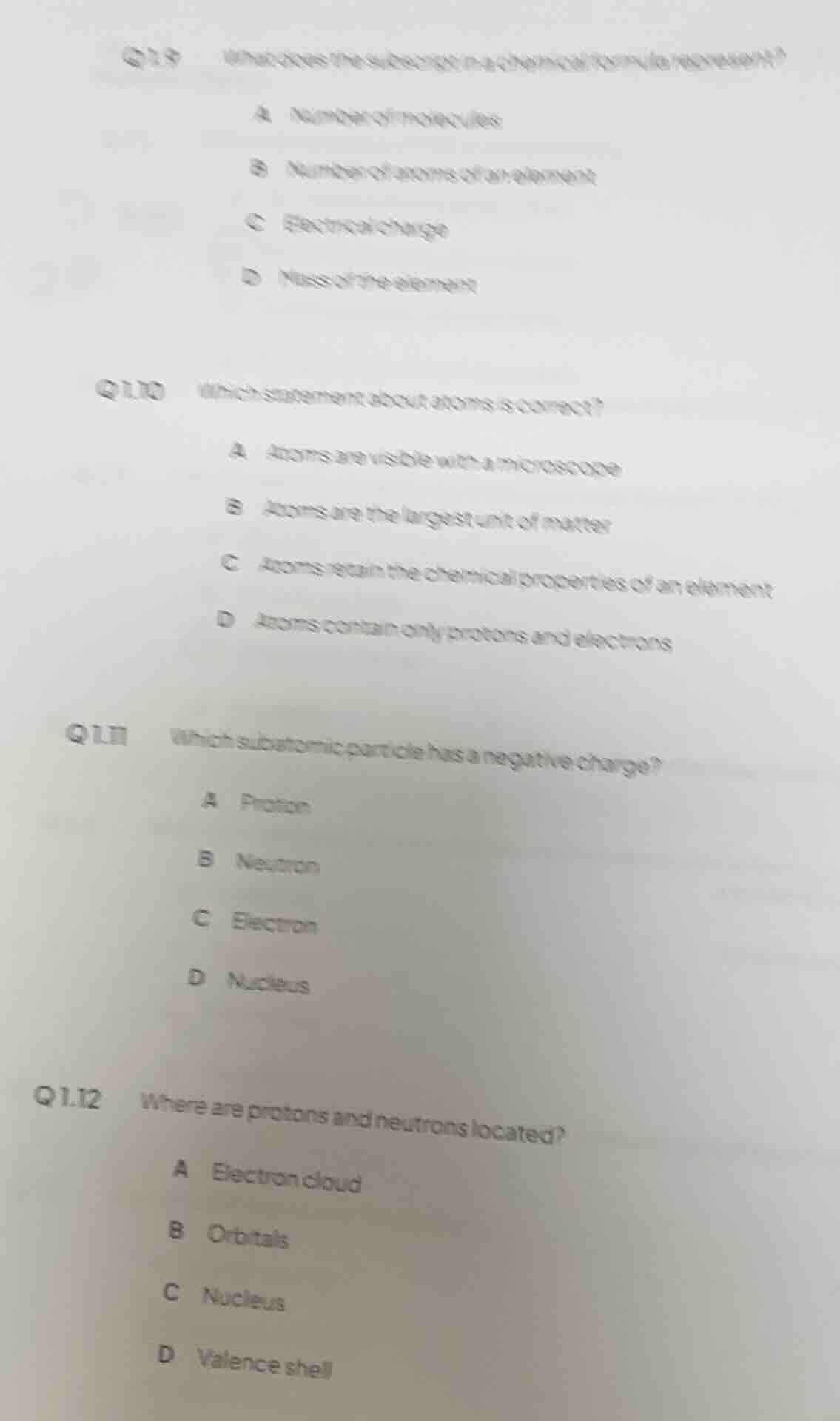
Question
Question was provided via image upload.
Analyze subscripts in chemical formulas
A subscript in a chemical formula (like the \(2\) in \(\text{H}_2\text{O}\)) indicates how many atoms of that specific element are present in one molecule of the substance. Therefore, it represents the number of atoms of an element.
Analyze statements about atoms
Let's evaluate each statement:
- A: Atoms are generally too small to be seen with standard microscopes.
- B: Atoms are not the largest unit of matter; they are extremely small, and molecules are larger.
- C: An atom is the smallest unit of an element that retains the chemical properties of that element. This is correct.
- D: Atoms contain protons, neutrons (except hydrogen-1), and electrons.
Identify the negatively charged subatomic particle
Subatomic particles have characteristic electric charges:
- Protons have a positive charge (\(+1\)).
- Neutrons have no charge (\(0\)).
- Electrons have a negative charge (\(-1\)).
Thus, the electron is the particle with a negative charge.
Locate protons and neutrons
The structure of an atom consists of a dense central core and an outer region:
- The nucleus is at the center and contains protons and neutrons.
- The electron cloud (orbitals) surrounds the nucleus and contains electrons.
Therefore, protons and neutrons are located in the nucleus.

Snap & solve any problem in the app
Get step-by-step solutions on Sovi AI
Photo-based solutions with guided steps
Explore more problems and detailed explanations
Question 1.9
- A Number of molecules
- B Number of atoms of an element (Correct answer)
- C Electrical charge
- D Mass of the element
Question 1.10
- A Atoms are visible with a microscope
- B Atoms are the largest unit of matter
- C Atoms retain the chemical properties of an element (Correct answer)
- D Atoms contain only protons and electrons
Question 1.11
- A Proton
- B Neutron
- C Electron (Correct answer)
- D Nucleus
Question 1.12
- A Electron cloud
- B Orbitals
- C Nucleus (Correct answer)
- D Valence shell